Brian Merchant delivers a stark warning that California's legislative moment has become a referendum on whether Silicon Valley's lobbying machine can still dictate policy in the world's fifth-largest economy. The piece cuts through the noise of national headlines to reveal a quiet, high-stakes battle in Sacramento where common-sense protections for workers and children are being held hostage by a governor's presidential ambitions. This is not just about state law; it is about whether the tech industry's iron grip has become unbreakable, even in a state that claims to lead on progressive issues.
The Stakes of Inaction
Merchant frames the current legislative session as a critical inflection point. After a year of intense lobbying, a handful of bills designed to rein in artificial intelligence now sit on Governor Gavin Newsom's desk, awaiting a decision that could signal the death of state-level tech regulation. "If even the barest-bones laws can't pass here right now, it will come down to one reason above all: Gavin Newsom is currently preparing to run for president and he doesn't want to upset Silicon Valley and its deep-pocketed donors," Merchant writes. This framing is powerful because it shifts the narrative from a policy debate to a test of political courage, suggesting that the governor's future ambitions are currently outweighing the immediate safety of his constituents.
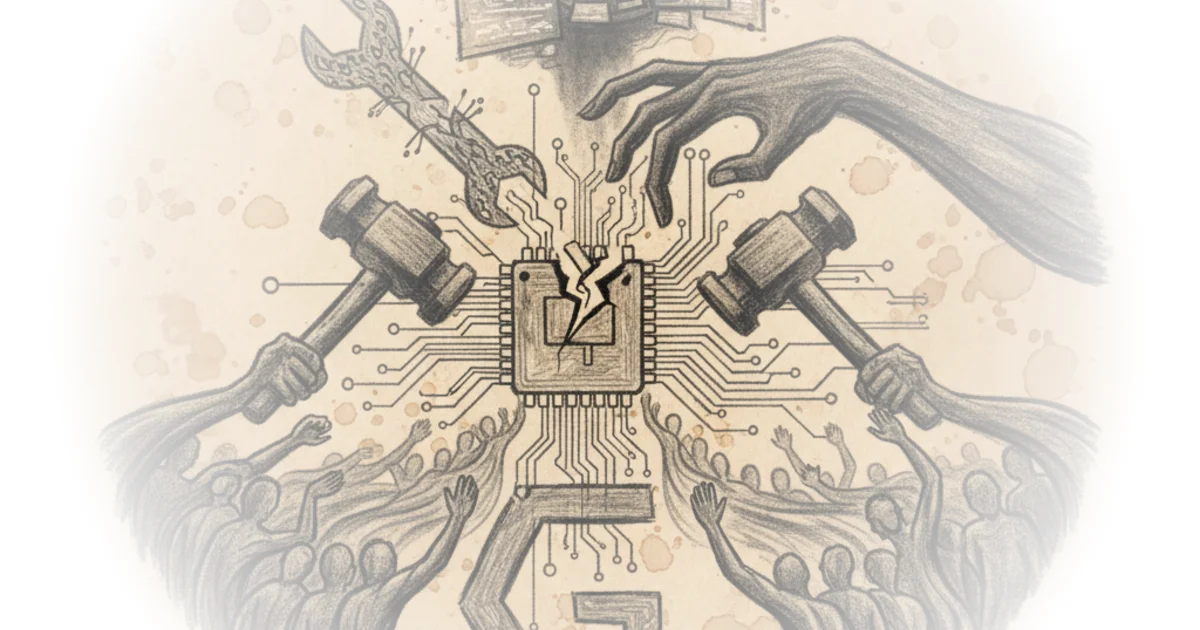
The author argues that the bills in question are hardly radical, describing them as "straightforward, common sense measures that none but the most diehard libertarians would take issue with." Yet, the industry has fought them with disproportionate ferocity. Merchant notes that Silicon Valley's army of lobbyists has successfully "defanged many of them, while helping to stall out others," turning potential victories into two-year delays. This strategy of delay is a familiar tactic, but the scale here is alarming. Critics might note that the administration could argue that federal regulation is the more appropriate venue, but the piece effectively counters this by highlighting the immediate, tangible harms occurring while waiting for Washington to act.
The Human Cost of Algorithmic Management
The coverage shines when it details the specific human impacts of the proposed legislation, moving beyond abstract concepts of "AI risk" to concrete workplace realities. The "No Robot Bosses Act" (SB 7) would prevent employers from using automated decision systems to fire or discipline workers without human review. "It's a simple question of: Should there be guardrails?" Lorena Gonzalez, president of the California Labor Federation, tells the author. "Bosses should have souls. We shouldn't be run by computers." Merchant uses this quote to anchor the argument in human dignity, contrasting the cold efficiency of algorithms with the moral responsibility of human oversight.
The piece reveals that earlier versions of this bill included safeguards against discrimination, which were stripped out over industry outcry. This detail is crucial; it shows that the industry is not just fighting regulation, but actively dismantling the strongest protections before they can even be signed. The author points out that the current version is a "barest-bones" compromise, yet the industry still opposes it. This suggests that the opposition is not about the specifics of the bill, but about the principle of accountability itself.
Bosses should have souls. We shouldn't be run by computers.
Protecting Children from Digital Harms
Perhaps the most emotionally charged section of the commentary addresses the "Leading Ethical AI Development for Kids Act" (AB 1064). This bill seeks to ban AI chatbots marketed to children that are foreseeably capable of encouraging self-harm or violence. Merchant highlights the tragic context, noting the bill is a response to cases where chatbots have encouraged children to kill themselves. The industry's reaction, however, has been to launch a "disgusting ad campaign" claiming the bill would "limit innovation" and "take away children's futures."
Merchant exposes the hypocrisy of this argument, noting that the industry knows their current models cannot guarantee safety without expensive investments they are unwilling to make. "The AI companies know that, given the current limitations of large language models, they can't easily guarantee their chatbot products won't continue to generate noxious content... they just think they should be allowed to continue to market their products to them anyway." This is a devastating critique of the industry's business model, which prioritizes engagement over safety. The author also notes a surprising ally in First Partner Jennifer Siebel Newsom, who has publicly stated, "I can't imagine being one of these tech titans and looking at myself in the mirror and being OK with myself." This adds a layer of personal moral pressure that the piece suggests the Governor cannot easily ignore.
The Illusion of Safety and Union Rights
The commentary also scrutinizes the "AI Safety Bill 2.0" (SB 53), describing it as a "little bit of a joke" compared to previous, more robust proposals. The new bill merely requires companies to file progress reports on their safety protocols, a move that Merchant argues is "loose and rather unenforceable." The fact that major AI firms like Anthropic have endorsed this watered-down version suggests it is designed to create the appearance of action without imposing real constraints. "The previous bill was at least a little interesting because it required AI companies to share data about their training models; which is of course why they were furious about it," Merchant writes, highlighting the industry's consistent strategy of blocking transparency.
Similarly, the piece critiques the gig worker union bill (AB 1340) for limiting which unions workers can choose, effectively cutting out grassroots organizations that have been organizing drivers for years. "We don't think the bill is strong enough actually," Nicole Moore of Rideshare Drivers United tells the author, noting that the legislation limits the choice of representation. This reveals a pattern where the administration and the industry are willing to offer the form of reform while stripping away the substance that would actually empower workers.
Bottom Line
Brian Merchant's analysis is at its strongest when it connects the dots between corporate lobbying, legislative dilution, and the political calculus of a governor eyeing the White House. The piece's greatest vulnerability is its reliance on the assumption that Newsom's decision is the sole variable, potentially underestimating the structural power of the industry regardless of who signs the bill. However, the verdict is clear: if these modest, common-sense bills fail, it will be a grim omen for the future of democracy in the face of Silicon Valley's dominance. The reader should watch closely to see if the Governor's presidential ambitions will override the urgent need to protect workers, children, and consumers from the unchecked power of artificial intelligence.