Most historical accounts of the Soviet collapse focus on the peaceful transitions in Eastern Europe, but this piece from Kings and Generals forces a confrontation with a brutal exception: the state-sanctioned massacre in Baku that set a violent precedent for the USSR's final days. The coverage is notable not just for recounting the death toll, but for tracing the deep economic and cultural roots of Azerbaijani nationalism back to the 19th-century oil boom, arguing that the seeds of the 1990 tragedy were sown decades earlier in the "wild west" of Baku's industrialization.
The Oil-Fueled Birth of Nationalism
Kings and Generals opens by reframing the narrative of Soviet decline, noting that while the end of communism is often celebrated for its lack of bloodshed, "the growing movement for democracy was so threatening to the state that it provoked one of the most extreme crackdowns in the Soviet government's history." This distinction is crucial; it suggests that the violence in Azerbaijan was not an anomaly but a calculated response to a perceived existential threat.
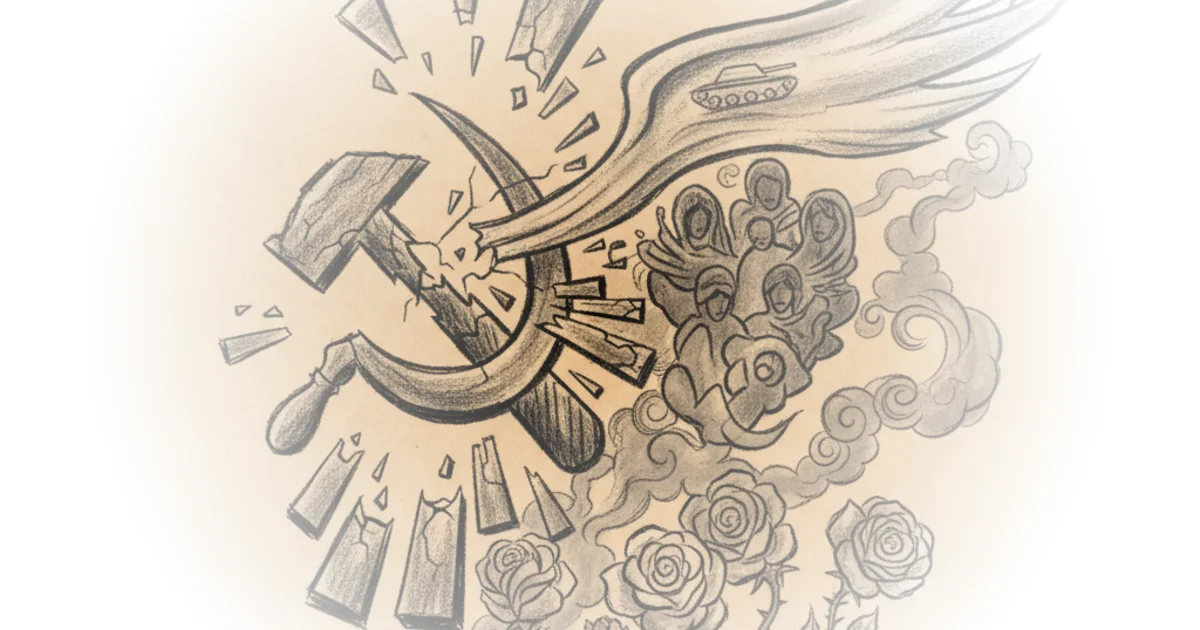
The authors anchor their argument in the unique economic history of the region. They cite historian Audrey Alstat to explain how the rapid industrialization of Baku created a distinct national identity: "The rapid expansion of the oil industry was primarily responsible for Baku's apparently well-deserved reputation as a wild boom town replete with grand hotels, telephones, casinos, gas lit streets, prostitutes, and a frontier lawlessness." This framing effectively connects economic disparity to political awakening. The influx of foreign capital and the exclusion of locals from ownership created a fertile ground for resentment.
As Kings and Generals puts it, "The point is, of course, that the oil boom brought with it an unusually high influx of foreigners from the west, huge sums of money, and sparked incredibly fast industrialization." This rapid change accelerated the formation of a secular, democratic intelligentsia that viewed Russian rule not as a partnership but as a colonial imposition. The argument holds up well here, as it moves beyond simple ethnic tension to explain how economic structures shaped political consciousness.
"The Azerbaijanis viewed the Russians as foreign oppressors, people of another language and religion. In the eyes of the Azerbaijanis, Russia's Caucasian policy was anti-Muslim and an outright colonial conquest."
The Soviet Legacy and the Nagorno-Karabakh Flashpoint
The commentary then pivots to the Soviet era, highlighting a critical administrative decision that would eventually ignite the region. Kings and Generals notes that in 1923, Moscow created the Nagorno-Karabakh Autonomous Oblast within the Azerbaijan SSR, despite the fact that "at the time of the 1926 Soviet census, 89.2 of its population was Armenian." This section effectively illustrates the disconnect between Moscow's bureaucratic map-making and the demographic realities on the ground.
The authors argue that while national identity was suppressed politically, it was allowed to fester culturally. They quote historian Audrey Alstat again to show how the Brezhnev era's false sense of stability backfired: "The origins of descent, initially moderate, sporadic and exclusively inerviani language journals and literature went back to the Brezhnev era when writers and scholars had begun to examine topics that were forbidden by the Soviet regime." This suggests that the policy of Glasnost (transparency) did not create the nationalism but rather removed the lid on pressures that had been building for decades.
When the conflict over Nagorno-Karabakh erupted in 1988, the administration's response was reactive and often clumsy. Kings and Generals describes how the central authorities saw the Armenian push for unification as a challenge to their authority, leading to a deployment of interior ministry troops that would remain for 17 months. The coverage details the tragic escalation in the town of Sumgait, where tensions boiled over into pogroms, noting that "at least 32 Armenians living in Sunit would be murdered as tensions spilled over into a procam." While the authors acknowledge that atrocities were committed by both sides, the focus remains on the failure of local and central leadership to prevent the violence.
Critics might note that the piece briefly touches on the complexity of the Sumgait pogroms without fully exploring the role of local criminal elements versus organized political agitation, a nuance that historians continue to debate. However, the broader point about the collapse of social order remains valid.
The Failure of Reform and the Road to Black January
The final section of the coverage examines the political vacuum that emerged as the Communist Party lost its grip. Kings and Generals describes the rise of the Azerbaijani Popular Front (APF) and its leader, Elchibey, who sought to collaborate with the party but was rebuffed. The authors argue that this missed opportunity for reform was fatal: "This was a critical juncture in Azerbaijan's late Soviet history because alternative forces in Azerbaijan ultimately couldn't find a way to collaborate with the ruling communists."
As the movement grew, the administration's response became increasingly repressive. The piece details the massive protests in Lenin Square and the subsequent imposition of a curfew, which the APF used to organize more formally. The narrative builds toward the inevitable confrontation, where the Soviet leadership chose force over negotiation. Kings and Generals writes that the administration's failure to address the exodus of refugees and the demands for sovereignty led to a situation where "the masses were asking why the Soviet authorities had failed to stop the exodus of tens of thousands of Azerbaijanis from Armenia."
The coverage concludes by setting the stage for the January 1990 massacre, implying that the violence was the culmination of decades of suppressed identity, economic grievance, and political mismanagement. The argument is compelling because it treats the massacre not as a sudden outburst of hatred, but as the logical, albeit tragic, conclusion of a system that could not accommodate its own diversity.
Bottom Line
Kings and Generals delivers a powerful historical analysis by connecting the 19th-century oil boom to the 1990 massacre, successfully arguing that the violence was rooted in long-standing structural and cultural tensions rather than mere ethnic animosity. The piece's greatest strength is its refusal to treat the event as an isolated incident, instead weaving a complex narrative of colonial legacy and failed reform. However, the coverage occasionally glosses over the specific tactical decisions made by local Soviet officials in the weeks leading up to the crackdown, leaving some operational details to the imagination. Readers should watch for how this historical precedent continues to influence the geopolitical dynamics of the South Caucasus today.