Rohin Francis doesn't just recount medical history; he resurrects a century-old medical horror story to expose the dangerous hubris that still plagues modern healthcare. By framing the 1898 self-experimentation of German physicians as a dark comedy of errors, Francis forces a reckoning with how easily "scientific progress" can devolve into reckless self-harm when ego overrides safety protocols.
The Anatomy of Hubris
Francis opens by adopting a satirical, British-accented persona to narrate the correspondence of Dr. August Bier, a German physician who pioneered spinal anesthesia. The framing is deliberate: Francis uses humor to disarm the reader before delivering a stark warning about the lack of ethical oversight in early medicine. He highlights the casual cruelty of Bier's early trials, noting that Bier described injecting cocaine into the spinal cords of patients with tuberculosis and osteomyelitis with a detached, almost bored tone.
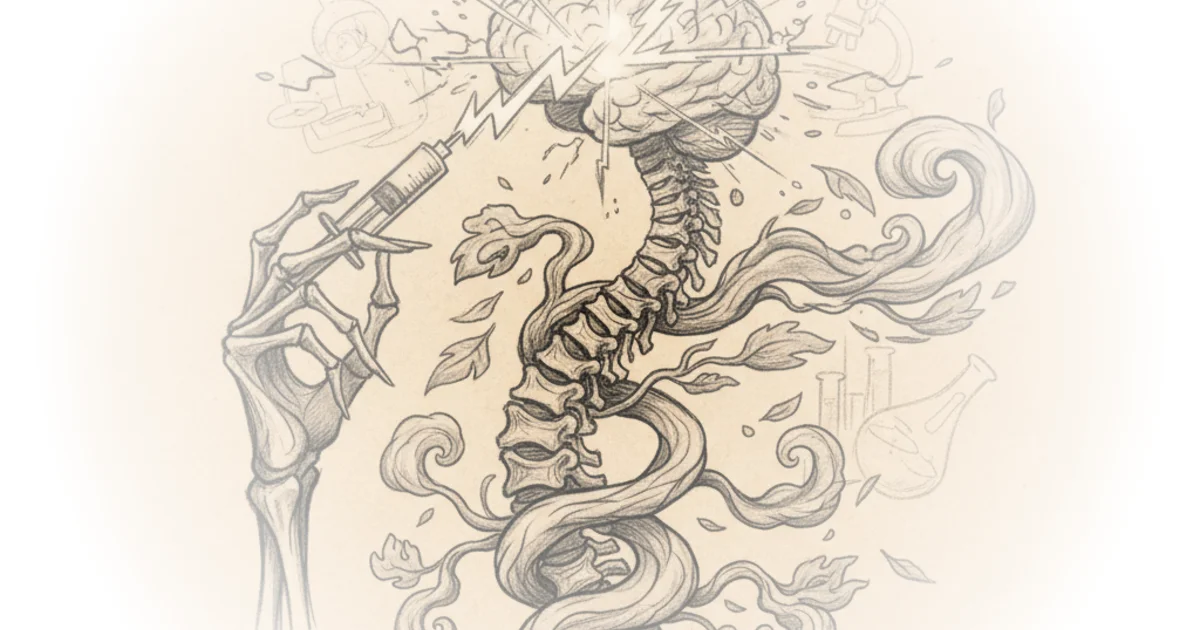
Francis quotes Bier's own words to illustrate the severity of the side effects: "After administration he felt nothing in the lower half of his body and I sawed off his leg and he felt no pain... two hours after the operation his back and left leg became painful and the patient vomited and complained of severe headache which persisted for two days." This quote is chilling not just for the description of the surgery, but for the author's matter-of-fact delivery of the suffering that followed. Francis uses this to argue that the drive for innovation often blinds practitioners to the immediate, visceral cost paid by the vulnerable.
The narrative escalates when Bier decides to test the procedure on his own assistant, Dr. Hildebrand. Francis points out the absurdity of the situation, quoting Bier's description of the torture inflicted on Hildebrand to prove a point: "Strong pressure and traction on the testicles was not painful... strong blows on the shin with an iron hammer did not provoke pain." Francis notes that while the anesthesia worked, the aftermath was catastrophic. Hildebrand suffered a violent headache, vomiting, and developed pus-filled sores where he was beaten with a hammer. Francis writes, "Dr. Hildebrand... was nevertheless unable to get to sleep due to a agitated state at midnight a violent headache set in that quickly became insupportable." This section serves as a grim reminder that even when the "science" works, the human cost can be devastating, a lesson that echoes in modern discussions about patient safety and informed consent.
"The Germans invented that infernal homeopathy... German medicine is like German automobiles unlikely to last."
Francis uses this satirical line to mock the arrogance of the era, suggesting that the belief in one's own infallibility is a universal flaw in medical history, not just a German one. Critics might argue that Francis's comedic tone risks trivializing the genuine suffering of Bier's patients, but the underlying data on spinal headaches and neurological damage remains a serious, documented reality that modern anesthesiologists still manage today.
The Legacy of Manic Productivity
The commentary then pivots to the American counterpart of this era: Dr. William Halsted. Francis connects the historical use of cocaine to the modern, grueling culture of medical residency. He argues that the current expectation for doctors to work extreme hours is a direct lineage to Halsted's own cocaine-fueled mania. Francis writes, "You might not know that cocaine was indeed commonly used in medicine around the turn of the 20th century... a young doctor called Sigmund Freud wrote a glowing 70 page document called Uber Cocaine extolling its virtues." He traces the trajectory from Freud's endorsement to the U.S. Surgeon General's 1887 recommendation that cocaine treat depression, noting the absurdity that "there was no such thing as cocaine addiction."
Francis makes a sharp, provocative link between this history and the present: "It can be directly traced back to Halsted whose manic nature and work ethic driven in part by cocaine combined with his huge impact on modern American medicine has resulted in generations of residents starting their ward rounds of patients at 5 am for no good reason." This is the piece's most potent argument: that our current systemic failures in physician well-being are rooted in a historical moment when the very substance causing the burnout was hailed as a miracle cure. He warns that "cocaine is not advisable... it can cause heart attacks in even the most healthy young person," drawing a parallel between the physiological damage of the drug and the structural damage of a sleep-deprived workforce.
The Bottom Line
Francis's strongest move is connecting the historical recklessness of early anesthesiology to the modern crisis of physician burnout, suggesting that the culture of "pushing through pain" is a dangerous relic of a time when doctors were their own first, and often only, test subjects. The piece's vulnerability lies in its heavy reliance on satire, which may obscure the nuanced policy changes actually needed to fix residency hours. However, the core warning remains undeniable: medical progress must never again be measured by the ability of a doctor to withstand their own dangerous experiments.
Bottom Line
Francis effectively uses historical absurdity to expose a persistent flaw in medical culture: the glorification of endurance over safety. While the comedic delivery is engaging, the underlying critique of how historical drug abuse shaped modern work expectations is a vital, often overlooked connection. Readers should watch for how institutions address the legacy of this "manic productivity" in current healthcare reform debates.