Brad DeLong resurrects a 2003 critique that feels startlingly prescient for our current moment: the idea that certain strains of conservatism do not merely tolerate economic insecurity but actively require it as a tool for social control. By reframing David Frum's arguments through John Holbo's lens, DeLong exposes a "dark satanic millian liberalism" where the goal isn't wealth creation, but the systematic breaking of the masses' will to assert themselves. For readers navigating an era of institutional fragility and rising authoritarianism, this piece offers a terrifyingly clear diagnostic for why some political movements seem to crave material deprivation as a form of cohesion.
The Architecture of Fear
DeLong begins by dissecting David Frum's 1994 book Dead Right, noting how Frum admits that conservatives often fail when their "glittering generalities" turn into legislative specifics like raising tuition or cutting social services. However, DeLong argues that Frum misses the deeper philosophical rot in his own party's strategy. Instead of viewing the welfare state solely as an economic inefficiency, Frum posits a more chilling rationale: risk is necessary for discipline. As Brad DeLong writes, "Risk makes people circumspect. It disciplines them and teaches them self-control."
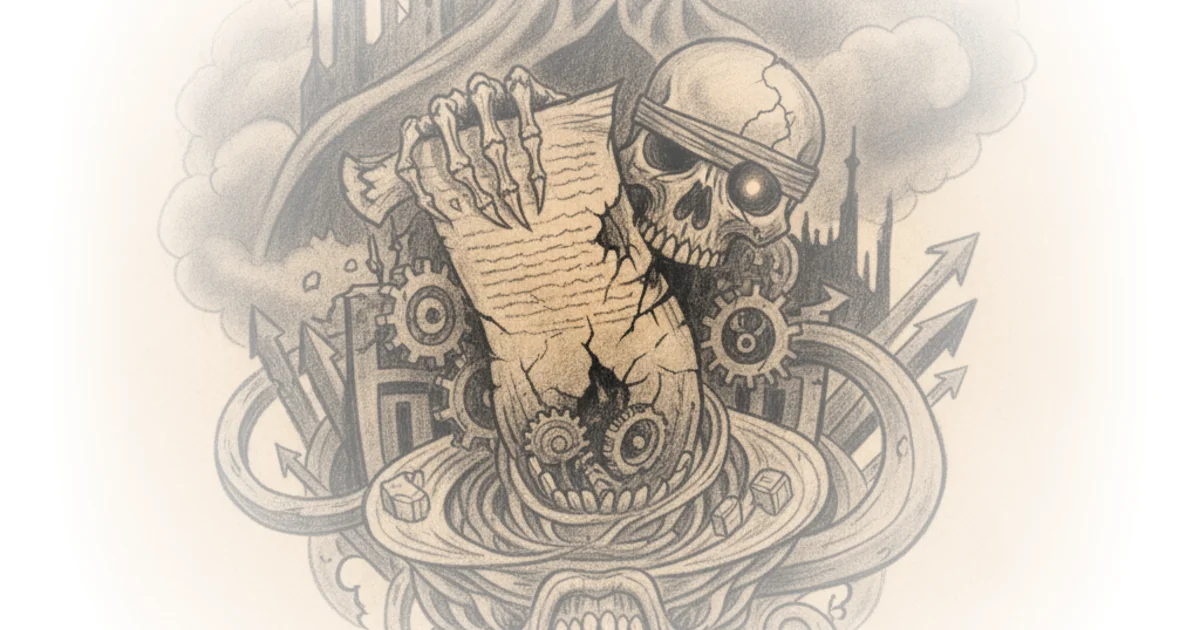
This framing suggests that the safety net isn't just a financial burden; it's a moral hazard that allows people to be reckless. The core of the argument is that without the constant threat of losing everything, individuals lose their capacity for "conservative" behavior—defined here as crouching in fear and conformity. DeLong finds this logic deeply unsettling because it implies that human suffering is not a bug in the system, but a feature designed to enforce obedience.
"The thing that makes capitalism good, apparently is not that it generates wealth more efficiently than other known economic engines. No, the thing that makes capitalism good is that, by forcing people to live precarious lives, it causes them to live in fear of losing everything and therefore to adopt – as fearful people will – a cowed and subservient posture."
This interpretation strips away the usual justifications for laissez-faire economics. It's not about innovation or growth; it's about social engineering through anxiety. DeLong notes that this view treats the "pagan self-assertion" of the individual—the drive to take risks, create art, or challenge authority—as a threat to be managed rather than a virtue to be celebrated. Critics might argue that Frum was simply describing the natural consequences of market forces rather than prescribing them as an ideal, but DeLong insists the text supports a more intentional design for social control.
The Millian Inversion
The commentary takes a sharp turn into intellectual history, connecting these modern political anxieties to John Stuart Mill's concept of liberty. DeLong highlights how Frum's position is essentially the inverse of Mill's philosophy. While Mill argued that civilization advances only when individuals are free to be "pinched and hidebound" by custom no longer, Frum seems to believe that without the crushing weight of economic risk, society will succumb to "collective mediocrity."
DeLong writes, "Let's call this position 'dark satanic millian liberalism': the ethico-political theory that says laissez faire capitalism is good if and only if under capitalism the masses are forced to work in environments that break their will to want to 'jump across the big top'." This phrase, borrowed from Holbo, serves as a powerful metaphor for the suppression of human potential. The "big top" represents the arena of self-actualization, and the conservative impulse described here is one that ensures no one has the energy or spirit to jump.
"Without a safety net, people won't try to vault across the big top... Social security, student loans, and other government programs make it far less catastrophic than it used to be for middle-class people to dissolve their families."
Here, DeLong exposes the paradox: the very mechanisms meant to protect society are viewed as dangerous because they might allow people to become too independent. The argument suggests that a truly "ordered" society requires its citizens to remain perpetually vulnerable. This connects to broader historical debates about the purpose of education and governance; just as William Empson explored the complexities of language in Seven Types of Ambiguity, DeLong reveals the ambiguity in conservative rhetoric where "freedom" is actually a mechanism for enforcing submission.
"The single-parent family; tumbling educational standards; immigration; crime; ethnic balkanization – the conservative magazines and conservative conversation bubble with ferment over these. But their fervor for eliminating the progressive income tax and the redistribution of wealth via Washington has cooled, when it has not disappeared altogether."
DeLong points out that this shift in focus—from economic liberty to social control—reveals a deeper truth about modern political movements. The obsession with cultural issues often masks an underlying desire to maintain a hierarchy where the masses are too exhausted by survival to challenge the status quo. This is not just a policy disagreement; it is a fundamental clash over what it means to be human in a capitalist society.
The Human Cost of "Discipline"
The most striking part of DeLong's analysis is his refusal to let this remain an abstract philosophical debate. He emphasizes that when political theory treats risk as a virtue, the real-world consequence is the erosion of human dignity. If the goal is to keep people "circumspect," then policies must be designed to ensure they never feel safe enough to dream or plan for the future.
"The point isn't to induce a society-wide conformist crouch by way of making the workers safe and happy. The point is to induce a society-wide conformist crouch. Period."
This blunt admission forces the reader to confront the reality that some political actors view human agency as a problem to be solved. DeLong suggests that this mindset explains why certain policies persist despite their obvious failure to improve lives: they are succeeding at their true, unspoken goal of social containment. The "dark satanic mills" are not just places of production; they are engines of psychological conditioning.
"A solid foundaton is hereby laid for a desirable social order."
The irony, as DeLong notes, is that this "order" is built on the backs of those who are most vulnerable to its mechanisms. By framing insecurity as a moral good, these ideologies justify the very suffering they claim to solve. It's a self-fulfilling prophecy where the fear of poverty becomes the primary tool for governance.
"Whatever is rich and diversified will be crushed by the weight of custom, by men's constant tendency to conformity, which breeds only 'withered', capacities, 'pinched and hidebound', 'cramped and dwarfed' human beings."
DeLong uses this quote from Isaiah Berlin to underscore what is lost when freedom is sacrificed for control. The "dwarfed" personalities he describes are not just a metaphor; they represent real people whose potential has been stunted by a system designed to keep them in line. This is the ultimate cost of "dark satanic millian liberalism": a society that is stable, perhaps, but utterly devoid of the creativity and courage needed to thrive.
Bottom Line
DeLong's revival of Holbo's critique offers a devastatingly clear lens through which to view modern political conflicts: some movements don't want to fix the system; they want to keep it broken enough to ensure obedience. The strongest part of this argument is its ability to reframe economic policy as a tool of social control, revealing the hidden motives behind calls for deregulation and austerity. Its biggest vulnerability lies in assuming that all conservatives hold these views intentionally, rather than being swept up in a logic they don't fully understand. Readers should watch for how this "discipline through risk" narrative plays out in current debates over social safety nets, where the fear of dependency is often weaponized to justify cutting essential support.