Ryan Grim & Jeremy Scahill deliver a dispatch that refuses to let the world's most critical conflicts fade into the background noise, exposing a coordinated strategy where humanitarian aid is weaponized and civil liberties are dismantled with bureaucratic precision. This is not merely a recap of headlines; it is an indictment of how the executive branch and its allies are actively reshaping the rules of engagement in Gaza, Sudan, and the American domestic sphere, often with a disregard for the human cost that is staggering in its scale.
The Humanitarian Paradox in Gaza
The coverage opens with a stark contradiction that defines the current moment in the Middle East. Israel has announced the opening of the Rafah border crossing, but with a chilling caveat: it is for exits only. "The residents' exit through the Rafah Crossing will be facilitated through coordination with Egypt, following security approval by Israel and under the supervision of the European Union mission," the Coordination of Government Activities in the Territories (COGAT) stated. Yet, Egypt immediately rejected this one-way mechanism, insisting that "movement would take place in both directions—into and out of the Strip—in accordance with what stated in the plan put forward by U.S. President Donald Trump."
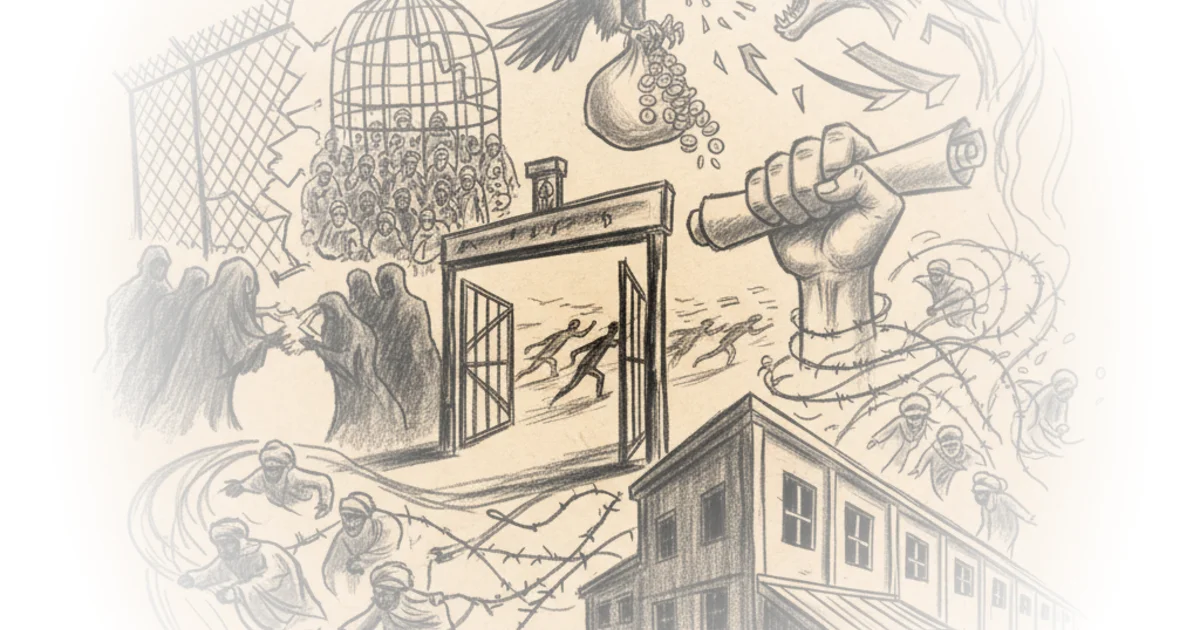
Grim & Scahill highlight how this logistical maneuver is set against a backdrop of escalating violence even during the so-called ceasefire. The authors note that since the truce began on October 11, Israel has killed at least 360 Palestinians and wounded 922, while 617 bodies have been recovered from under the rubble. The sheer volume of suffering is underscored by the report on the International Day of Persons with Disabilities, where the Gaza Health Ministry revealed there are currently over 6,000 urgent amputee cases, a quarter of them children. "Amputees are facing 'shocking conditions' in the enclave," the ministry said. This framing is crucial; it forces the reader to confront the reality that a "ceasefire" does not equate to safety, but rather a different, perhaps more insidious, mode of attrition.
The ceasefire has not stopped the killing; it has merely changed the tempo of the slaughter, leaving thousands of children without limbs and families without closure.
The authors also scrutinize the political theater surrounding the release of captives. While Hamas and Palestinian Islamic Jihad announced the handover of a body, Netanyahu's office claimed forensic testing revealed the remains did not match any of the remaining captives. Grim & Scahill point out the grim exchange rate of this diplomacy: Israel has been releasing 15 Palestinian bodies for the remains of each hostage, yet the Gaza Health Ministry notes that many of the 330 remains received bore signs of torture and field execution. This detail strips away the sanitized language of "negotiations" to reveal a brutal transaction where human life is the currency.
The Weaponization of American Institutions
Shifting focus to the United States, the commentary exposes how the administration is leveraging federal power to target specific communities and silence dissent. The authors detail a major immigration enforcement operation in Minnesota, where roughly 100 federal agents are targeting hundreds of undocumented Somalis. Local advocates warn this risks civil rights violations in a state where most Somali residents are U.S. citizens, with reports of racially motivated arrests already surfacing. The rhetorical support for this crackdown is explicit and unapologetic. "President Donald Trump called Somali immigrants 'garbage' and labeled Rep. Ilhan Omar 'garbage' during a White House press event," the authors report. Rep. Summer Lee's response is noted as a direct challenge to this dehumanization, warning that such words "put a target" on the community.
The administrative overreach extends to the judiciary and the Department of Justice. Harmeet Dhillon, a Trump DOJ official, labeled Mayor-elect Zohran Mamdani "an antisemitic demagogue" at a pro-Israel summit, a move that Grim & Scahill describe as part of a broader campaign against universities and local leaders. The authors also highlight the administration's threat to cut off SNAP funding in blue states unless governors hand over detailed beneficiary data, a move Agriculture Secretary Brooke Rollins defended as necessary to fight fraud. Experts warn this could "destabilize food assistance for millions and weaponize hunger in the name of fighting largely nonexistent fraud."
Critics might argue that the administration is simply enforcing the law and protecting national security, but the evidence presented suggests a pattern of targeting political opponents and vulnerable populations rather than addressing systemic issues. The case of a six-year-old child separated from his father during an ICE check-in in New York serves as a harrowing example of this disconnect. "The officers separated them and sent the father to Orange County Jail... while the child's whereabouts remain unknown," advocates reported. This is not just policy; it is a systemic failure of humanity.
Global Entanglements and the Shadow of Influence
The piece broadens its scope to international conflicts where U.S. interests and foreign policy collide. In Sudan, the Rapid Support Forces (RSF) are accused of systematically holding trapped residents for ransom in El-Fasher. Grim & Scahill cite a Reuters investigation based on interviews with 33 former captives, revealing that "many of those who could not pay were shot at close range or mowed down in groups." This mirrors the historical context of the RSF's rise to power, a paramilitary group that has long operated with impunity, now using starvation and ransom as tools of war. The authors also touch on the release of former Honduran President Juan Orlando Hernández, who was freed from a U.S. prison after a pardon, raising questions about the consistency of U.S. justice for allies versus adversaries.
In the realm of influence operations, the authors expose a report alleging that Act for Israel, a group founded by actress Noa Tishby, secretly coordinated with the Israeli government to shape U.S. media coverage, potentially violating the Foreign Agents Registration Act (FARA). The documents detail how the group arranged interviews for IDF delegations and organized junkets that required favorable coverage. "Leaked emails show that Act for Israel... secretly coordinated with the Israeli government to shape U.S. media coverage," Connor Echols reported. This revelation challenges the narrative of organic public opinion and suggests a manufactured consensus.
When advocacy groups secretly coordinate with foreign governments to shape domestic media, the line between diplomacy and propaganda dissolves, leaving the public in the dark.
The authors also note the irony of Hillary Clinton blaming youth solidarity with Palestine on TikTok, dismissing it as "totally made up" propaganda, while the administration simultaneously threatens to cut off food aid to states that disagree with its policies. This cognitive dissonance is a central theme of the piece: the gap between the administration's rhetoric and the reality on the ground.
Bottom Line
Ryan Grim & Jeremy Scahill have constructed a narrative that is as unsettling as it is necessary, connecting the dots between the humanitarian crisis in Gaza, the erosion of civil liberties in the U.S., and the global spread of authoritarian tactics. The strongest part of their argument is the unflinching documentation of how policy decisions are directly impacting human lives, from the 6,000 amputees in Gaza to the children separated from their parents by ICE. The biggest vulnerability, perhaps, is the sheer scale of the tragedy they describe, which risks overwhelming the reader with despair. However, by grounding these events in specific, verifiable facts and direct quotes, they provide a roadmap for understanding the mechanisms of power at play. The reader should watch for the next moves in the SNAP funding battle and the outcome of the El-Fasher siege, as these will be the true tests of whether the world's institutions can still hold the line against the tide of dehumanization.