Matt Stoller delivers a startling diagnosis for the current political moment: the label of "moderate" has been hijacked by a specific class of financial elites, turning a once-virtuous ideal of balance into a shield for corporate dominance. This piece cuts through the noise of the upcoming midterms by revealing that the fight isn't between radicals and centrists, but between a public demanding accountability and a party establishment that has forgotten how to govern for anyone but Wall Street.
The Illusion of the Middle
Stoller begins by dismantling the comforting myth that "moderation" is simply about being reasonable or avoiding extremes. He traces this concept back to a historical fear of civil unrest, noting how figures from Teddy Roosevelt to Lyndon Johnson used the term to signal stability while often enacting aggressive policies. "In 1904, one of the most aggressive American leaders, Teddy Roosevelt, described some of the great virtues of the American people as 'moderation' and 'good sense,' particularly in addressing 'whatever of mischief of evil' there was in the 'conduct of great corporations,'" Stoller writes. This historical framing is crucial because it exposes moderation not as a neutral stance, but as a rhetorical tool used to manage conflict in favor of the status quo.
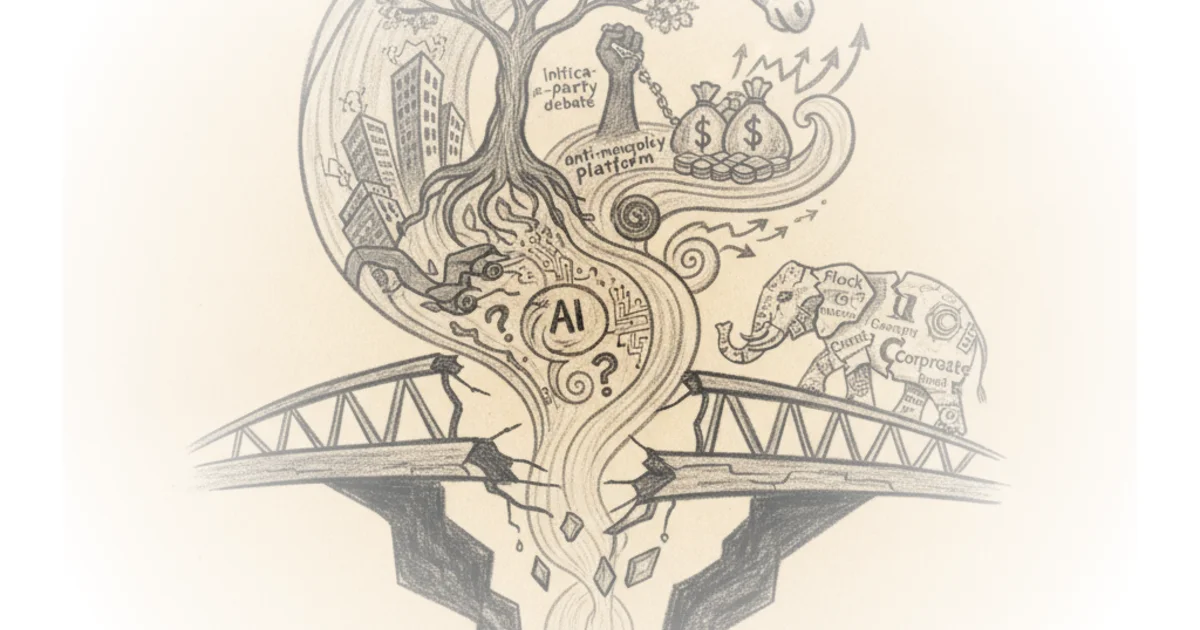
The author argues that today's self-proclaimed moderates are often the very people blocking the kind of structural change voters crave. He highlights the strange contradiction where a candidate like Abdul El-Sayed, who won a primary with a clear anti-monopoly platform, is labeled a radical, while others who share similar views on curbing corporate power are praised as sensible. "This politician, framed in the piece as more moderate, has been one of the best anti-monopolists in Congress, investigating United Health Group, as well as the local utility Central Hudson," Stoller notes regarding Representative Pat Ryan. The distinction, Stoller suggests, is arbitrary and designed to confuse the electorate about what is actually being debated.
Moderates like to imagine themselves as offering civility, but civility can be populist or anti-populist.
This observation lands hard because it reframes the current political fatigue. Voters aren't turning to populism because they love chaos; they are turning away from a "moderate" establishment that refuses to address the tangible harms of high prices and corporate corruption. As Stoller puts it, "Most Americans want business to work well and get upset when cheated. They are frustrated at the high cost of health care, and are voting to address their needs, rather than using violence. That seems like common sense, not the melody of the Internationale." The argument here is that the demand for anti-monopoly action is a return to basic common sense, not a descent into extremism.
Who Owns the Brand?
The piece takes a sharp turn into the mechanics of power, identifying the group Third Way as the primary gatekeeper of the "moderate" brand. Stoller doesn't just critique their ideas; he dissects their funding and personnel to show who they actually represent. He points out that despite claiming to be "passionate moderates," the group recently raised $15 million to wage a "war" against the left. "We are preparing for the next war that is coming," said Jonathan Cowan, the president of the group, Stoller quotes, juxtaposing this aggressive stance with the group's self-image as peacemakers.
The most damning evidence Stoller presents is the composition of Third Way's board. He reveals that the group is not a broad coalition of Democrats but a gathering of financial elites. "There are 32 outside trustees, with 62.5% of them having a background at a major Wall Street bank or private equity firm, such as JP Morgan, Goldman Sachs, or Warburg Pincus," he writes. This data point transforms the abstract concept of "centrism" into a concrete conflict of interest. The group's policy preferences—lower taxes on capital gains, lax antitrust enforcement, and less financial regulation—directly mirror the interests of its donors.
Stoller argues that this dynamic has paralyzed the Democratic Party for decades, creating a culture of fear where any challenge to corporate power is dismissed as too risky. He traces this anxiety back to the electoral trauma of the 1980s, when Democrats lost repeatedly to Ronald Reagan. "Democrats lost complete confidence in themselves, not only in terms of being able to win elections, but having any sense they could be trusted to run major governing institutions," Stoller explains. This historical context is vital; it shows that the current hesitation to embrace anti-monopoly policies isn't a strategic choice based on current polling, but a generational PTSD response to past defeats.
Critics might argue that Stoller oversimplifies the role of groups like Third Way, suggesting that internal party debates are more nuanced than a simple battle between a corrupt elite and a pure populace. However, the sheer concentration of wealth on the board of a major advocacy group makes the "conflict of interest" argument difficult to dismiss.
What Third Way has been selling, for decades, is a sort of snake oil on how to win elections, to a set of voters that have no confidence in the government to matter.
The author connects this historical fear to the present moment by referencing the Sherman Antitrust Act, noting how the legal framework for breaking up monopolies has been neglected in favor of a financialized economy. He suggests that the "moderate" label is now a barrier to enforcing these long-standing laws, as the people who control the label have a vested interest in keeping them dormant. The argument is that the party's fear of losing has made it a prisoner of the very forces that voters are angry at.
Bottom Line
Stoller's most compelling contribution is exposing "moderation" not as a philosophy of governance, but as a brand managed by financial interests to protect the status quo. The argument's greatest strength lies in its specific, data-driven attack on the personnel behind the rhetoric, moving beyond abstract political theory to show exactly who benefits from the current narrative. The biggest vulnerability is the assumption that voters are fully aware of these dynamics, as the article implies a level of political clarity that may not yet exist in the broader electorate. The reader should watch for how the anti-monopoly movement navigates this new landscape, where the definition of "reasonable" is being rewritten by the very people it claims to moderate.