Roger Pielke Jr. challenges a foundational assumption of modern finance: that the global economy is facing a novel, unprecedented form of "climate risk" that demands entirely new regulatory frameworks. While the financial sector has spent billions building models to price this supposed existential threat, Pielke argues these models are built on a category error that conflates rising economic losses with rising weather severity, effectively inventing a crisis where the science suggests continuity rather than catastrophe.
The Invention of a New Risk Category
The core of Pielke's argument is that "climate risk" as a distinct financial asset class is a social construct, not a scientific discovery. He points to the sudden explosion of the term in literature following Mark Carney's 2015 speech, noting that prior to this, the concept was virtually non-existent. "The notion of 'climate risk' can be found sparingly in the literature prior to Mark Carney's 2015 speech that launched the climate-risk industrial complex," Pielke writes. This framing suggests that the urgency driving current regulations is not a response to new data, but a response to a new narrative.
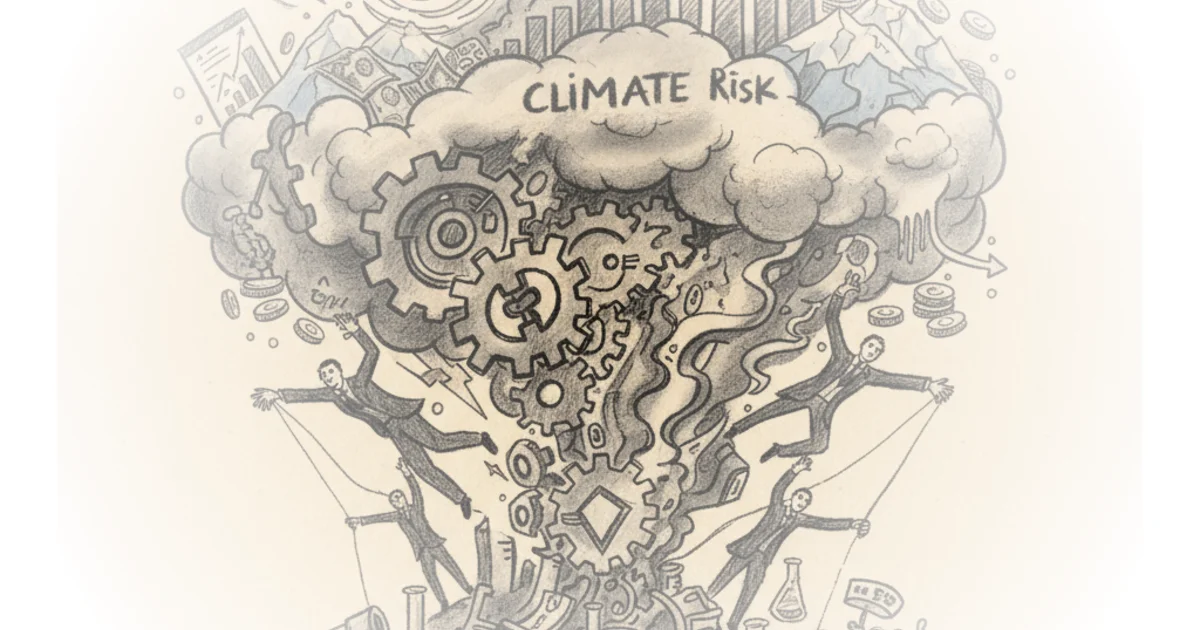
This narrative was quickly institutionalized by bodies like the Financial Stability Board (FSB) and the Bank for International Settlements (BIS). Pielke highlights how these institutions adopted a definition of physical risk that focuses almost exclusively on dollar signs rather than meteorological data. The FSB defined physical risks as "the possibility that the economic costs of the increasing severity and frequency of climate-change related extreme weather events... might erode the value of financial assets." By anchoring the definition to economic costs, the financial community created a feedback loop where inflation and better reporting could be mistaken for climate-driven destruction.
Either the global financial community swallowed the notion of catastrophic climate change hook, line, and sinker — or, more cynically, it put apocalyptic visions to work as a tool to try to reengineer the entire global economy.
The stakes of this framing are high because it justifies a massive expansion of regulatory power. Pielke notes that the BIS went so far as to cite neo-Malthusian literature to suggest climate change poses an "existential threat to humanity," a claim that stands in stark contrast to the more measured, probabilistic assessments of the Intergovernmental Panel on Climate Change (IPCC). Critics might argue that financial regulators are right to be cautious and that the precautionary principle demands acting on worst-case scenarios, but Pielke contends that basing trillions in asset valuations on "apocalyptic visions" rather than peer-reviewed climate science is a dangerous gamble.
The Data Trap: Losses vs. Weather
Perhaps the most damaging critique Pielke offers is the reliance on flawed data to justify these new risk models. The financial sector, including the Network for Greening the Financial System (NGFS), routinely cites rising disaster costs as proof of intensifying weather. However, Pielke points out that this is a logical fallacy. "Note how in that last sentence the NGFS incorrectly uses the trend in losses to make a conclusion about 'extreme weather events,'" he observes. The data sources, primarily Munich Re and NOAA's Billion Dollar Disaster tabulations, reflect the increasing value of assets in harm's way, not necessarily an increase in the frequency or intensity of the storms themselves.
This distinction is critical. If the rise in losses is driven by population growth and wealth accumulation in coastal zones, then the risk is a function of human development, not just climate change. Yet, the "climate-risk industrial complex" treats these losses as a direct proxy for climate severity. Pielke argues that this has led to a rejection of historical data, which is the bedrock of traditional risk management. The TCFD and BIS have argued that "Data on past changes in climate may also be a particularly poor guide to future climate-related risks," claiming that the future is too non-linear to be understood through history.
Traditional approaches to risk management consisting in extrapolating historical data and on assumptions of normal distributions are largely irrelevant to assess future climate-related risks.
This call for an "epistemological break" from conventional science is what Pielke finds most troubling. It allows private vendors to create bespoke, unverified models that claim to predict the future with precision, bypassing the rigorous detection and attribution methods used by climate scientists. While the shift toward forward-looking scenarios is standard in finance, the wholesale dismissal of historical trends as "irrelevant" removes the only empirical anchor we have. A counterargument worth considering is that climate change does introduce non-linearities that break historical patterns, but Pielke's point remains that the financial sector has not proven that current losses are driven by these non-linearities rather than by standard economic exposure.
The Rise of the Industrial Complex
The ultimate consequence of this framing is the creation of a self-perpetuating ecosystem of consultants, vendors, and regulators. Pielke describes this as a "climate-risk industrial complex" that exists because it has convinced the world that a new type of risk requires new tools. "The establishment of a climate-risk industrial complex was thus unnecessary," he asserts, arguing that the risks of hurricanes and floods have always been managed through conventional insurance and engineering, regardless of the climate context.
By declaring the past irrelevant, the financial sector has opened the door for a new industry to sell uncertainty. "Risk estimates from analytics companies are likely to affect billions of lives and trillions of dollars," Pielke warns. This creates a situation where the definition of risk is no longer grounded in the physical reality of the atmosphere but in the proprietary algorithms of private firms. The irony is palpable: a system claiming to manage climate risk is actually distancing itself from climate science.
There is no such thing as novel physical 'climate risk' to be managed separately from the ongoing risks associated with hurricanes, floods, tornados, etc.
Bottom Line
Pielke's most compelling contribution is his insistence that the financial sector has confused economic exposure with meteorological change, leading to a regulatory overreach that may ultimately undermine financial stability by pricing in phantom risks. The argument's greatest vulnerability is the potential underestimation of true climate tipping points, yet the evidence he presents regarding the conflation of loss data with weather data is difficult to refute. Readers should watch for the next phase of this debate: how these private risk models will perform when real-world disaster data inevitably fails to match their catastrophic projections.