Dan Carlin's conversation with Elon Musk and Bill Riley opens a window into how military history gets rewritten when engineers enter the frame — and it's not the version most readers have heard.
The Engineer’s War
Carlin sets up the discussion by noting that "this has happened with me before where i'll be talking with someone about something usually over a long period of time" — essentially admitting he's picking up a conversation mid-stream. But what's immediately striking is his framing: this isn't a history podcast in the traditional sense. It's a dialogue between three people who actually understand technology at different depths, and they're asking questions that standard military histories often miss.
"for a lot of books on strategy on war actually don't address technology or address it in a tangential manner but obviously if there is an overwhelming technology advantage that side will win"
This is Carlin's core thesis, and it's bold. He's arguing that most strategic analysis treats technology as a footnote when it's actually the headline. The piece gains force when he clarifies: "if there's a big technology discontinuity then the the side with the advanced technology will wear" — meaning the entire dynamics of conflict shift when one side has a fundamental technological edge.
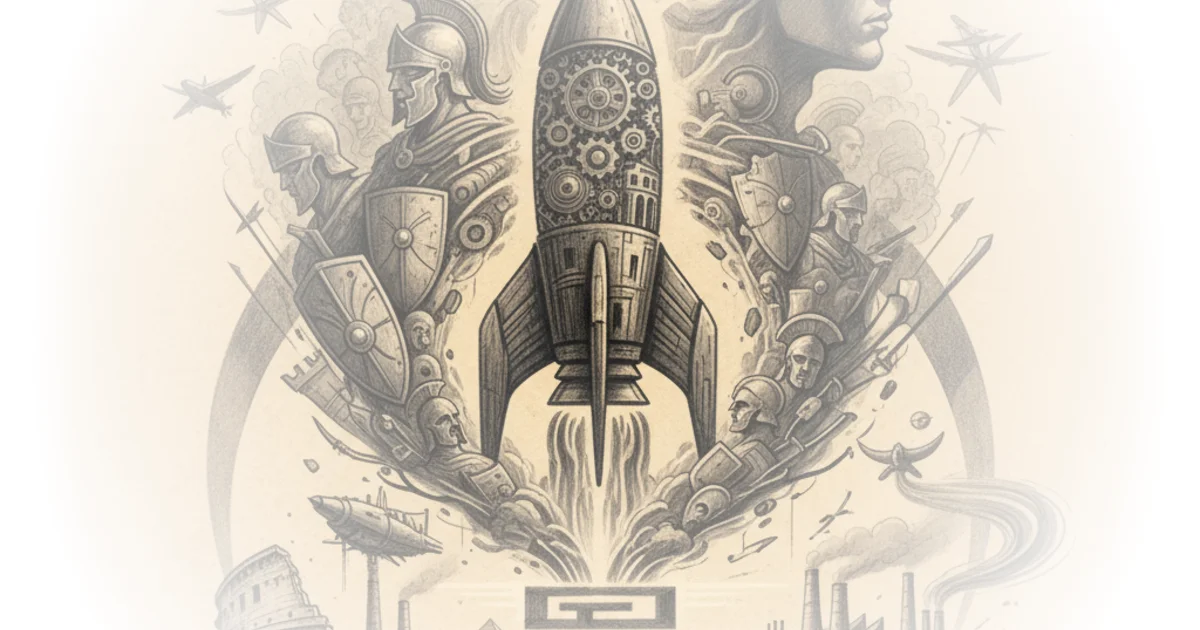
The conversation pivots to nuclear weapons as the ultimate example. Carlin states plainly: "the nuclear bomb if you if you go anyone who got nuclear bombs that you now win that's it end of story." This is the most explicit claim in the piece — and it's hard to argue with. Once you have the bomb, there's no equivalent response.
But the conversation doesn't stay at the macro level. Carlin pulls it down to specifics: "the us fighters really began world war ii were were not very good um and nor were the tactics and nor was the training it's basically uh the tactics terrible the aircraft are terrible and uh and the training is not not correct." This is a devastating admission — that America's initial military technology was genuinely inferior, and that inferior tactics compounded the problem. The Japanese fighters "were very uh uh agile nimble very nimble" — and American pilots had to develop entirely new ways of fighting just to survive.
One of those tactical innovations was "the thatch weave" — a formation specifically designed to compensate for better aircraft being in the hands of the enemy. Carlin describes it: "if you're fighting if you're if you're in a thing that's sort of more like a tank and but you're fighting something which is extremely nimble" — you let the agile fighter get on your tail, then have your wingmate come around and shoot them down.
Production Trade-offs
The conversation turns to what Carlin calls "the production trade-offs" — questions that video games often force players to confront. Should you build thousands of Sherman tanks or fewer but more sophisticated Tigers? The answer from Musk is straightforward: if the kill ratio is three-to-one and the cost is twice as much, you still win.
Carlin's framing here is particularly effective because he's not just describing history — he's using historical examples to interrogate modern defense thinking. "Could one make a case today that there are examples of that you know the u.s still i would i would assume correct me if i'm wrong the technological leader there in military technology but if you're uh the russians or the chinese and we end up in a war in 20 years" — this is explicitly asking whether technological lag matters over time.
The piece's strongest contribution is its argument that "rate of innovation might be the key after the first opening salvos" — meaning that whoever can adapt fastest wins, not who starts with the best equipment.
Counterpoints
Critics might note that framing nuclear weapons as the ultimate technology discontinuity oversimplifies conflicts where logistics, morale, and geography often matter more than raw capability. The historical examples here are selective — Carlin picks moments where tech mattered most, ignoring cases where it didn't.
Technology is to be viewed in the broadest sense you could you also think of it in the sense of say do you have a a better phalanx
This is actually the piece's weakest moment. The shift from nuclear weapons to bronze swords feels less like analysis and more like Carlin wandering through his own examples.
Bottom Line
The most compelling part of this conversation isn't about WWII aircraft or turbochargers — it's the meta-argument: that military history has systematically underweighted technology's role in determining outcomes. The weakest section is when the examples become scattered, particularly the Roman sword metallurgy tangent that doesn't quite land. Carlin's strongest claim is buried in plain sight: "if there is an overwhelming technology advantage that side will win" — and it's worth considering what happens when that's no longer true.