Zichen Wang delivers a brutal autopsy of China's state media, arguing that the sector is not merely struggling but has already collapsed under the weight of its own institutional contradictions. The piece's most startling claim is that the massive subsidies propping up these outlets are not a lifeline but a symptom of a business model that no longer exists, leaving the state to pay for a monopoly without a market. This is essential listening for anyone trying to understand how information flows in the world's second-largest economy, where the gap between official messaging and public attention has become an unbridgeable chasm.
The Illusion of Connection
Wang begins by dismantling the comforting myth that state media still commands a loyal audience. He writes, "The primary reason mainstream media have fallen into systemic difficulty is the failure of user connection. It is no exaggeration to say that mainstream media today lack a sizeable user base and have effectively been abandoned by their audiences." This is a stark admission from within the system, one that rejects the usual narrative of external interference in favor of internal obsolescence.
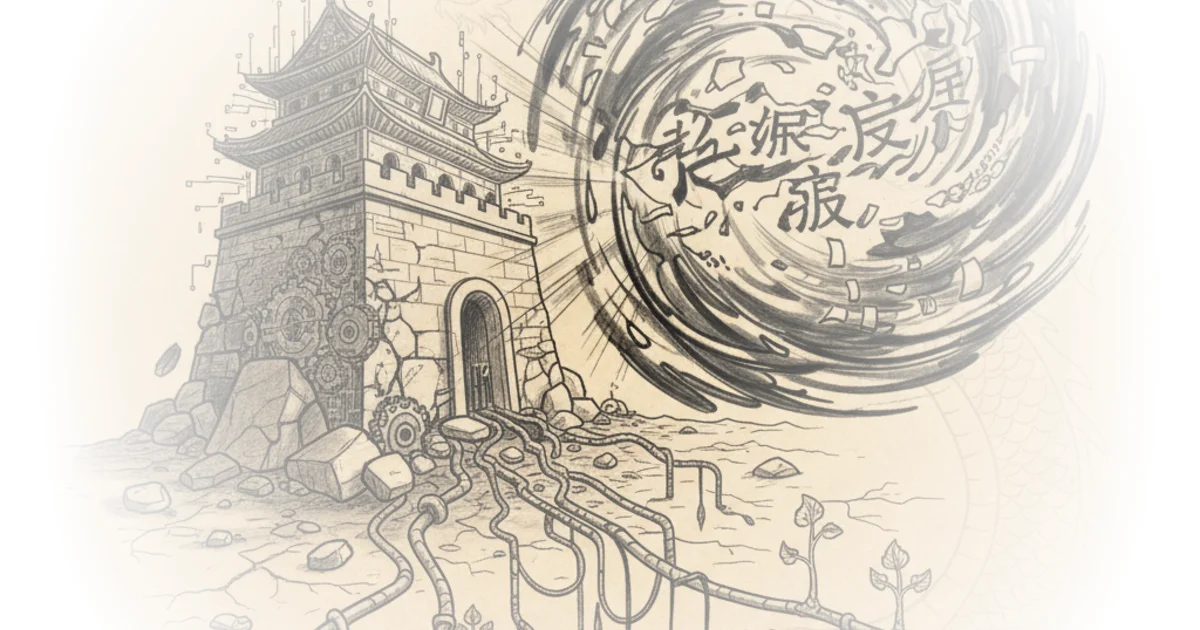
The author draws a sharp distinction between having followers on a platform and actually owning a user base. As Wang puts it, "Followers of mainstream media on internet platforms belong to the platforms, not to the mainstream media themselves." He argues that while state outlets may boast millions of followers on WeChat or Douyin, they possess none of the data or leverage that comes with true ownership. This reframing is critical: it suggests that the administration's push for "systemic transformation" is fighting a battle against a reality where the audience has already voted with their attention. Critics might argue that state media still holds unique authority in times of crisis, but Wang's data suggests that even that authority is eroding as the public retreats to private, algorithm-driven ecosystems.
The concept of the "user" is a personalised and data-driven notion... Internet platforms, leveraging strong technological capacity and sophisticated user operation mechanisms, have acquired hundreds of millions of users.
The Economic Cliff
The financial argument is where Wang's analysis becomes most devastating. He traces the collapse of the traditional "secondary sales" model—selling content to audiences and then selling that audience to advertisers—not as a slow decline, but as a structural implosion. "The once-effective 'secondary sales' business model has completely collapsed," Wang writes, noting that advertising follows distribution channels, not content quality. This is a fundamental shift that the state media establishment has struggled to accept.
The evidence is in the numbers. Wang points out that in 2023, fiscal subsidies for broadcasting and television nearly doubled their advertising revenue, reaching nearly 100 billion yuan against just 58 billion in ad sales. "Without such subsidies, most broadcasting and television outlets nationwide would struggle to survive," he notes. This creates a bizarre dynamic where the state is essentially paying to keep its own megaphones running, while the actual market for information has migrated entirely to private tech giants. The historical parallel is striking: just as print circulation in the early 2000s failed to predict the speed of digital displacement, today's state media is clinging to a "resource-based development" model that the internet has rendered obsolete.
Wang highlights the futility of the current approach: "Many mainstream media professionals still fail to grasp the fundamental relationship between advertising, content, and distribution channels. Some still harbour the illusion that producing high-quality journalism can help them win back advertising revenue." This illusion is dangerous because it masks the reality that the monopoly on distribution—the true source of their past wealth—is gone. The administration's recent calls for "systemic transformation" may be too little, too late, as the very resources these outlets relied upon (licenses, frequencies, ISBNs) have lost their scarcity value.
The Institutional Trap
Perhaps the most profound insight Wang offers is that the problem is not just technological, but deeply political and structural. State media in China operates under a "triple identity" as state agencies, public institutions, and enterprises, a hybrid that Wang argues is incompatible with the speed and risk-taking required for digital survival. "Purely market-oriented internet media require a privately led institutional and operational mechanism," he asserts, listing the need for rapid decision-making, flexible capital, and high-risk incentives.
The state-owned model, by contrast, is bogged down by wage caps, lengthy approval processes, and a culture of risk aversion. Wang writes, "Leadership teams often lack sufficient incentives; their innovation awareness is weak, while risk aversion is strong." This creates a paradox: the executive branch demands that these outlets transform into modern, competitive digital platforms, yet the very rules that govern them prevent them from acting like modern, competitive businesses. The result is a sector that is overstaffed, underfunded in terms of technology, and disconnected from the users it is supposed to serve.
The root cause of mainstream media's deep crisis lies in the failure of user connection, and the fundamental solution lies in rebuilding that connection.
Critics might suggest that the state's goal is not profitability but ideological control, rendering market metrics irrelevant. However, Wang's analysis suggests that without a viable economic model, even ideological control becomes unsustainable. If the audience is not listening, the message is lost, regardless of the budget behind it.
Bottom Line
Wang's most compelling argument is that China's state media is trapped in a "monopoly without market," sustained only by the very government that is trying to reform it. The strongest part of his case is the unflinching data showing that subsidies have become the primary revenue source, effectively nationalizing the cost of a failed business model. The biggest vulnerability in the administration's current strategy is the belief that "systemic transformation" can be mandated from the top down without fundamentally altering the institutional constraints that make such transformation impossible. The reader should watch for whether the state will eventually accept that its media arm is no longer a market player, but a purely subsidized public utility, or if it will continue to chase a digital ghost that has already moved on.