Michael Huemer doesn't just critique political theory; he dismantles the very logic we use to justify state power by turning it into a farcical sales pitch. In his satirical dialogue "The tv contract," Huemer exposes the absurdity of claiming that mere residence in a territory constitutes consent to be governed, a claim that underpins much of modern political philosophy. For busy readers seeking to understand why the social contract feels increasingly like a scam, this piece offers a devastatingly clear lens through which to view the mechanics of authority.
The Monopoly of Force
Huemer begins by constructing a scenario where a salesman represents the state, offering a television (protection) for $50 (taxes). The immediate red flag isn't the price, but the lack of choice. "There are no other options," the salesman insists, revealing that the company is the only one allowed to sell televisions because they "forcibly close down" any competitors. Huemer writes, "If anyone else tries to sell televisions, we send people over to forcibly close them down." This is a sharp, direct paraphrase of the state's monopoly on violence, stripped of its noble rhetoric.
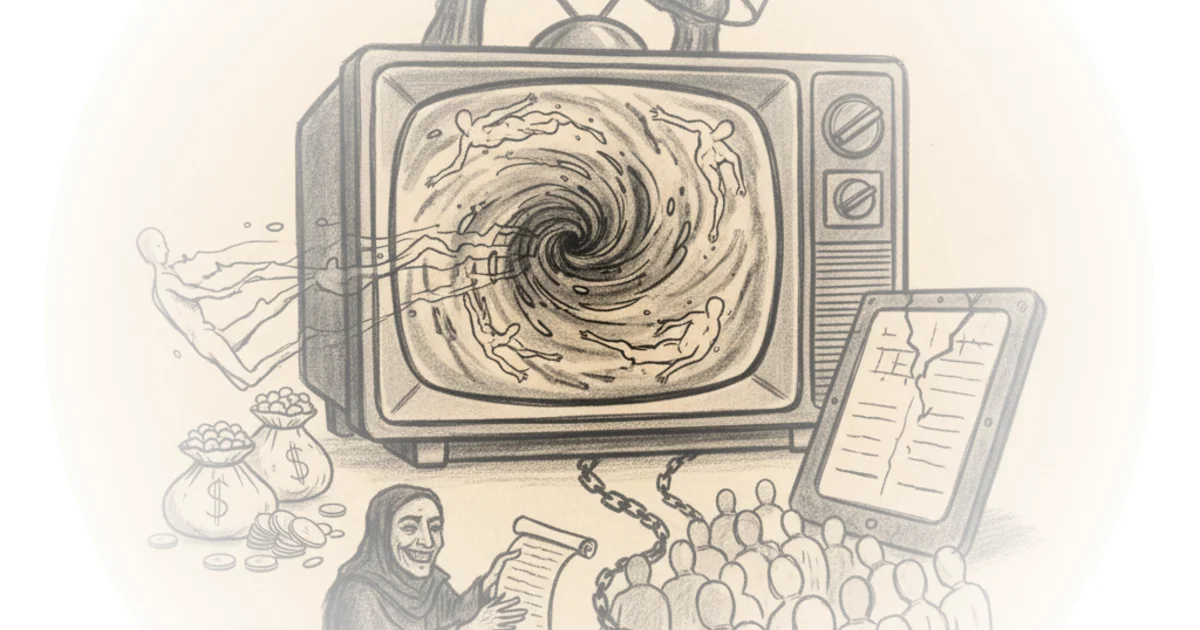
The author's framing is effective because it forces the reader to confront the reality that the state does not compete in a free market; it eliminates the market entirely. By comparing the government to a monopolist who destroys rivals to claim they are protecting consumers from "chaos," Huemer highlights the circular logic often used to defend state intervention. The salesman's claim that they want people to have "only the best televisions" serves as a biting critique of paternalistic policies that restrict liberty in the name of public good.
"We can't have the chaos of multiple different people selling different kinds of TV's, now, can we? What if their televisions weren't as good as ours?"
Critics might argue that this analogy oversimplifies the complexity of public goods and the necessity of a central authority to prevent a "tragedy of the commons." However, Huemer's point is not that no organization is needed, but that the current justification for this specific organization relies on a monopoly that would be illegal in any other sector of the economy.
The Illusion of Consent
The dialogue shifts to the core philosophical problem: how can a contract be binding if one party never signed it? When the protagonist explicitly refuses to agree, the salesman retorts, "You implicitly agreed by your actions." Huemer uses this exchange to satirize the concept of "tacit consent," a doctrine often used to argue that living within borders implies agreement to the laws. The salesman suggests the only way to opt out is to "move to Antarctica in the next three months," a standard that Huemer notes is practically impossible for most people.
This is where the piece connects deeply to historical debates on the Consent of the governed. Unlike the Lockean tradition, which struggled with the idea of how to leave a state of nature, Huemer's salesman exposes the modern reality: there is no exit. The author writes, "We couldn't do that [ask them and listen]. It wouldn't be practical. I mean, what if some irrational or ill-informed people said no?" This admission is crucial. It reveals that the system cannot tolerate dissent because its legitimacy relies on universal compliance, not actual agreement.
The argument gains further weight when the salesman delivers a television the customer never asked for and then claims, "You're keeping it, aren't you? So obviously you agree to our contract." Huemer is dismantling the "benefits received" theory of obligation. Just because the state provides services does not mean the citizen consented to the terms of service, especially when those terms include dangerous labor and unlimited price hikes.
The Arbitration Trap
Perhaps the most chilling part of the satire is the description of the Dispute Resolution Department (DRD). The salesman assures the customer that the DRD is fair, yet admits its members are "appointed by the president, in consultation with the board of directors." Huemer writes, "The company president wouldn't appoint someone who wasn't fairminded, would he?" This rhetorical question exposes the flaw in relying on the state to adjudicate disputes between the state and the citizen.
The author draws a parallel to the Lockean proviso, which suggests that legitimate government requires the protection of natural rights. Yet, in Huemer's dialogue, the only rights protected are those defined by the state itself. The contract includes a clause that the company will not "unreasonably" send agents into the house, but the definition of "reasonable" is decided by the very people doing the invading. As Huemer puts it, "Who decides what counts as reasonable? ... Well, normally the president, in consultation with the board of directors, decides what's reasonable."
This section effectively argues that without an independent arbiter, the social contract is merely a tool for coercion. The salesman's assurance that "everything's taken care of" rings hollow when the mechanism for justice is entirely internal to the monopoly.
"If anyone could just decide for himself what was reasonable? That would be an utter disaster—for us and for the television-viewing public."
The author's choice to have the salesman label the customer an "extremist" for wanting to decide what is reasonable for themselves is a masterstroke. It mirrors the way modern political discourse often frames individual autonomy as a threat to social stability. Huemer suggests that the fear of individual judgment is the primary engine of authoritarian control.
The Good Samaritan Fallacy
In the final stretch, the salesman attempts to justify the contract using a moral argument: the "Good Samaritan" duty. He argues that if the customer sees a neighbor's TV about to be smashed, they have a duty to warn them. Huemer writes, "Because you could save his television at very little cost to yourself?" The salesman then pivots, claiming that refusing to sign the contract is akin to letting the neighbor's TV be destroyed.
This is a clever but flawed analogy that Huemer sets up to be dismantled. The protagonist correctly points out that the cost of signing this contract is not "very little." It includes "unknown future price increases, unknown restrictions on my behavior, and possibly being forced to do dangerous work." The salesman dismisses these costs, claiming, "It's small in comparison with the total benefits we provide." Huemer uses this to critique the utilitarian calculus often used to justify state overreach, where individual rights are sacrificed for a vague "greater good."
The dialogue ends with the salesman asserting that the restrictions are not bad because they "usually only prohibit very unpopular activities." This is a sobering reminder of how rights are eroded not by banning popular things, but by criminalizing the unpopular or the inconvenient. The author leaves the reader with the realization that the "contract" is a trap where the terms are constantly rewritten by the seller.
Bottom Line
Michael Huemer's "The tv contract" succeeds because it refuses to treat political authority as a given, instead exposing the logical gaps in the stories we tell ourselves about why we obey. Its greatest strength is the relentless application of common-sense business ethics to state power, revealing that the state would be a criminal enterprise in any other context. The piece's vulnerability lies in its assumption that a society without a monopoly on force could function without descending into chaos, a question it leaves open for the reader to ponder. For anyone questioning the legitimacy of the current political order, this satire offers a necessary, if uncomfortable, mirror.