Most historical documentaries treat Alexander the Great as a static statue of bronze and marble, but Kings and Generals dismantles that myth to reveal a commander defined by terrifying contradictions. This piece stands out not merely for recounting battles, but for its insistence that Alexander's genius was inextricably linked to his capacity for paranoia and brutal improvisation. For the busy strategist or history buff, the value here lies in seeing how a young king turned a precarious inheritance into a world-altering campaign through sheer, audacious speed.
The Inheritance of Instability
Kings and Generals opens by reframing Alexander's accession not as a coronation, but as a crisis management exercise. The authors write, "He began as a young king of Macedonia and then developed into a hero and god during his own lifetime," yet they immediately undercut this romanticism by noting that his early reign was a "tragic figure, a Greek tragedy made real in a man who succeeded purely off the back of his own ambition and drive." This framing is crucial; it suggests that the myth of the god-king was a survival mechanism for a regime on the brink of collapse.
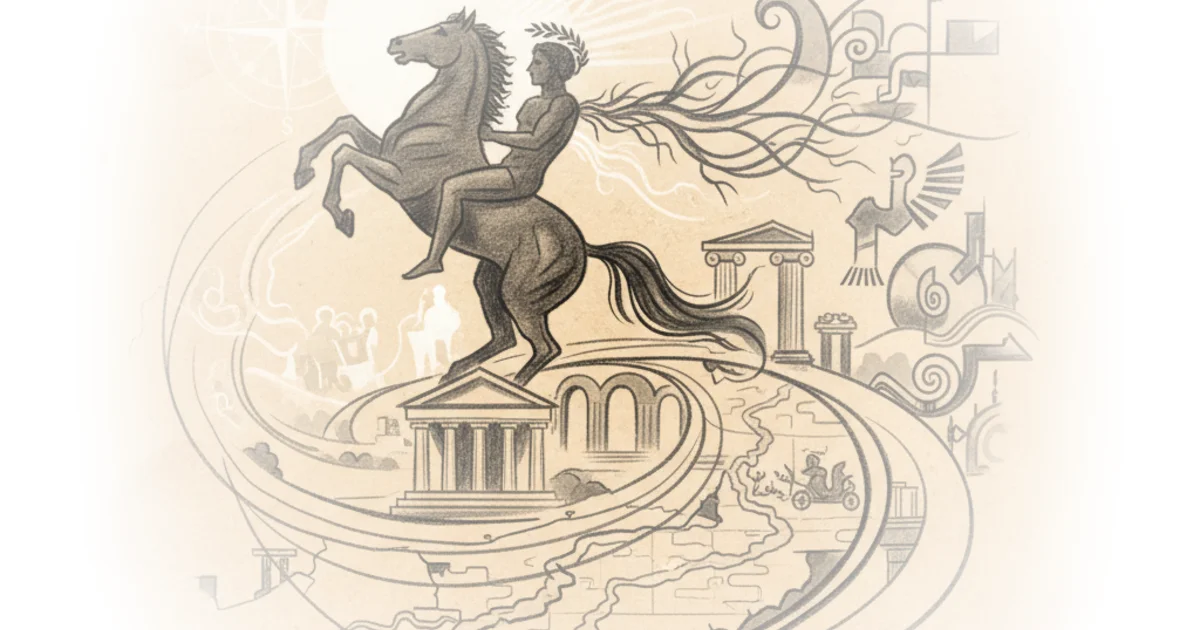
The text details how the young ruler inherited a powerful army but a fractured political landscape. As Kings and Generals puts it, "These inheritances were tenuous, and to keep them, Alexander would have to fight for them." The commentary here is sharp: the author argues that Alexander's immediate execution of his father's rival, Atalas, was not just cruelty, but a necessary consolidation of power. The piece notes that while advisors urged caution, Alexander "instead chose boldness and audacity." This sets the tone for the entire narrative: hesitation was death, and speed was the only currency that mattered. Critics might argue that this focus on boldness glosses over the sheer luck involved in Alexander's early survival, but the evidence of his rapid suppression of Thebes and Athens supports the claim that his aggression was a calculated deterrent.
He could be as vicious and brutal as he could be generous and kind. He was a forward-thinking rationalist, but also superstitious and paranoid.
The Art of the Impossible
The coverage then shifts to the northern campaigns, where Kings and Generals excels at translating ancient tactical problems into modern strategic lessons. The authors describe the confrontation at Mount Hamus, where Thracian tribesmen attempted to roll wagons down a mountain onto the Macedonian phalanx. The narrative highlights the discipline required to counter this: "Following their king's instruction, the phalangites calmly broke formation and opened gaps to let the wagons go by harmlessly... and lay prone with their locked shields above their head if not." This is a masterclass in unit cohesion under pressure.
The piece argues that Alexander's greatest weapon was often psychological. When facing the Gete nomads across the Danube, he didn't wait for a proper fleet. Instead, he "ordered that every single native canoe and craft be gathered up so that floats could be made from tents stuffed with hay." Kings and Generals writes, "Thus provisioned with such a makeshift fleet, that night, masked by the darkness, Alexander boldly ferried 4,000 of his infantry and 1,500 cavalry across the Danube." The commentary here emphasizes the element of surprise over logistical perfection. The authors suggest that the sheer audacity of crossing a major river at night with improvised rafts shattered the enemy's will to fight before the first sword was drawn.
A counterargument worth considering is whether this reliance on improvisation was sustainable or merely a reflection of the chaotic nature of ancient warfare. However, the specific detail that the Macedonian army suffered "just 54 dead" against a force of 14,000 suggests that the tactical innovation was as effective as the psychological shock.
The Trap at Pelium
The narrative takes a darker turn as it describes the siege of Pelium, where Alexander's overconfidence nearly cost him his army. Kings and Generals admits, "Such freedom of the land allowed the Macedonian king to encamp and begin pulling forward his siege equipment. It was a rare tactical blunder for Alexander, which committed his army to the siege, thus leaving his rear exposed." This admission of vulnerability is rare in popular history and adds significant credibility to the analysis.
Trapped between a fortified city and a relief force, Alexander had to rely on pure theater to escape. The authors describe how he ordered his phalanx to perform drills in full view of the enemy: "Like a programmed machine of war, they pivoted right, left, back, and forth again without a word being uttered." The commentary posits that this display was designed to terrify the enemy into believing the Macedonians were invincible. As Kings and Generals notes, "Disconcerted and enthralled by this unprecedented display of martial prowess, the Illyrians were not ready when Alexander gave his final signal." The escape was not won by superior numbers, but by the psychological impact of disciplined movement.
The Macedonians were, however, a politically separate group, and that divide between Macedonians and those from the Greek city-states is an occasionally important one to make.
Bottom Line
Kings and Generals succeeds by stripping away the divine veneer of Alexander the Great to reveal a brilliant, flawed, and terrifyingly effective operator who relied on speed and psychological dominance to survive. The piece's greatest strength is its refusal to shy away from the "rare tactical blunder" that nearly doomed the campaign, proving that even the greatest commanders are human. The biggest vulnerability in the narrative is the reliance on ancient sources like Arrian, whose casualty figures are often inflated or deflated for dramatic effect, yet the core strategic lessons on adaptability and morale remain timeless.
He was in some ways terrible and in other ways truly great.