Most gaming commentary treats Minecraft as a sandbox for conquest or architectural mastery, but Tom van der Linden argues the game's true limitation is its philosophical silence. He posits that the world's indifference to player action isn't just a design choice, but a reflection of a specific, outdated worldview that treats nature as an infinite resource rather than a reactive system. This is a rare, deep-dive analysis that moves beyond mechanics to ask why we play the way we do, and what we lose when the virtual world refuses to push back.
The Architecture of Indifference
Van der Linden begins by dissecting the game's default assumptions through the lens of environmental sociology. He notes that while the game offers freedom, it lacks consequence. "Minecraft's world as a whole never gives you any real feedback to your actions," he observes, highlighting a disconnect between the player's agency and the world's response. The author breaks this down into three layers: the strategic (what you can do), the normative (what is good or bad), and the ontological (what is real). In Minecraft, the ontological layer is built on the premise that nature is a passive backdrop.
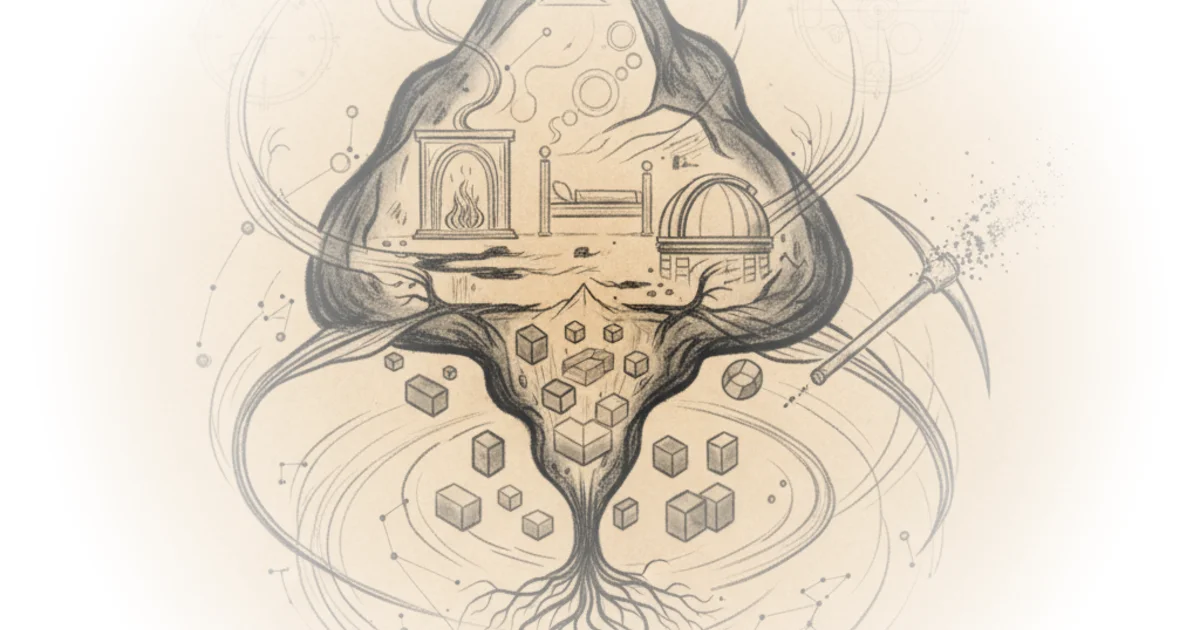
This framing is effective because it explains why the game feels hollow to players seeking immersion beyond resource extraction. Van der Linden writes, "The fundamental assumption on which Minecraft's world exists is that the world is ultimately indifferent to the player." He argues that this mirrors a neoliberal frame dominant after World War II, where nature was viewed as something to be manipulated for human progress without serious regard for environmental well-being. The game rewards expansion and exploitation precisely because it assumes the environment will never fight back.
Critics might argue that a game designed for relaxation shouldn't burden players with complex ecological simulations, but van der Linden is not asking for a lecture; he is asking for a living world. He suggests that the current design limits the game's potential to teach or inspire genuine reflection on our relationship with the planet.
"You're not building inside a vacuum. You're playing in a world where there are different biomes, different animals, trees, and water."
A World That Pushes Back
The core of van der Linden's proposal is a shift from a passive to an active ontology. He imagines a version of the game where the "environmentalist frame" replaces the current indifference. In this hypothetical scenario, draining a swamp would have consequences, and over-farming would deplete the soil. "Imagine biomes no thriving or deteriorating based on the available amount of water per X amount of blocks," he suggests. This isn't about making the game harder, but about making it more honest.
He envisions a system where "excessive industrialization caused issues like sour rain or smog," forcing players to find sustainable ways to modernize rather than simply expanding their footprint indefinitely. This approach would transform the game from a collection of raw materials into a complex, interconnected ecosystem. The author argues that this would allow players to "learn about ecological causes and the fact and utilize them to improve your base and the world around it."
The strength of this argument lies in its refusal to be preachy. Van der Linden clarifies, "I'm not arguing for Minecraft to be turned into political propaganda." Instead, he believes that clever game design can make players reflect on issues they otherwise wouldn't consider. By letting the world react to their actions, the game would naturally encourage a more thoughtful approach to resource management.
"I want to feel the danger of new and unexpected environmental hazards, the joy of surprising opportunities, and that blissful sensation of after hours and hours of work standing within your own creation, existing in peaceful harmony."
The Unfulfilled Potential
Ultimately, van der Linden's critique is a call for a deeper connection between player and world. He acknowledges that the current version of the game is fun, but he believes it is missing a layer of depth that could make it truly transformative. "The point isn't necessarily to raise awareness about the global environmental consequences to our collective behavior," he writes, "but by letting you find out for yourself how different elements of the environment interact with each other."
This perspective challenges the industry's obsession with expansion and conquest. It suggests that the most compelling gameplay might come not from defeating a dragon, but from understanding the delicate balance of a virtual ecosystem. The author's vision is one where the game world feels alive, where every action has a ripple effect, and where the player is forced to confront the reality of their impact.
Bottom Line
Tom van der Linden's argument is a compelling call to reimagining the sandbox genre, moving from a model of infinite extraction to one of ecological interdependence. While some may find the proposed mechanics too complex for a casual game, the underlying insight—that a game world should reflect the reality of its setting—is undeniable. The strongest part of this piece is its ability to reframe a popular game as a missed opportunity for meaningful engagement with environmental ethics, leaving readers to wonder what other digital worlds are missing by staying silent.