In an era where digital efficiency often dictates the pace of life, Helen De Cruz offers a startlingly slow, tactile counter-narrative born from the bedbound reality of cancer treatment. This is not merely a showcase of colored pencil art; it is a philosophical argument that the very limitations of a physical medium—its inability to be rushed or easily undone—mirror the ancient Daoist concept of wu wei, or effortless action. De Cruz suggests that the friction of layering pigment is not a hurdle to be overcome, but the precise mechanism required to process the fragility of the human body.
The Medium as Message
De Cruz frames her return to analog art as a deliberate rejection of the speed and artificiality of digital tools and generative AI. She writes, "I switched back to physical media because of a disgust with ai and a feeling I wanted to try something different." This choice is not aesthetic nostalgia but a survival strategy. The author notes that with colored pencils, "you must layer them... It's a slow medium you cannot rush. Ideal for me now." By forcing herself to work in light, cumulative layers rather than heavy, decisive strokes, she aligns her creative process with the pacing of her own recovery. The physical constraint becomes a spiritual discipline.
This approach reframes the concept of disability and illness. Instead of viewing her condition as a barrier to creation, De Cruz treats it as the specific context that makes this art possible. She argues that the slowness of the medium allows for a depth of engagement that digital speed precludes. As she puts it, "Even if you don't blend colors you must go easy and very lightly make a layer, then on top another one until the desired saturation is obtained." This methodical accumulation mirrors the way one must navigate chronic illness: incrementally, without the luxury of forcing a cure.
Reimagining Uselessness
The core of De Cruz's commentary lies in her visual interpretation of the Zhuangzi, specifically the stories that celebrate the "useless." She tackles the parable of the giant gourd, where the philosopher Huizi dismisses a massive fruit because it cannot hold water, while Zhuangzi suggests it could be a boat for floating on rivers. De Cruz writes, "I love this story on uselessness and spent a pleasant afternoon looking at images of gourds." By illustrating this, she challenges the modern obsession with utility and efficiency.
You certainly are dense when it comes to using big things! Obviously you still have a lot of underbrush in your head.
De Cruz extends this to the story of the gnarled tree, which carpenters ignore because it cannot be squared or measured. She notes, "Why don't you plant it in Not-Even-Anything Village or the field of Broad and-Boundless, relax and do nothing by its side, or lie down and have a free and easy sleep under it?" The author's decision to depict these "useless" objects with care and beauty is a political act in a world that demands constant productivity. Critics might argue that this romanticization of disability ignores the very real pain and economic hardship that often accompanies it, but De Cruz navigates this by acknowledging her own anger while finding a space for peace within the art.
The Ethics of Representation
De Cruz is acutely aware of the ethical dimensions of her subject matter, particularly regarding disability and the depiction of suffering. When illustrating the story of "Disabled Shu," a figure described in the text with severe physical deformities, she makes a conscious choice to diverge from the literal description. "I did not follow Zhuangzi's description but rather drew a man with cerebral palsy washing clothes," she explains. She explicitly cites the work of John Altmann and Bryan Van Norden to ground her interpretation in a "disability positive" framework.
This choice highlights a tension in adapting ancient texts for a modern audience. The original text often uses physical deformity as a metaphor for spiritual freedom, which can feel exploitative to contemporary readers. De Cruz sidesteps this by focusing on the dignity of the figure's labor rather than the spectacle of his body. She writes, "With a disabled body, he's still able to look after himself and finish out the years Heaven gave him. How much better, then, if he had disabled virtue!" By grounding the abstract philosophy in the tangible reality of washing clothes, she humanizes the metaphor.
The Limits of Control
The piece also grapples with the loss of control inherent in both the artistic process and the experience of illness. De Cruz admits her frustration with the "three in the morning" story, where a monkey trainer changes the distribution of acorns to manipulate the monkeys' emotions. She confesses, "Looking at pictures of Chinese traditional monkey trainers is very disturbing so I did not depict the trainer." This omission is significant; it reflects a refusal to participate in the manipulation of others, even in art.
Her most visceral confrontation with the text comes from the story of Master Yu, who accepts his transformation into a hunchback with calm detachment. De Cruz writes, "I felt angry, as a cancer patient, reading this passage. I don't feel happy that nature is turning me into this and I hope the chemo can slow it down." Here, the author rejects the stoic acceptance demanded by the ancient text, asserting the validity of her own anger. This honesty is the piece's emotional anchor. It prevents the commentary from becoming a dry philosophical exercise and instead makes it a raw, human document.
I felt angry, as a cancer patient, reading this passage. I don't feel happy that nature is turning me into this and I hope the chemo can slow it down.
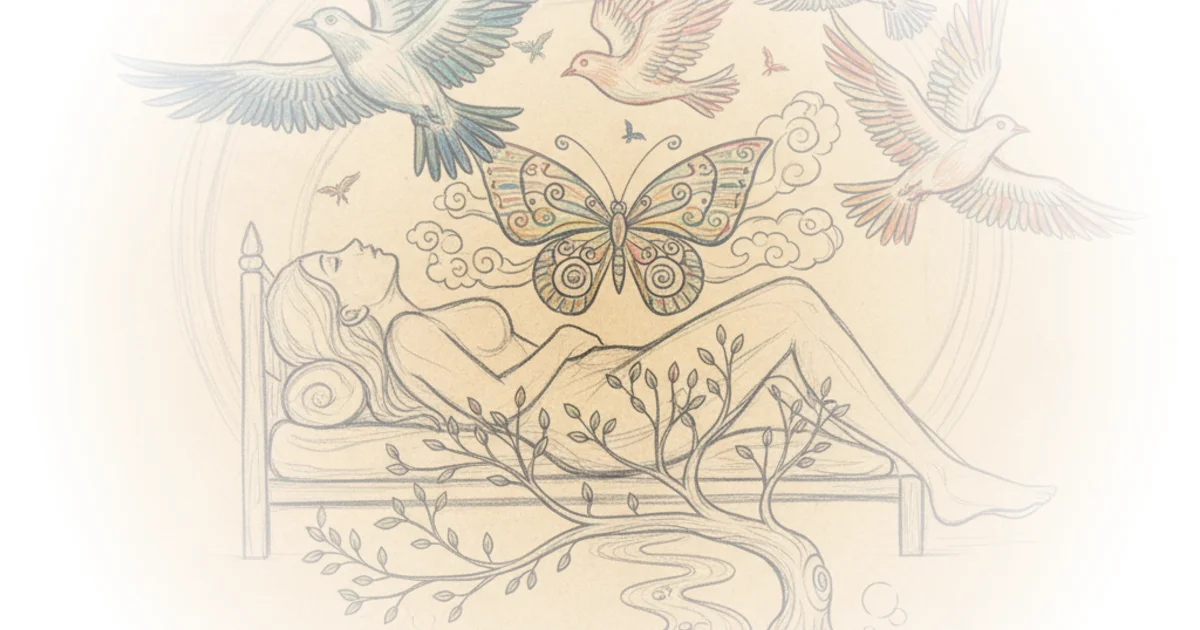
De Cruz also touches on the "Butterfly Dream," questioning the boundary between reality and illusion. She notes, "Between Zhuang Zhou and a butterfly, there must be some distinction! This is called the Transformation of Things." Yet, in the context of her illness, this distinction blurs. The act of drawing becomes a way to navigate the uncertainty of her own existence, a way to say "I am here" even when the body feels alien.
The Bottom Line
Helen De Cruz's commentary succeeds because it refuses to separate the art from the artist's suffering, using the ancient wisdom of Zhuangzi not as a shield against pain, but as a lens to examine it. The strongest element of the piece is its refusal to offer a tidy resolution; the anger remains, the illness persists, and the art is simply the space where these contradictions are held. The biggest vulnerability lies in the risk of romanticizing the "useless" life, a danger De Cruz mitigates by grounding her philosophy in the gritty reality of medical treatment and the physical labor of drawing. For the busy reader, this is a reminder that slowing down is not a retreat, but a necessary act of resistance.