Most human evolution stories still cling to a tidy, straight-line timeline, but this episode from Big Biology dismantles that illusion with a flood of fresh genetic data and unexpected fossils. The piece argues that our origins are not a ladder but a "luxuriant evolutionary bush," a chaotic tangle of lineages that lived, died, and occasionally interbred long before Homo sapiens walked the Earth. For a listener pressed for time, this shift from a simple family tree to a complex web of relationships is the most critical update in paleoanthropology in decades.
The Bush, Not the Ladder
Big Biology reports that "our understanding of hominin evolution over the past several million years has been transformed by exciting new fossil finds and new DNA sequence data." This is not merely an accumulation of bones; it is a fundamental rewrite of the narrative. The editors note that the central question has shifted from "where did we come from?" to "who else was there?" By inviting Kate Wong, a senior editor at Scientific American, to unpack her latest article, the piece moves beyond the usual suspects of human ancestry to explore the "complex set of ancestral hominins that preceded us."
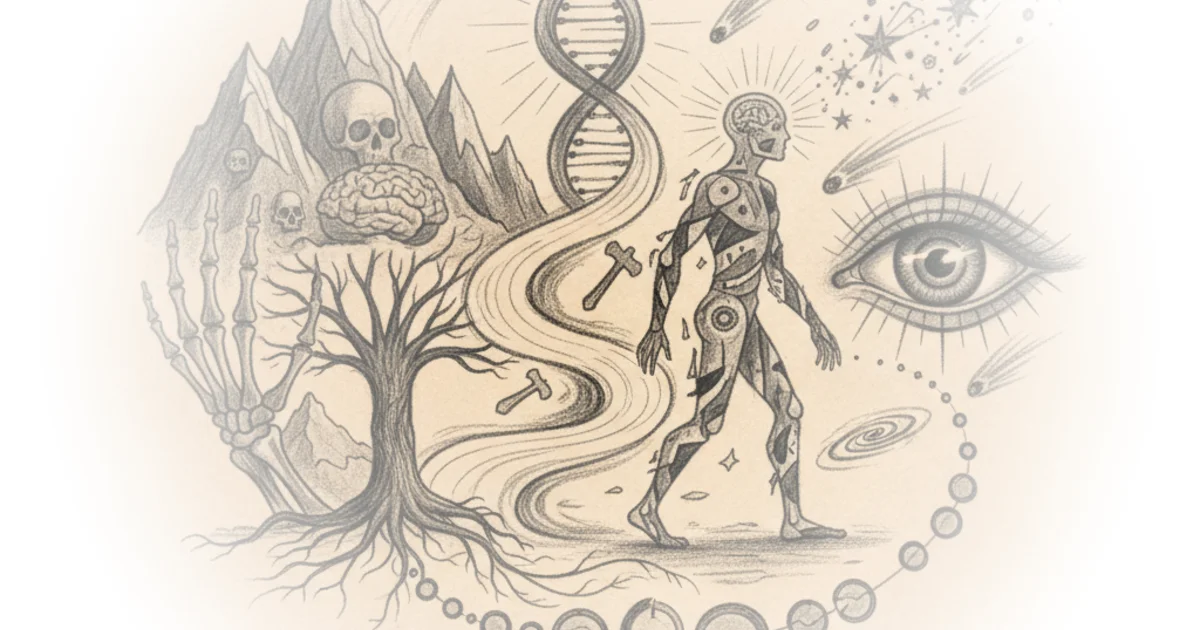
The argument here is that the "luxuriant evolutionary bush from which our ancestors emerged in Africa" was far more crowded than previously imagined. This framing is effective because it forces the listener to abandon the comforting notion of a single, inevitable path to modern humanity. Instead, we are presented with a history of dead ends and parallel experiments. As the piece puts it, the goal is to understand "what happened to them"—the other lineages that vanished while ours survived.
"Where, when, and how did Homo sapiens appear?" is no longer a question with a single, clean answer.
Critics might argue that emphasizing the "bush" risks obscuring the clear biological continuity that defines our species. However, the piece balances this by focusing on the specific "favorite fossil species" that anchor these new genetic discoveries, ensuring the science remains grounded in physical evidence rather than just abstract modeling.
The Genetic Revolution
The most compelling evidence cited comes from the intersection of ancient DNA and traditional paleontology. Big Biology highlights how "new DNA sequence data" has allowed researchers to detect interbreeding events that the fossil record alone could never reveal. The piece suggests that the boundaries between different hominin groups were porous, challenging the rigid species definitions of the past.
Kate Wong, quoted in the discussion, emphasizes the scale of this change: "The biggest news... is the realization that our ancestors were not alone." This statement reframes human history as a series of encounters with other intelligent, tool-using groups. The editorial voice in the piece suggests that this complexity makes the story of human origins richer, not less coherent. It forces us to ask why Homo sapiens succeeded where others failed, a question that moves the conversation from mere description to evolutionary dynamics.
The coverage also touches on the timeline, asking "how recently did other hominin lineages live." This temporal proximity is startling; it implies that for thousands of years, different forms of humans coexisted on the same continents. The piece argues that this coexistence was likely the norm, not the exception, and that our current isolation is a recent, perhaps anomalous, state of affairs.
Bottom Line
The strongest part of this argument is its successful integration of genetic data with fossil evidence to create a dynamic, non-linear history of human origins. Its biggest vulnerability lies in the sheer volume of new data, which can sometimes outpace the ability to build a cohesive narrative. Listeners should watch for how future discoveries continue to reshape the "bush," potentially revealing even more surprising connections between the ancestors we thought we knew and the ones we have yet to find.