Mick Ryan delivers a jarring correction to the prevailing narrative: what looks like a single military clash in the Middle East is actually two distinct wars fought with incompatible definitions of victory. While the public fixates on missile counts and air strikes, Ryan argues that the United States is fighting a conventional campaign for military dominance while Iran is waging a global economic war designed to break the American political will. This distinction is critical for busy strategists because it explains why overwhelming tactical success in the air has failed to produce a clear political end-state.
The Two-War Reality
Ryan's central thesis dismantles the idea of a unified conflict. He writes, "There is a temptation, as we observe the opening weeks of Operation Epic Fury, to see a single war taking place. This oversimplifies what is occurring." Instead, he posits that the United States and Iran have entered a conflict defined by fundamentally different theories of what victory means. The American approach, driven by the executive branch's narrow coalition, relies on AI-assisted intelligence and overwhelming air power to degrade nuclear and naval capabilities. Ryan notes that this strategy was executed with "remarkable precision," with over 7,000 targets struck in the first three weeks.
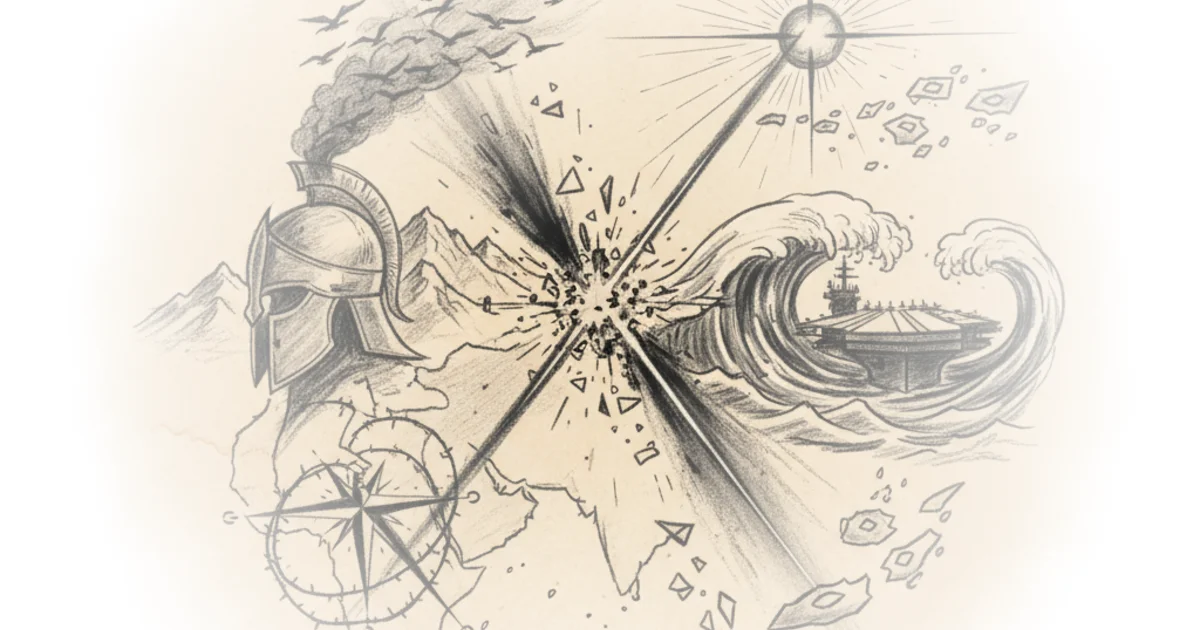
However, the author argues that military precision does not equal strategic clarity. The administration's goals have shifted from preventing nuclear development to demanding unconditional surrender, creating a foggy endgame. Ryan observes, "The ends remain opaque." This lack of a coherent political vision for "winning the peace" is the campaign's Achilles' heel. Critics might argue that in a conflict against a hostile regime, destroying military capacity is the only viable path to peace, but Ryan counters that without a plan for governance or reconstruction, the victory is merely temporary.
"A theory of victory must embrace objectives beyond military activity. Now, notions of victory must include economic, diplomatic, and societal long-term needs as well as short- and medium-term military outcomes."
The Economic Front and the Petrodollar
While Washington focuses on air superiority, Tehran is fighting a war of attrition designed to inflict economic pain. Ryan points out that Iran's core instruments are not its depleted air force, but the Strait of Hormuz, drone swarms, and the global oil price. The regime's strategy is simple: "who can take the pain the longest?" By threatening to close the world's most critical oil chokepoint, Iran has driven prices to the $95-105 range and sparked volatility in global food markets.
The most provocative element of Ryan's analysis is the potential shift in global finance. He highlights a report that Tehran is considering allowing oil tankers through the Strait only if payments are made in Chinese yuan. Ryan writes, "The condition, if formalised, would represent the most significant challenge to the petrodollar system in its fifty-two-year history, striking at the financial architecture that underpins American global power rather than at US military assets." This moves the conflict from a regional skirmish to a systemic challenge to the US-led financial order. The author draws a parallel to the economic warfare seen in Operation Praying Mantis, where naval dominance was used to control trade routes, but notes that the current economic stakes are exponentially higher.
The Cost of Asymmetric Warfare
The disparity in cost between the two sides is staggering. Iran produces over 100 ballistic missiles a month, while the United States produces far fewer interceptors. Ryan notes that cheap Shahed drones, costing a few thousand dollars, are being countered by interceptors costing millions. Secretary of State Rubio has publicly acknowledged that this arithmetic is unsustainable for the United States. The author argues that even a significantly degraded Iran can impose serious economic disruption and military costs on the US and its allies through mass saturation attacks.
This dynamic forces a difficult choice on the executive branch: continue to absorb massive financial losses or de-escalate. Ryan suggests that the administration is struggling with this calculus, as "winning in Iran while maintaining deterrence in Europe and Asia requires a level of resource coverage and concurrent activity that the United States does not currently possess." With 40 percent of the US Navy in the Middle East and critical defense systems like THAAD removed from the Korean Peninsula, the strain on global deterrence is palpable. This connects to the broader strategic lessons for Pacific allies, who are watching how the US manages its resources across multiple theaters.
The Long Game and Regional Isolation
Despite Iran's short-term success in imposing costs, Ryan warns that the long-term outlook for the regime is bleak. He cites RAND analyst Raphael Cohen, who argues that an Iranian regime that survives this war will emerge "poorer, weaker, and more regionally isolated than at any point since 1979." By striking Arab states that were previously neutral, Tehran has damaged the regional relationships that constituted 60 percent of its trade base. The strategic logic of using proxy networks as a deterrent shield has been dismantled, and the nuclear program has been struck twice.
Ryan concludes that the regime's theory of victory is fundamentally flawed in the long run. He writes, "Even a surviving Iran that declares victory will have triggered its own long-term strategic decline; their strategic gambling over the past few decades has finally cost more than the winnings." This assessment suggests that while the regime may survive the immediate bombardment, the economic and diplomatic fallout could be existential. The internal protests seen in early 2026, driven by economic challenges, further complicate the regime's ability to present the war as a unifying success.
Bottom Line
Ryan's most compelling contribution is his reframing of the conflict as a clash of economic endurance rather than military superiority, exposing the US administration's lack of a viable political end-state. The argument's greatest vulnerability lies in its assumption that the petrodollar system is as fragile as the author suggests, potentially underestimating the inertia of global financial structures. Readers should watch for whether the administration can pivot from a narrow military campaign to a broader economic strategy before the cost of attrition becomes politically untenable.
"The distinction matters enormously. A narrow theory of victory — degrade and deter, establish a new baseline, then enforce it — is viable. Regime change as a theory of victory requires a plan for the day after."