Ryan Grim & Jeremy Scahill deliver a harrowing inventory of a world where humanitarian catastrophe is treated as a logistical footnote to geopolitical maneuvering. Their coverage strips away the diplomatic varnish to reveal a stark reality: while the administration negotiates high-stakes arms deals and energy contracts, the human cost in Gaza and Sudan continues to mount with terrifying speed. This is not merely a news recap; it is a forensic audit of the gap between policy announcements and the suffering they fail to prevent.
The Architecture of Suffering
The authors immediately ground the reader in the visceral reality of the conflict, refusing to let the reader look away from the statistics. They note that "the total recorded death toll since October 7, 2023 is now 70,669 killed, with 171,165 injured." This figure is not presented as a dry data point but as a cumulative tragedy, underscored by the grim detail that "a one-month-old baby, Said Said Abdeen, died from exposure to the extreme cold." Grim & Scahill emphasize that these deaths are not collateral damage from active combat alone; they are the direct result of systemic neglect, noting that "55,000 families across Gaza have been affected by recent rainstorms, losing their shelter or having their personal property damaged."
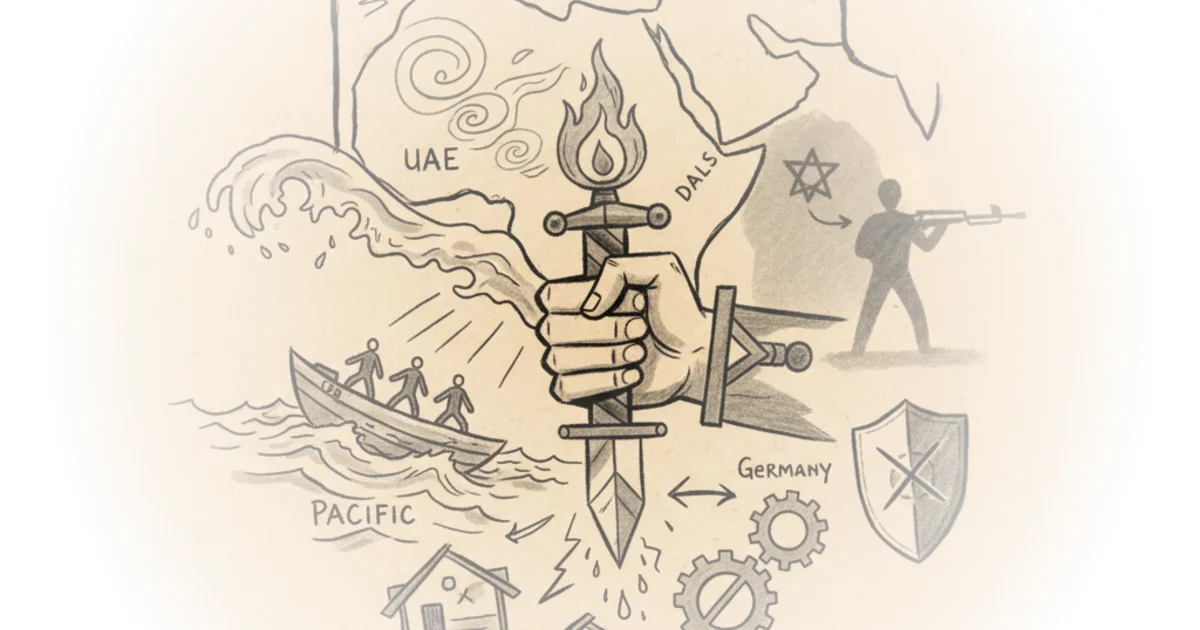
The commentary here is essential: the authors force us to see that the "ceasefire" has not stopped the bleeding, merely changed the mechanism. They report that "since October 11, the first full day of the ceasefire, Israel has killed at least 395 Palestinians in Gaza and wounded 1,088." This framing challenges the official narrative of stability, suggesting that the violence has simply shifted from high-intensity bombardment to a slower, more attritional form of destruction. The human cost is the central character of their story, not the policy debates surrounding it.
The Board of Peace and the Stabilization Force
Shifting to the diplomatic front, Grim & Scahill dissect the administration's proposal for a "Board of Peace" with a skeptical eye. They report that the U.S. is telling interlocutors it has secured commitments from Egypt, Qatar, the United Arab Emirates, the United Kingdom, Italy and Germany to have their leaders sit on this body, which is "led by U.S. President Donald Trump and is supposed to oversee Gaza's postwar governance and reconstruction, even after Trump leaves office." The authors highlight a critical contradiction in this plan: while the administration courts these nations, "willingness to sit on the Board of Peace does not mean further support from each country is guaranteed."
The proposed International Stabilization Force (ISF) receives similar scrutiny. The authors reveal that "U.S. officials privately told participants at a recent U.S. Central Command conference in Doha that a proposed International Stabilization Force (ISF) would not directly confront Hamas, and would deploy only along the so-called 'yellow line'." This limitation fundamentally undermines the force's ability to secure a lasting peace, a point Grim & Scahill make clear by noting that diplomats at the conference admitted "key issues remain unresolved, particularly how the force would address Hamas's weapons." The authors also point out the hesitation of regional players, noting that "Azerbaijan does not plan to join the proposed International Stabilization Force in Gaza and also does not intend to sign the Abraham Accords in the foreseeable future," driven by fears that participation could jeopardize relations with Turkey. This adds a layer of geopolitical realism that the administration's optimistic press releases often omit.
The administration is building a diplomatic theater of peace while the machinery of war continues to operate with full force.
Energy, Arms, and the Illusion of Neutrality
Perhaps the most jarring juxtaposition in the piece is the simultaneous approval of record-breaking economic and military deals while the humanitarian situation in Gaza deteriorates. Grim & Scahill report that "Israel approved a major natural gas export deal with Egypt on Wednesday, with Prime Minister Benjamin Netanyahu saying the government signed off on a roughly $35 billion agreement to supply Egyptian markets with gas from the Leviathan field." This deal, the largest in Israel's history, is set to deliver gas over the next 15 years, with "about half the revenue would flow to state coffers." The authors connect this to the broader regional energy strategy, referencing the Leviathan field's role in the region's energy security, a topic explored in their companion deep dives.
Simultaneously, the authors detail the expansion of military cooperation: "Germany has approved an expansion of a defense agreement for Israel's Arrow 3 missile defense system... bringing the value of the deal from $3.6 billion to $6.7 billion, making the largest Israeli defense export deal ever." The Arrow 3 system, a key component of the Iron Dome's outer layer, is now being bolstered by German industrial might. Grim & Scahill's framing suggests a disturbing normalization: as families lose shelter to rainstorms, the machinery of defense is being upgraded to unprecedented levels. The authors do not explicitly condemn the deals but let the contrast speak for itself, forcing the reader to question the moral calculus of such transactions.
The Domestic Front: Citizenship and Control
The coverage extends beyond the Middle East to the domestic policies of the executive branch, revealing a parallel track of authoritarian consolidation. Grim & Scahill report that "the Trump administration set an internal target of pursuing 100–200 denaturalization cases per month," a policy that represents a "sharp escalation in efforts to strip U.S. citizenship from naturalized Americans." This move, they note, expands a legal process "typically reserved for cases involving fraud during naturalization" to a much broader, politically motivated target. The authors quote the administration's justification that Trump wants to revoke citizenship from those he claims were "naturalized maybe through Biden or somebody that didn't know what they were doing," exposing the arbitrary nature of the policy.
Further eroding civil liberties, the House approved a measure permitting invasive searches of children. The authors state that "the House passed H.R. 4371, the so-called Kayla Hamilton Act, which would allow federal agents to conduct invasive body examinations of unaccompanied children as young as 12 without a parent or guardian present." This legislation, passed with a vote of 225–201, signals a shift in how the state treats its most vulnerable populations. The authors also touch on the administration's aggressive stance toward Venezuela, noting that Trump "defends Venezuela blockade, and claims country's oil belongs to the U.S.," framing the blockade as a necessary measure to reclaim "stolen" energy rights.
Critics might note that the administration's focus on denaturalization and border control is a distraction from the economic instability caused by the very policies they are enforcing. However, Grim & Scahill's reporting suggests these are not distractions but core features of a governance model that prioritizes control over due process.
Bottom Line
Ryan Grim & Jeremy Scahill have crafted a piece that refuses to let the reader look away from the dissonance between high-level diplomacy and ground-level suffering. Their strongest argument lies in the juxtaposition of record arms deals and energy contracts against the backdrop of mass displacement and death, exposing the hollowness of the administration's "peace" initiatives. The piece's biggest vulnerability is its reliance on reported leaks and private statements, which, while compelling, lack the public accountability of official records. Readers should watch for how the proposed International Stabilization Force actually deploys, and whether the administration's aggressive denaturalization targets translate into a wave of legal challenges that could reshape the definition of American citizenship. The evidence presented suggests a world where policy is increasingly detached from human consequence, a trend that demands urgent scrutiny.