This piece by Ryan Grim & Jeremy Scahill dismantles the common narrative that settler violence in the West Bank is the work of rogue extremists. Instead, they present a chillingly detailed blueprint of a state-sanctioned system where civilian militias are armed, funded, and integrated into the military chain of command to systematically displace Palestinians. The reporting moves beyond anecdotal horror to expose the bureaucratic machinery that turns violence into policy, revealing a legal and operational gray zone designed to evade accountability.
The Architecture of Impunity
Grim & Scahill argue that what appears as sporadic chaos is actually a highly organized government system operating as intended. They detail how the state has created a dual structure where military occupation and civilian settlements reinforce one another. The authors write, "The volunteer militias, the reservist militias, and the military itself all work together to attack and terrorize Palestinians in the West Bank." This framing is crucial because it shifts the blame from individual actors to the institutional design itself. By tracing the flow of weapons from the Defense Ministry to civilian armories, the authors demonstrate that the state is not merely failing to stop these attacks; it is actively enabling them.
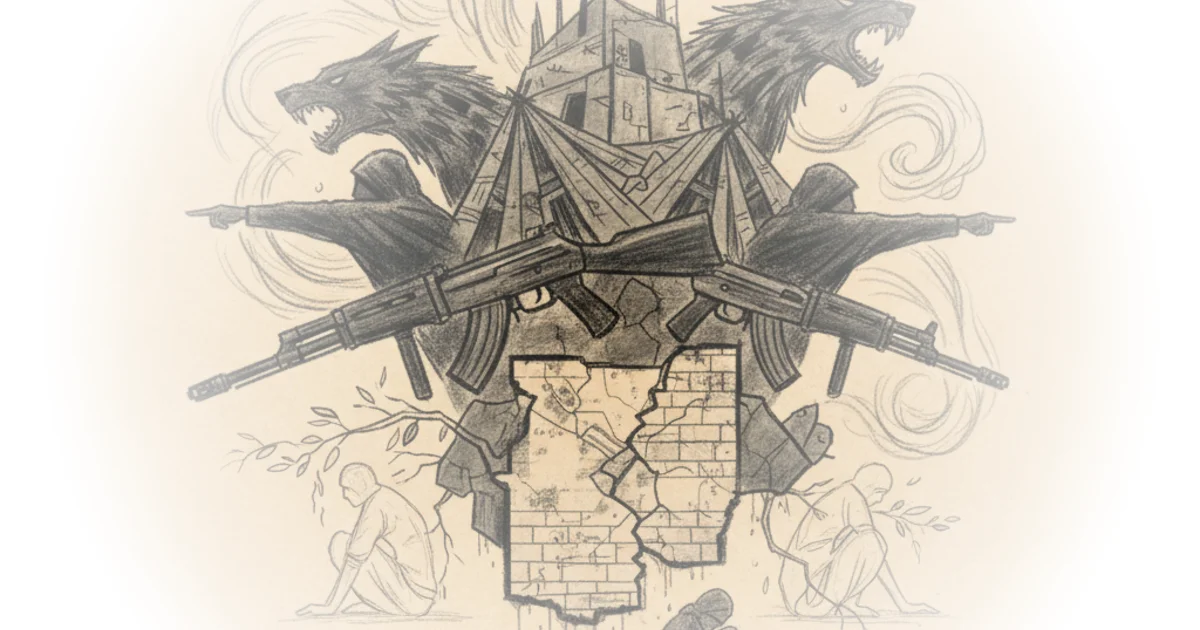
The reporting highlights a specific legal device: regional settlement councils that function as municipalities in occupied territory. Grim & Scahill explain that while Israeli law applies to the settlers, the land itself remains under military orders, creating a jurisdictional void. "On paper, the weapons are checked in and out by the ravshatz, but in reality, they almost never come back," notes an activist interviewed in the piece. This observation underscores the breakdown of oversight. The system relies on a permanent state of "ongoing routine security" rather than declared war, allowing armed civilians to operate with military cover without the legal constraints of a war zone.
The result is that we have settlers operating as the military without regulation.
Critics of this analysis might argue that the government is simply struggling to control a volatile frontier, but the evidence presented suggests a deliberate delegation of enforcement. The authors point out that complaints about violence routinely bounce between police and military jurisdictions, resulting in a "situation where no one investigates." This bureaucratic ping-pong is not an accident; it is a feature of a system designed to insulate the state from liability while maximizing territorial control.
The Expansion of Private Armies
The piece provides a stark timeline of escalation, particularly following October 7, 2023. Grim & Scahill document how the National Security Ministry, led by Itamar Ben-Gvir, expanded the number of rapid-response squads from roughly 450 to over 1,000 in a matter of months. They write, "By November 2025, Ben-Gvir's office said roughly 230,000 gun licenses had been issued over the past two years." This statistic is not just a number; it represents a massive militarization of the civilian population in the West Bank. The authors note that these new units were often incorporated under the border police specifically to operate outside the Green Line, bypassing traditional military constraints.
The funding mechanisms are equally revealing. The authors describe how regional councils supplement state funding with private donations, including U.S.-Jewish federations gifting sniper rifles. This creates a hybrid force that is both state-sponsored and privately fueled. Grim & Scahill observe that the Finance Minister's new Settlements Administration absorbed powers from the Civil Administration, giving direct control over civilian-security budgets. "The settler who broke in called the ravshatz on his phone... That's how it usually happens. The ravshatz makes a few calls, and within minutes they start showing up—half in uniform, half not—all with state-issued rifles," an activist recounts. This immediacy of response suggests a level of coordination that contradicts claims of rogue action.
The human cost of this expansion is documented through specific cases, such as the raid on Ibsiq where an 84-year-old man, Abu Safi, was forced to flee his home and died of a heart attack shortly after. Grim & Scahill do not shy away from the brutality: "They dragged me behind a fence where four of them beat me until I required hospitalization." By centering these personal tragedies, the authors ground the bureaucratic analysis in the reality of human suffering. The argument is that the system is working exactly as designed: to depopulate Palestinian areas through fear and force.
The Illusion of Accountability
A recurring theme in the coverage is the impossibility of legal recourse for victims. The authors describe a pattern where settlers detain Palestinians, warn them, and release them, effectively acting as a private police force. "We file complaints, but many times the authorities tell us the perpetrators were acting outside their capacity as soldiers, so we're referred to the police," says a B'Tselem researcher. "Then the police say it's a military matter." This circular logic ensures that investigations are closed for "lack of evidence" before they truly begin.
The piece also touches on the intelligence capabilities of these militias, noting that they intercept army radio frequencies to disrupt coordination between the military and Palestinian farmers. This level of sophistication further blurs the line between civilian vigilante and state actor. Grim & Scahill conclude that the distinction between the different types of settler units is "merely a technical one," with the same individuals often serving in multiple capacities. This fluidity allows the system to adapt and evade scrutiny.
Bottom Line
The strongest element of this report is its forensic dissection of the legal and financial mechanisms that legitimize settler violence, moving the conversation from moral condemnation to structural critique. However, the piece's reliance on anonymous sources for the most sensitive operational details, while necessary for safety, leaves some gaps in the public record regarding the highest levels of command approval. Readers should watch for how the international community responds to this documented expansion of armed civilian militias, as the current trajectory suggests a deepening of the conflict that is increasingly difficult to reverse.