Noah Smith delivers a stinging autopsy of San Francisco's Market Street, arguing that the street's collapse wasn't just a victim of the pandemic or crime, but a casualty of flawed urban planning that prioritized transit modes over human experience. While the "Doom Loop" narrative is familiar, Smith's specific indictment of the 2019 car ban—claiming it subtracted cars without adding pedestrians—is a provocative thesis that challenges the conventional wisdom of modern progressive urbanism.
The Anatomy of a Dead Zone
Smith begins by grounding the reader in the visceral reality of the street's decline, contrasting his college-era memories with the current desolation. "That Market Street is gone now," he writes. "In its place is a giant empty field of asphalt in the center of San Francisco — a desolate gray waste baking in the sun." This opening sets a somber tone, forcing the reader to confront the physical emptiness rather than just the statistics. He attributes this to a convergence of factors: the pandemic, the shift to remote work, and a crime wave that created a self-reinforcing cycle of decline.
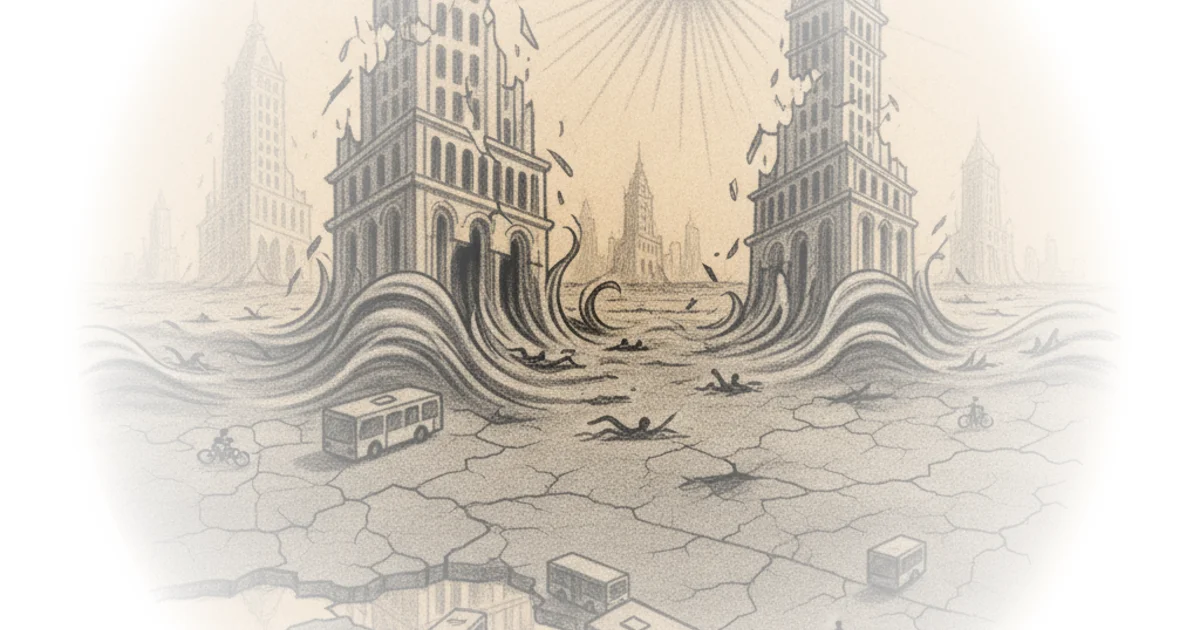
The author describes this cycle as the "Doom Loop," where crime and emptiness fed on each other. "Less foot traffic meant fewer 'eyes on the street' to discourage property crime," Smith explains, noting how this dynamic culminated in the January 2026 closure of the San Francisco Centre. This historical parallel to the decay of other American downtowns is potent, yet Smith goes further by highlighting a specific policy failure that predates the pandemic. He argues that the city's decision to close Market Street to cars in 2019 was a critical error. "Cars were subtracted, but pedestrians weren't added," he asserts, a mathematical certainty that doomed the street to become less vibrant, not more.
"Instead of Jane Jacobs, they ended up just being the Robert Moses of buses."
This comparison is the piece's sharpest intellectual move. Smith suggests that urban planners fell into a trap of "transit good, cars bad" thinking, treating the street as a thoroughfare rather than a destination. He contrasts San Francisco's approach with Paris, where car restrictions were designed to create spaces for people to occupy, not just pass through. In Paris, the "Limited Traffic Zone" bans cars from transiting but allows those within the area to drive, fostering a culture of occupation. Smith points out that Market Street has no more pedestrian areas than it did in 2019, noting that the city "never really followed up on those plans" for elevated bike lanes, leaving cyclists vulnerable to bus traffic and train tracks.
Critics might argue that blaming the car ban ignores the sheer scale of the pandemic's economic shock or the severity of the crime wave, which were external forces beyond the control of local zoning. However, Smith counters that the policy exacerbated these issues by making the street less accessible to the very people needed to fill it: diners, shoppers, and families. "The intersection of Powell Street and Market Street, once bustling and alive with tourists, shoppers, and street vendors, is now virtually empty," he observes, attributing this to a failure to create a safe, inviting environment.
The Cost of Suburban Thinking
The commentary deepens as Smith critiques the underlying philosophy of the ban. He argues that the approach reflects a "suburban" mindset where life is lived point-to-point, ignoring the value of the space in between. "In a suburb, the mode of transportation — how you get from Point A to Point B — is the important question," he writes. By focusing on the mode of transit rather than the public space, the administration and its allied groups failed to create a destination. Smith notes that while crime has fallen by 27% in 2025, and office demand is rebounding due to the AI boom, Market Street remains a "dead zone" with weekday foot traffic down by half compared to 2019.
He suggests that the solution is not more ambitious, underfunded infrastructure projects like the "$600 million capital project called Better Market Street," which he notes saw its vision degenerate as funds evaporated. Instead, Smith proposes a pragmatic reversal: "In lieu of turning Market Street into a pedestrian paradise, SF's best move is probably just to allow private cars again." He acknowledges this isn't the optimal long-term vision but argues it is the "quickest and easiest" way to restore the street's vitality. "Best to simply bury the era when Market Street was a large empty scar commemorating the decline of San Francisco," he concludes, urging a return to what the street used to be if it cannot become Paris.
Bottom Line
Smith's argument is compelling because it shifts the blame from abstract forces like the pandemic to concrete policy choices, specifically the car ban that failed to deliver on its promise of a pedestrian paradise. The piece's greatest strength is its refusal to accept the "transit good, cars bad" dogma without examining its real-world consequences. However, the solution of simply allowing cars back in may be politically difficult to implement and risks alienating the very urbanist base that supports the city's broader sustainability goals. The reader should watch to see if the city pivots from ideological purity to pragmatic revival, or if the "scar" of Market Street remains a permanent monument to a planning failure.