The war nobody asked for has become a war nobody can control.
That is the most striking finding from reporting on March 17, 2026: even Donald Trump's own allies now admit the Iran conflict has slipped beyond the president's grasp. Sources close to the administration told Politico that Trump "no longer controls how, or when, the war ends." One characterized the situation as "clearly just kicked their ass in the field, but, to a large extent, they hold the cards now" — referring not to the U.S. military, but to Iran.
The Strait That Became a Choke Point
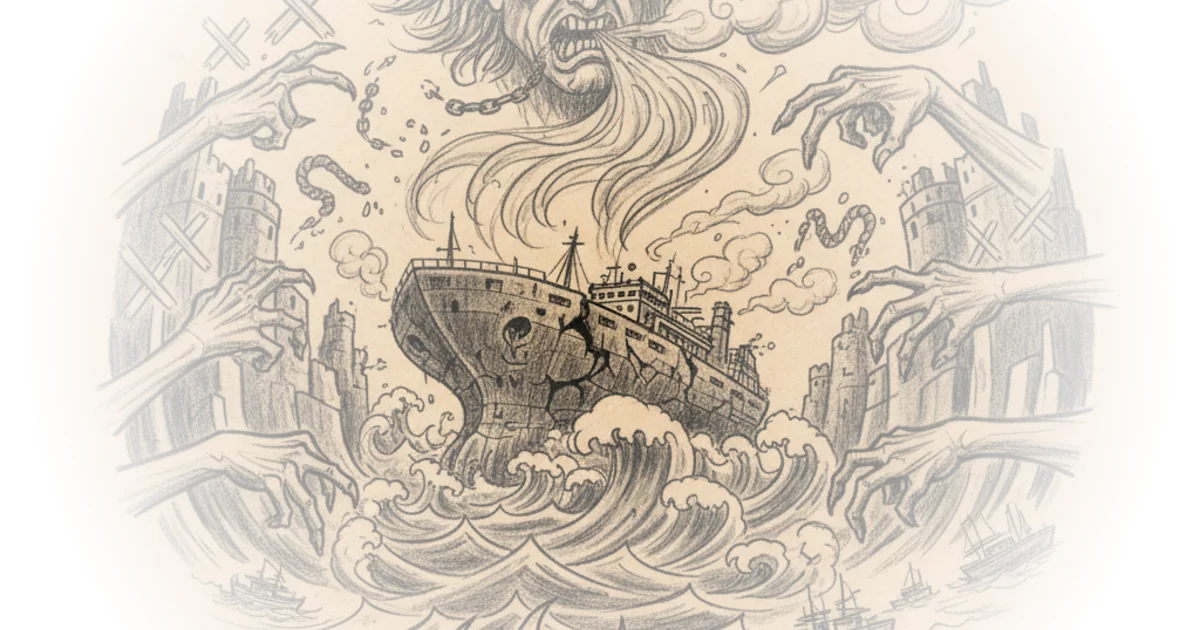
The core of this crisis runs through the Strait of Hormuz, one of the world's most critical chokepoints for global energy supplies. About 20% of the world's oil passes through that narrow passage between Oman and Iran — along with roughly 20% of the world's fertilizer shipments and helium necessary for semiconductor manufacturing.
Oil prices have climbed from approximately $70 per barrel before the February 28 strikes to more than $100 today. Gasoline has risen by at least 70 cents per gallon. These aren't abstractions: they affect farmers planning this season's crops, hospitals needing cooling equipment, and chip manufacturers across Asia.
But what makes this crisis so revealing is who was left behind to manage it.
The Empty Desk Where Experts Used to Sit
Last fall, the Trump administration cut every State Department staffer from the Bureau of Energy Resources. Nine former employees told Anna Kramer of NOTUS that they were the only experts in tracking sanctioned oil tankers and coordinating with international agencies managing strategic petroleum reserves. There was no handover, no transition, no contact list left behind.
"There was never any handover or transition," one former official said. "We were all just let go."
Critics might note that previous administrations specifically planned for exactly this scenario — a disruption of Hormuz traffic — and built diplomatic channels accordingly. Those channels now sit empty.
The Minesweeper Ships That Vanished
The administration decommissioned the last of its four minesweeper ships in September, according to Judd Legum of Popular Information. Based in Bahrain, those vessels could find and destroy both moored and bottom mines. They were supposed to be replaced by newer unmanned systems, but those have proven unreliable and apparently haven't been deployed at all.
Starting a military operation without any anti-mining capability in the region — to protect traffic through the strait — illustrates how poorly officials planned for this crisis. The Strait of Hormuz has seen similar tensions before: during the 1980s tanker wars, oil markets convulsed repeatedly as Iran and Iraq fought near those waters.
Allies Won't Help — And Trump Is Blaming Everyone Else
Yesterday, Trump continued demanding that other countries help reopen the strait for tankers. One by one, they declined. It is a dangerous business, and since Trump launched the war without consulting anyone, nations don't seem inclined to help him out of the mess he created.
Trump has told reporters that "numerous countries" said they're "on their way" to help enable ships to transit — but NATO allies have refused. In fact, his own social media post this morning claimed: "We no longer 'need' or desire the NATO Countries' assistance — WE NEVER DID!" The president appears to be preparing to leave the alliance over this refusal.
This is remarkable given that NATO was formed specifically to contain Russian aggression — and has done so successfully for decades. Israel's prime minister Benjamin Netanyahu, meanwhile, opened another front in Lebanon, saying Israel intends to destroy terror infrastructure there as operations have killed more than 850 people and displaced at least 800,000.
The Russia-Iran Axis Deepens
Thomas Grove, Milan Czerny, and Benoit Faucon of the Wall Street Journal reported that Russia has expanded its efforts to keep Iran in the fight against the U.S. and Israel — offering more intelligence sharing and military cooperation. Moscow is providing drone components and satellite imagery that enables Iran to strike U.S. troops and radar systems.
"Russia is trying to keep its closest Middle Eastern partner in the fight against U.S. and Israeli military might and prolong a war that is benefiting Russia militarily and economically," the reporters wrote. This represents a significant escalation from Russia's perspective, tying directly back to how NATO has historically viewed Moscow's intentions.
The Internal Collapse
Today, Joe Kent — a staunch Trump ally — resigned as director of the National Counterterrorism Center. His statement was damning: "Iran posed no imminent threat to our nation, and it is clear that we started this war due to pressure from Israel and its powerful American lobby."
The White House pushed back aggressively on Kent's assessment. House speaker Mike Johnson insisted there was "clearly an imminent threat" — but independent reporting from the Scientific American notes experts agree Iran was nowhere close to a nuclear bomb.
Trump himself seemed to try blaming former president Barack Obama, telling reporters: "if I didn't terminate Obama's horrible deal that he made..., you would have had a nuclear war four years ago." Sources close to all former Democratic presidents — Bill Clinton, Barack Obama, and Joe Biden — deny having said any such thing or having recent contact with Trump.
The Political Calculus Shifts
The sense that Trump has dragged the U.S. into a Middle Eastern war is splitting his own MAGA leadership. Isolationists who supported his "America First" claims and ending long foreign wars are turning against those backing the Iranian incursion. Their attacks on social media have become deeply personal — seemingly trying to hive supporters off toward even more extreme nationalism.
Trump's allies in the White House are talking to journalists like Politico's Megan Messerly, suggesting they see this conflict as a political disaster. Sources told her they hoped the strikes would be quick — removing Iran's leader much as Trump's Venezuela strikes did in January. They thought Trump's vagueness on objectives would let him declare victory whenever he wanted.
Now, though, one source said: "We clearly just kicked their ass in the field, but, to a large extent, they hold the cards now."
The Court and The Vote
Trump has also gone after the Supreme Court, complaining about its ruling that his tariffs were unconstitutional — while continuing to insist, against all evidence, that the 2020 presidential election was stolen. He called the court "little more than a weaponized and unjust Political Organization" and demanded Congress pass the Safeguard American Voter Eligibility (SAVE) America Act.
But there's an uncomfortable truth emerging: since the 2024 election, Trump has lost working-class white voters and Latino voters who put him in office. Republicans could woo them back — but instead are trying to push voters off the rolls by demanding proof of citizenship to vote. That demand could cut as many as 21 million people from voter registration.
The Senate voted tonight to take up the measure, setting up a fight between Republicans eager to pass voter suppression to support Trump and those willing to protect voters and their own voices in the Senate.
"They hold the cards now. They decide how long we're involved — and they decide if we put boots on the ground."
Bottom Line
This article's strongest argument is that Trump's Iran war has already slipped beyond presidential control — even his own allies admit it. The Strait of Hormuz crisis reveals a stunning failure of planning: from decommissioned minesweepers to emptied State Department bureaus, the administration was not prepared for what comes next.
Its vulnerability lies in the political framing: Trump continues to blame everyone from Obama to NATO to the Supreme Court, while the actual war — with rising oil prices and military consequences — keeps expanding. The president may not control how this conflict ends, but he's very much still trying to control the narrative around it.