Eric Blanc argues that the path to reversing labor's decline in New York City doesn't start in Albany or Washington, but at City Hall, leveraging the mayor's unique ability to shift culture before passing laws. The piece is notable for its specific, actionable roadmap for a mayoral administration to bypass federal gridlock, suggesting that the "bully pulpit" is a more immediate tool for organizing than legislation.
The Power of the Platform
Blanc opens with a stark reality check: despite New York's reputation, the private sector unionization rate has plummeted to 13.5%, a fraction of its 1980s peak. He contends that turning this around is not just a labor issue, but a prerequisite for the city's broader economic survival. "Turning around labor's decline is crucial for achieving Mamdani's overarching goal of an affordable New York," Blanc writes. This framing is effective because it moves the conversation from abstract solidarity to concrete economic necessity. In a state with the highest income inequality in the nation, the author argues that millions of workers urgently need the wage boost and job protections that only a union can provide.
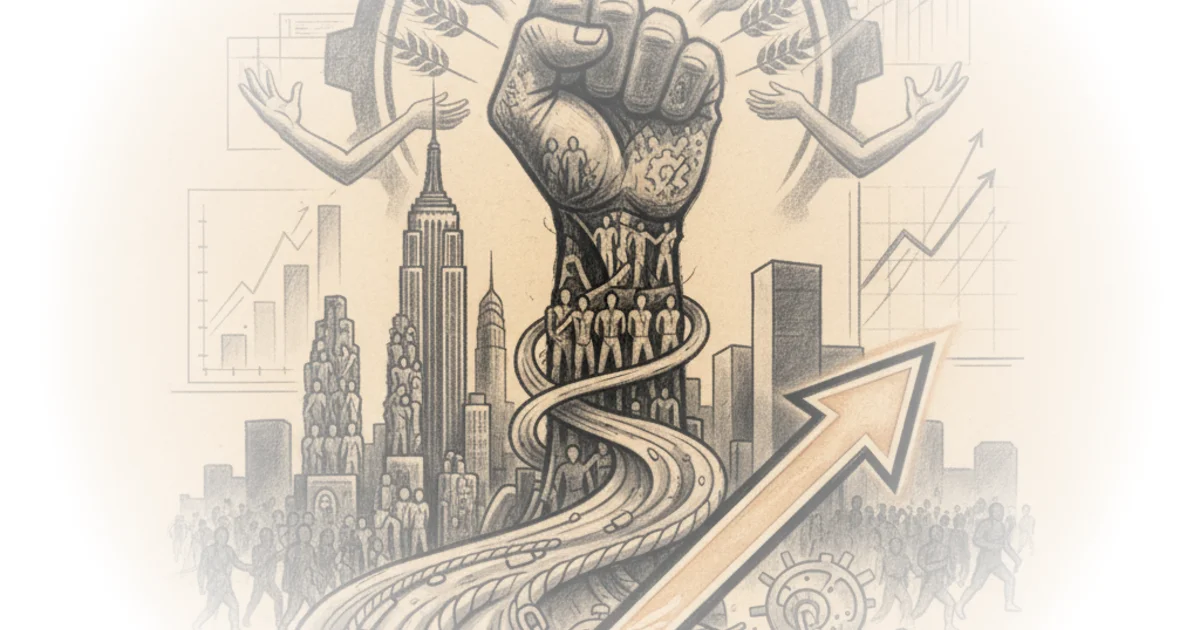
The core of Blanc's argument rests on the idea that the mayor's most potent weapon is communication, not regulation. He suggests that a significant stumbling block is simply that most workers don't realize any job can become a union job. "People assume that certain jobs are union and others are not—end of story," he notes. This observation highlights a critical gap in labor strategy: the failure to educate the workforce on the mechanics of organizing. Blanc proposes that a new administration could use social media to launch a public campaign to educate New Yorkers about why they should unionize, how to do so, and where to get organizing support.
The main thing I hope a new admin does, with its amazing communication reach, is to change the culture around unionization: to make it something not just good, but cool.
This quote, attributed to labor activist David Kim, encapsulates the piece's central thesis. The argument is that visibility breeds viability. By framing unionization as a cultural imperative rather than a bureaucratic hurdle, the administration could galvanize the 60,000-plus volunteers and millions of followers already engaged with the movement. Blanc suggests that even a small fraction of this base starting their own campaigns could generate thousands of new organizing drives. However, critics might note that culture change is notoriously difficult to measure and that without tangible wins, a "cool" campaign could quickly devolve into performative activism.
Leveraging City Contracts
Moving beyond rhetoric, Blanc details how the city can use its massive purchasing power to force labor peace. He points to the 2021 laws regarding Labor Peace Agreements (LPAs), which allow the city to cancel contracts with employers who interfere with unionization. "Unlike much labor law at the federal level, this policy has teeth: if management fails to respect their workers' desires to unionize, the city can cancel their contract and claw back subsidies," Blanc explains. This is a crucial distinction, as federal labor law has been weakened significantly by recent executive actions that have made it harder for workers to act upon their federally guaranteed right to unionize.
The author focuses heavily on the non-profit and care sectors, where the city pays $23 billion in contracts yearly. These industries employ about 80,000 people, many of whom are non-white and female, yet face poverty-level wages. "The average income of New York City child care workers, for example, was only $25,000 in 2023," Blanc writes, highlighting the absurdity that it often pays better to work in fast food than to care for children. By expanding LPAs to cover all workers in establishments receiving city funding, the administration could tap into a massive pool of potential union members, including the 18 percent of the workforce employed by non-profits.
The non-profit industrial complex is ripe for unionization.
This blunt assessment challenges the traditional view of non-profits as inherently benevolent and non-confrontational. Blanc argues that these institutions are often hubs of recent union breakthroughs and that unionization is the key to stopping the city from outsourcing its workforce to bloated executive salaries. A counterargument worth considering is that strict union mandates could reduce the flexibility of non-profits to respond to community needs or increase the cost of services, potentially straining the very budgets they aim to protect. Nevertheless, Blanc maintains that leveling the playing field is essential for the city's long-term stability.
Rebuilding the Trades
The piece also addresses the severe decline in union power within the construction sector, where union density has dropped from 80 percent in 1995 to just 22 percent today. The consequences are dire: on-the-job fatalities have risen while pay has stagnated. Blanc proposes that the city can reverse this by tweaking rules to ensure Project Labor Agreements (PLAs) cover more city-backed projects. He suggests aggregating related construction projects to meet the current $3 million minimum threshold needed to trigger PLAs in New York City, a threshold that is currently double that of surrounding counties.
Furthermore, Blanc highlights the potential of the Construction Justice Act (CJA), which would mandate a reasonable wage floor for affordable housing projects. "Ensuring a minimum hourly wage of $40 would immediately lift a predominantly immigrant workforce out of poverty pay," he argues. This policy would level the bidding playing field between union and non-union contractors, enabling union labor to become the norm again. The author connects this directly to the mayor's promise to triple the city's production of permanently affordable, union-built homes.
It will take a huge increase in grassroots power to force Albany and Governor Kathy Hochul to fund Mamdani's core policy planks for childcare, transport, and housing.
This sentence underscores the political reality that local policy often requires state-level funding. Blanc's argument is that a strong, organized local workforce is the leverage needed to secure those funds. Without a robust union base, the administration lacks the political capital to push through ambitious reforms. The piece concludes by suggesting that a union resurgence could both feed into and feed off of a broader bottom-up movement for an affordable New York.
Bottom Line
Blanc's strongest argument is the pragmatic identification of City Hall's underutilized legal and cultural tools to bypass federal stagnation. The piece's biggest vulnerability lies in its reliance on a specific political figure to execute a complex cultural shift, which may be difficult to sustain without deep institutional support. The reader should watch for how local administrations translate these theoretical levers into actual contract negotiations and public campaigns in the coming months.