Jung's Two Creativities
Maria Popova's excavation of Carl Jung's 1939 essay on creativity arrives at a moment when the creative process has been flattened into content production, algorithmic optimization, and personal branding. What makes this piece notable is Popova's refusal to let Jung's distinction between psychological and visionary creation collapse into the contemporary conflation of creativity with productivity. She restores the mystery.
The Unconscious as Source
Popova opens by establishing creativity as something that draws from depths we cannot fully access. Maria Popova writes, "Creativity is the periscope through which the unconscious looks out onto the world and renders what it sees." This framing positions the artist not as a controller but as an instrument — a channel for something that exceeds individual will.
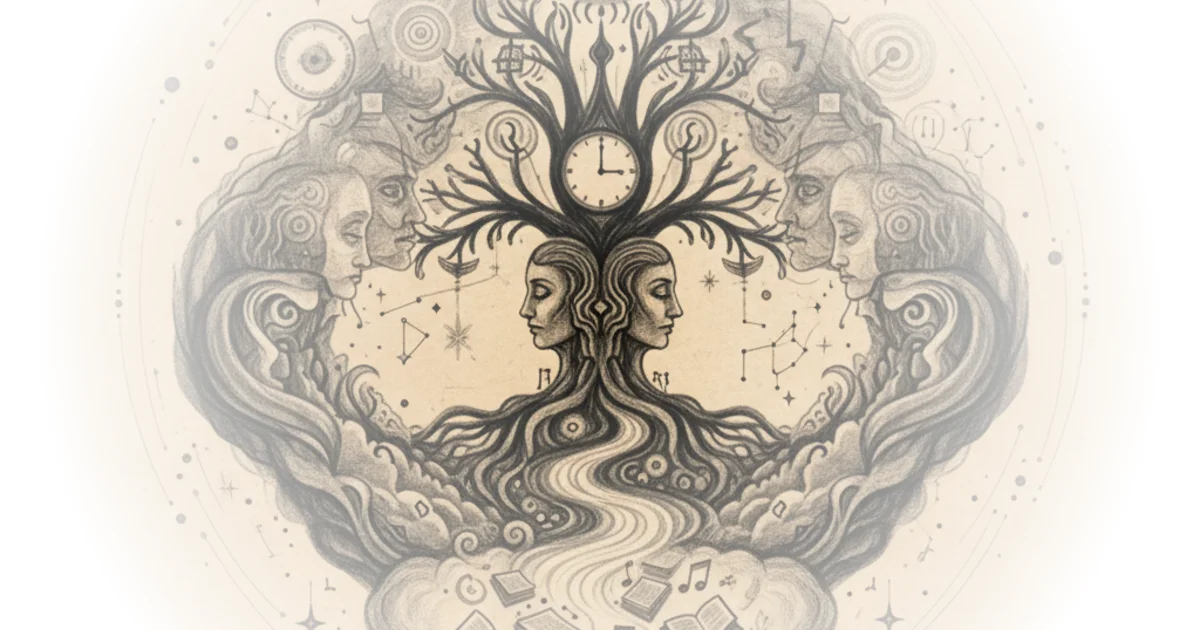
The piece emphasizes Jung's resistance to scientific reductionism even as he worked within psychology's emerging systematic methods. As Maria Popova puts it, "The creative imagination is the only primordial phenomenon accessible to us, the real Ground of the psyche, the only immediate reality… All other realities are derived from and indirectly revealed by it, actually with the artificial aid named science." Popova's editorial choice to foreground this quote signals her argument: creativity precedes explanation.
Psychological versus Visionary
Jung's central distinction — which Popova structures the piece around — separates two modes of creation. The psychological mode works with materials from conscious human experience: emotional shocks, passion, life lessons. These themes "repeat themselves millions of times" and "fully explain themselves."
The visionary mode is different. Maria Popova writes, "It is a strange something that derives its existence from the hinterland of man's mind — that suggests the abyss of time separating us from pre-human ages, or evokes a super-human world of contrasting light and darkness." This is creation that ruptures the ordered surface of reality. Popova connects this to dreams, to nighttime fears, to the "dark recesses of the mind that we sometimes sense with misgiving."
"A great work of art is like a dream; for all its apparent obviousness it does not explain itself and is never unequivocal."
Popova's placement of this quote as a standalone block gives readers space to register Jung's claim that art refuses didacticism. It presents. It does not instruct.
The Collective Unconscious
Here Popova traces Jung's divergence from Freud. While Freud located creativity in personal trauma and neurosis, Jung insisted that great art draws from the collective unconscious — impersonal, ancestral, shared. Maria Popova writes, "Great poetry draws its strength from the life of mankind, and we completely miss its meaning if we try to derive it from personal factors."
This is where Popova's piece takes on contemporary urgency. In an era of confessional content, of art reduced to biographical data points, Jung's insistence on impersonality offers resistance. As Maria Popova puts it, "The artist is not a person endowed with free will who seeks his own ends, but one who allows art to realize its purpose through him."
The Cost of Creation
Popova does not romanticize the creative life. She presents Jung's recognition that the tension between personal happiness and ruthless creative passion produces inherent conflict. Maria Popova writes, "The artist's life cannot be otherwise than full of conflicts, for two forces are at war within him — on the one hand the common human longing for happiness, satisfaction and security in life, and on the other a ruthless passion for creation which may go so far as to override every personal desire."
Critics might note that Jung's framework risks absolving artists of ethical responsibility by positioning them as instruments of impersonal forces. The claim that "the personal life of the poet cannot be held essential to his art" can shield harmful behavior under the mantle of creative necessity.
Critics might also observe that Jung's visionary mode — with its language of "primordial experiences" and "collective unconscious" — invites mystical vagueness that resists falsification. What cannot be tested cannot be refined.
Critics might further argue that Popova's curation, while luminous, does not interrogate Jung's historical moment: a European intellectual tradition that universalized particular cultural assumptions about art, psyche, and meaning.
Bottom Line
Popova's piece restores creativity's mystery without surrendering to mysticism. Her editorial judgment — selecting Jung's most lucid passages, structuring them around the psychological/visionary distinction, refusing to resolve the tension — makes this a durable intervention. The verdict: essential reading for anyone who creates or consumes art in an age that demands explanation over experience.