Matt Stoller reframes the current moment not as a clash of personalities, but as a fundamental spiritual war over the definition of humanity itself. By juxtaposing the Vatican's latest encyclical against the trillion-dollar valuation of SpaceX, he exposes how financial markets are currently pricing in a fantasy of human obsolescence rather than economic reality. This is a necessary intervention for anyone trying to discern whether the "efficiency" promised by Silicon Valley is actually solving problems or merely inflating bubbles built on the denial of human limits.
The God Complex vs. Human Limits
Stoller argues that the dominant figure in our political economy, Elon Musk, is not primarily a technologist but a salesman of a specific theological fantasy: transhumanism. He writes, "Musk is compelling because he offers a vision, a temptation really, of a world in which we can become God-like." This framing cuts through the usual chatter about rocketry and electric cars to identify the core appeal of Musk's empire: it promises an escape from the very things that make us human. The author notes that while SpaceX performs tasks similar to what NASA achieved in the 1950s, its valuation is driven by a narrative of "becoming more than human," a concept rooted in the Silicon Valley belief that we can use technology to transcend death and disease.
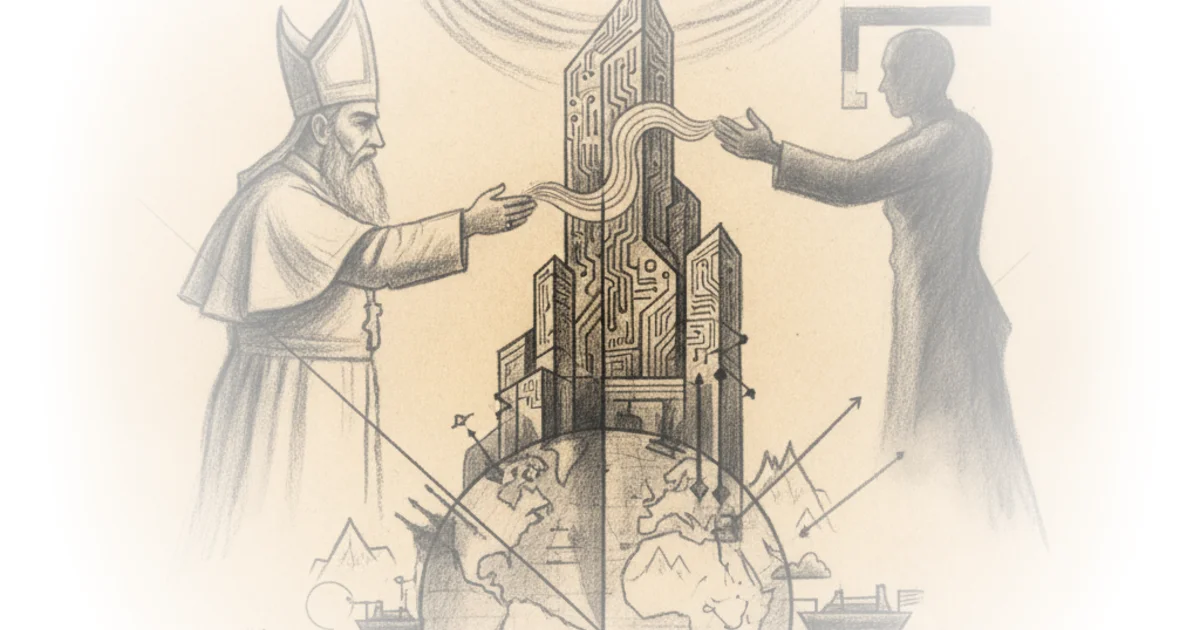
The commentary highlights how this worldview treats suffering not as an inevitable part of life, but as a defect to be engineered away. Stoller points out Musk's own description of his children as a "legion" and his stated goal to reach "legion-level before the apocalypse," suggesting a megalomania that views population growth as a military strategy for survival. This is not just business; it is a rejection of the natural order. The author observes, "He seeks to end aging, death, and disease," but frames this ambition as a dangerous delusion that ignores the reality that our humanity matures through vulnerability.
When efficiency becomes the ultimate measure of value, human beings are tempted to see themselves as a project to be optimized rather than as persons called to relationship and communion.
This argument gains significant weight when contrasted with the recent encyclical from Pope Leo XIV (Robert Francis Prevost), the first American-born pontiff. Stoller positions the Pope's document, "On safeguarding the human person in the time of artificial intelligence," as the direct counter-argument to Musk's philosophy. The Pope asserts that AI is merely "a form of statistical adaptation based on data and feedback" that does not imply inner growth or a new stage of humanity. Stoller writes that the encyclical serves as an "anti-Musk argument," insisting that social justice must shape technology from its design phase, not be applied as an afterthought.
Critics might argue that the Pope's stance is too abstract to compete with the tangible utility of modern tech giants, but Stoller counters that this abstraction is precisely where the moral danger lies. The author notes that the Church's influence comes from an "ancient view that mankind is not different," a perspective that has survived centuries because it acknowledges limits. By treating human vulnerability as a "reality through which our humanity matures," the Pope offers a framework that challenges the technocratic assumption that every problem has a silicon solution.
The Mechanics of the Bubble
Beyond the philosophical clash, Stoller dives into the financial mechanics that allow this fantasy to persist at such massive scales. He argues that Musk's wealth is not a reflection of genuine economic value creation but rather the result of "self-dealing and rigged markets." The author points to a specific, glaring example: Google signing a deal to pay SpaceX $11 billion annually for compute capacity simply because Google owns 5% of SpaceX. Stoller writes, "Since Google owns 5%, it means Google spent $10 billion to increase its investment by $50 billion. Not bad!"
This transaction, the piece suggests, is less about the need for computing power and more about engineering a profitable narrative to satisfy index funds. The author explains that Musk needed SpaceX to meet Generally Accepted Accounting Principles (GAAP) profitability rules to be included in the S&P 500, prompting this artificial revenue injection. Stoller writes, "The conflicts of interest here suggest that's the wrong question," regarding whether Google actually wants the compute; the real issue is how financial markets are disconnected from underlying economic reality.
The idea he is worth a trillion dollars is comical, but also dangerous.
Stoller extends this critique to the broader market, noting that Tesla sells fewer cars than Toyota yet holds a valuation nearly five times higher. He argues that unlike other tech oligarchs whose companies generate real cash flow, Musk's empire relies on "fables of giving humanity superpowers" to maintain its overvaluation. The author suggests that this is a psychological trap for both the CEO and his fans: they must keep telling fantastical lies about multi-planetary species and space data centers just to prevent the bubble from bursting.
A counterargument worth considering is that Musk's companies are indeed pioneers in high-risk industries where traditional metrics fail to capture long-term potential. However, Stoller pushes back by noting that for every genuine success like Starlink, there are "fake enterprises" like the Boring Company or inflated claims about user engagement on Twitter. The author concludes that the market is rewarding a narrative of godhood rather than actual productivity, creating a system where "efficiency" is just a cover for monopoly power and wealth extraction.
The Cost of Denying Limits
The piece ultimately circles back to the human cost of this economic model. Stoller argues that when we accept the premise that limits are defects, we lose the ability to build communities based on love and relationship. He writes, "We can only choose to accept that with limits is a touch of the divine, and build lives and communities with love." The alternative, he warns, is to "pretend to be Gods, and act like sociopaths," a path that may yield temporary financial gains but leads to social fragmentation.
The author connects this spiritual crisis to broader political movements, noting that the fight between capital efficiency and human dignity animates most modern conflict. Whether it is Amazon's low prices masking high costs elsewhere or the "Gulag-like" atmosphere at Meta, Stoller sees a consistent pattern: the pursuit of optimization often comes at the expense of human well-being. He writes, "The Pope and Musk aren't the only ones having this debate, of course. We all are."
A more moral AI is not enough if that morality is determined by a few.
This final point underscores the danger of concentrating power in the hands of a few technocrats who claim to know what is best for humanity's future. Stoller suggests that true wisdom lies in remembering "ancient truths that transcend the NASDAQ," rather than chasing the next speculative boom. The article serves as a stark reminder that while markets can be manipulated and narratives spun, the fundamental realities of human existence—suffering, death, and vulnerability—remain unchanged.
Bottom Line
Stoller's strongest move is reframing the Musk phenomenon not as an economic success story but as a theological crisis where financial markets are betting on the end of human nature. The argument's greatest vulnerability lies in its heavy reliance on spiritual and philosophical premises that may alienate readers seeking purely data-driven policy solutions, yet it successfully exposes the fragility of valuations built on narrative rather than cash flow. Readers should watch for how this tension between "efficiency" and humanity plays out as regulatory bodies like the S&P 500 committee confront the reality of artificially inflated tech giants.