More Perfect Union exposes a financial sleight of hand that is quietly draining household budgets: the massive energy demands of artificial intelligence are being subsidized by ordinary ratepayers, not the tech giants driving the boom. The author's most striking claim is that while your personal electricity usage may be dropping, your bill is soaring because utilities are socializing the cost of building gigawatt-scale infrastructure for Amazon and Meta. This is not a distant future problem; it is a hidden transfer of wealth happening right now on your monthly statement.
The Invisible Surge
The piece opens with a relatable, jarring observation from a resident in Northern New Jersey who noticed her bill rising even as her usage fell. More Perfect Union writes, "To me, honestly, it felt almost like a slap in the face to use less energy and then get charged more for it." This anecdote serves as the entry point to a much larger structural issue. The author argues that the current utility business model, designed over a century ago to spread costs across all users, is now being exploited to fund private profit centers. The core of the argument is that the system is broken because it allows utilities to build expensive new power plants to serve data centers, then charge residential customers for the bulk of that infrastructure.
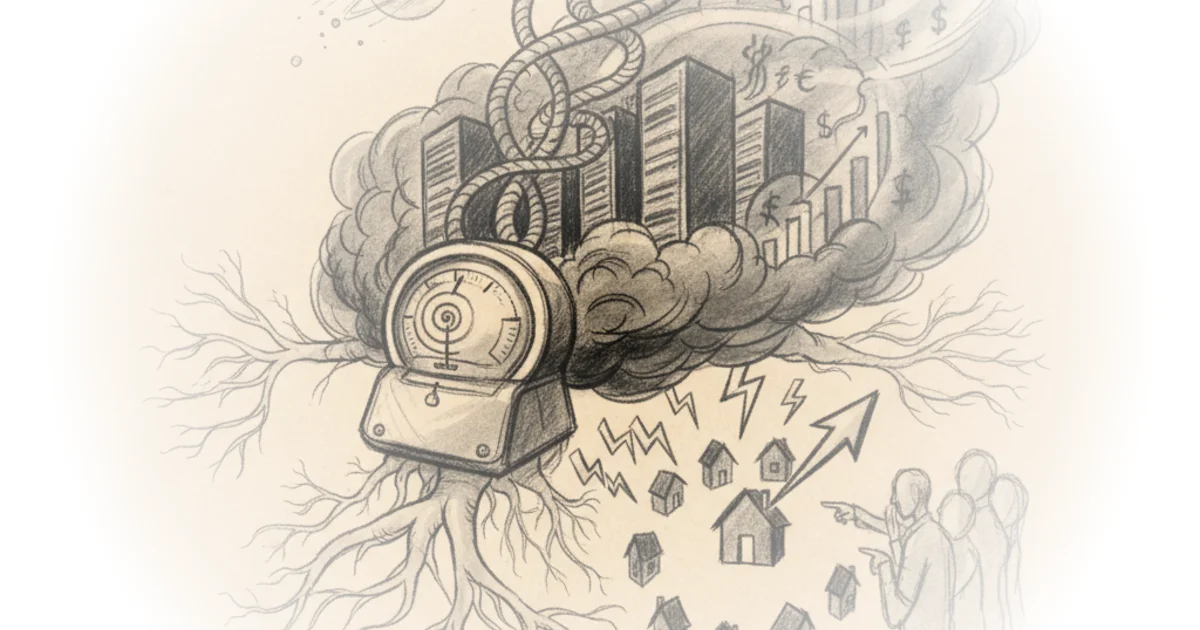
The evidence presented suggests this is a coordinated strategy rather than an accident. As More Perfect Union puts it, "Companies like Amazon and Meta striking secret deals with utilities... It's all proprietary. It's all behind non-disclosure agreements and blacked out documents." This lack of transparency is central to the author's critique. By keeping the terms of these deals hidden, tech companies can negotiate sweetheart rates while the public foots the bill for the necessary grid upgrades. Critics might note that utilities often argue these deals are necessary to attract investment and keep the grid stable, but the author effectively counters this by highlighting the sheer scale of the subsidy.
The Economics of AI
The commentary shifts to the sheer magnitude of energy required for modern artificial intelligence. The author explains that training AI models is akin to running a massive power plant, with some proposed facilities consuming as much energy as a nuclear reactor. More Perfect Union notes, "In 2025, the tech industry is expected to spend about $475 billion on data centers, up 42% since last year." This explosive growth is outpacing the grid's ability to adapt without drastic cost increases. The author points to the PJM Interconnection, a massive regional grid operator, where capacity auction prices jumped by 800% in a single year.
The direct link between these market spikes and consumer bills is made explicit. "Data centers were responsible for 63% of last year's price increase," the author states, citing an independent monitor. This statistic is the piece's smoking gun. It moves the conversation from abstract corporate greed to a concrete financial impact on the average household. The author argues that this is a "hidden wealth transfer," where the profits of the wealthiest corporations are being insulated from the costs of their operations. A counterargument worth considering is that the grid needs this investment regardless of who uses it, but the author dismantles this by showing that residential demand has flatlined while data center demand is skyrocketing.
We are all subsidizing the wealthiest corporations in the world and their pursuit of artificial intelligence.
The Political Battle
The final section of the coverage examines the legislative fight to stop this subsidy. The author highlights successful efforts in Maryland and Oregon to create a new customer class specifically for data centers, which would force them to pay their own way. However, the resistance from big tech is formidable. More Perfect Union writes, "The Data Center Coalition is opposing these efforts at state capitals across the country... In Virginia last year, its pack gave over $2 million to state legislators." The author frames this as a direct conflict between corporate lobbying and public interest.
The stakes are described as incredibly high for the average consumer. "If policymakers fail to change anything, by one estimate, electricity rates for average households will spike by as much as 70%," the author warns. This projection underscores the urgency of the piece. The argument is that the current path is unsustainable and that the political will to fix it is being bought off by the very industries causing the problem. The author's tone here is one of alarm, urging readers to recognize that their electric bill is the frontline of a battle over who pays for the future of technology.
Bottom Line
More Perfect Union's strongest asset is its ability to connect the abstract concept of "AI infrastructure" to the tangible pain of a rising electric bill, making a complex regulatory issue immediately personal. The piece's biggest vulnerability lies in its reliance on projected future costs and specific state-level examples, which may not perfectly translate to every region's utility structure. However, the underlying economic logic—that socializing the costs of private profit centers is unsustainable—is a compelling argument that demands immediate policy attention.