The most famous poster in recent animation history — the one that launched The Boy and the Heron to Ghibli's biggest Japanese opening without a single trailer or television spot — turns out to be a cropped fragment of a pencil-and-watercolor sketch Hayao Miyazaki dashed off as casually as a grocery list. Animation Obsessive traces the full arc of that habit: six decades of concept sketches, image boards piling up in studios and sketchbooks, ideas recycled, reimagined, and finally realized on screen.
What an Image Board Actually Is
The term gets lost in translation. Animation Obsessive explains that the Japanese imēji bōdo borrows its words from English but carries a different meaning — "imēji" referring not to a visual image but to something closer to a mental impression, an idea taking shape. The result is that Miyazaki's image boards are concept art in the fullest sense: not storyboards, not continuity sketches, but a private visual thinking process made physical.
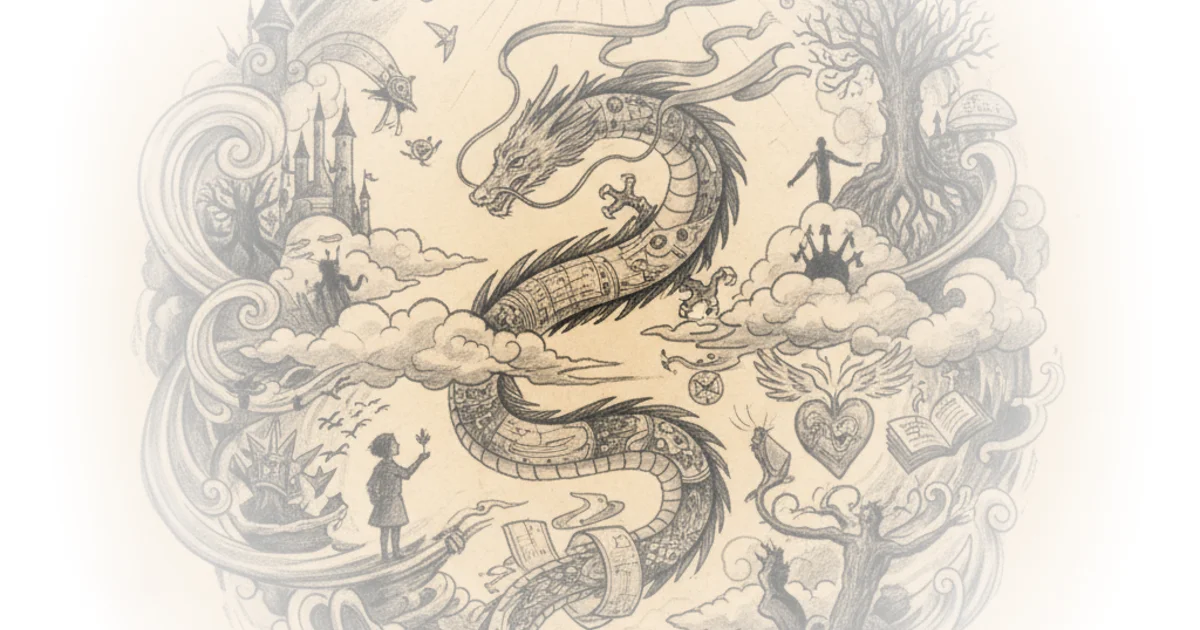
Miyazaki himself offered the clearest description of the method. As Animation Obsessive quotes him: "An image board is something drawn to prepare for a work." He traced the habit back to Horus: Prince of the Sun (1968), the debut feature by his close collaborator Isao Takahata, where boards were pinned to studio walls so anyone passing through could form a feel for the project. "People who were participating in the preparation and those who weren't could freely take a look at it," Miyazaki recalled, "and go, 'This is going to be interesting,' or, 'This is no good.'"
That communal function matters. The image board was never purely private. It was a communication device — faster and more evocative than a pitch document, more flexible than a storyboard. It let a director share the emotional texture of a project before the project existed.
Speed Over Finish
The technique Miyazaki developed and has used without significant modification for over sixty years is deliberately unpolished. Animation Obsessive quotes his description of the process: "the idea is not to spend an infinite amount of time creating these things, but to do them as quickly as possible... I first draw in pencil, and then quickly trace over that with watercolor, all the while trying to render as many images as possible, with as little effort as possible [laughs], as fast as possible."
That bracketed laugh is telling. Miyazaki understood the apparent absurdity of a master craftsman advocating for sloppiness. But the logic is sound: the image board is a thinking tool, not a finished artifact. Slowness introduces self-consciousness. Speed captures the thing before the critical mind can interfere. His earliest Horus sketches, the piece notes, were rough enough to read as frenzied — "as if he'd jabbed them onto the page." Colleague Yasuo Otsuka, recalling that era, wrote that "no matter how much I drew, my drawing skill couldn't match Miyazaki-san's." The energy compensated for the roughness, and eventually the roughness became purposeful.
Critics might note that this aesthetic of productive carelessness is harder to teach or replicate than Miyazaki's account suggests. His "quick and simple" sketches were already demonstrating a cinematic eye that contemporaries at Toei found difficult to match. The method and the talent are inseparable — the technique works because the imagination behind it is exceptional, not the other way around.
The Decade of Frustration That Built Everything
The most revelatory section of Animation Obsessive's piece concerns the mid-1970s, when Miyazaki spent years executing layouts for Takahata's television productions — Heidi: Girl of the Alps, 3,000 Leagues in Search of Mother — and grew increasingly miserable. Takahata was moving toward naturalism, away from fantasy, and Miyazaki felt the distance. "After Heidi, I didn't have my whole heart in my work," he said. He felt that he "lost sight of [his] own themes."
But he kept sketching. On the side, disconnected from any production, he was accumulating image boards for ideas that had nowhere to go yet. Around this period — the mid-1970s — he drew the bus stop scene in the rain that would eventually appear in My Neighbor Totoro. More than a decade before the film existed. The image board as time capsule.
Animation Obsessive frames the Totoro origin as an extension of the Panda! Go, Panda! sensibility: easygoing, big-hearted, designed to make those around the character happy simply by existing. Miyazaki made the connection explicit: "Panda is a very big-hearted, easygoing character. He makes those around him happy just by being there, without doing anything in particular. In that respect Totoro and Panda are similar for me." The implication is that Miyazaki's most beloved creation grew from a period of professional dissatisfaction — that the suppressed creativity had to go somewhere, and it went into these casual sketches.
The Near-Miss Years and the Accumulation That Followed
By 1980, Miyazaki was approaching forty and had directed a television series that achieved middling ratings and a feature film that flopped. His self-assessment of The Castle of Cagliostro is as honest as any filmmaker's public accounting of creative exhaustion: "The Castle of Cagliostro was like a clearance sale of all I had done on Lupin and during my early Toei days. I don't think I added anything new... Nineteen eighty was my year of being mired in gloom."
What saved him was the image boards — or more precisely, the habit of producing them regardless of whether they connected to anything real. Animation Obsessive cites the book Nausicaä of the Valley of the Wind: Watercolor Impressions to note that "the drawings Miyazaki accumulated between 1980 and 1982 formed the basis of all his work, from Nausicaä of the Valley of the Wind to Princess Mononoke." The entire second act of his career — the Ghibli films that define his legacy — grew from sketches made when he had no obvious future.
New influences arrived in this period. The underground comics sensibility of Moebius and Richard Corben began appearing in the image boards. Miyazaki encountered the animation of Frédéric Back and Yuri Norstein and found it deeply unsettling — not because it was bad but because it revealed richness he hadn't known was possible. "It made him feel inadequate, and pushed him," the piece observes. The cartoon ambitions of Future Boy Conan and Cagliostro gave way to something more layered, and the shift was visible in the concept sketches before it reached the screen.
The failed Little Nemo Hollywood collaboration — an extended project in which every idea Miyazaki proposed was rejected — paradoxically served as a forcing function. "I ended up trying out all the different motifs I'd been carrying around with me," he said of the project. Each rejection refined the idea. By the time Nausicaä reached theaters in 1984, it was no longer a cartoon in the sense he had previously understood.
Continuity Across Sixty Years
One of Animation Obsessive's more striking observations concerns a specific visual motif — a U-shaped arrowhead — that appears in a proto-Nausicaä image board from the early 1980s and resurfaces, more than four decades later, in The Boy and the Heron. The image board as long-term memory. Miyazaki doesn't simply recycle visual ideas; he maintains them across decades, allowing them to evolve and find their proper context.
The piece tracks this tendency with care. Visual ideas from the unmade Pippi Longstocking project reappeared in Panda! Go, Panda!. A floating castle sketch from the early 1980s became Castle in the Sky. The Totoro bus stop drawing, made a decade before the film, was "realized on film — just deeper and richer now." The image board is not a dead end but a holding pattern — a way of preserving an idea until the right project arrives.
Critics might argue that this retrospective framing makes the creative process look more coherent than it was in the moment. It is easy, looking backward, to see the Totoro bus stop sketch as a harbinger. Living through the mid-1970s frustration, with no guarantee of Nausicaä or Ghibli anywhere on the horizon, the connection would have been invisible. The image boards are only legible as a continuous archive because of what came after.
The Poster That Proved the Point
Animation Obsessive closes the main argument with an anecdote that functions as a kind of proof. When producer Toshio Suzuki was designing the Japanese poster for The Boy and the Heron, he landed on something unusual — an image that Miyazaki himself, notoriously difficult to satisfy, actually praised. Suzuki recalled the moment: "I've been doing movies since, what, Nausicaä of the Valley of the Wind, and that poster is the first thing Hayao Miyazaki has ever really praised me for. He said, 'Suzuki-san, this is amazing.'... He said it was the best I've done."
The decision that followed — no trailers, no television spots, no newspaper advertisements — was one of the more audacious marketing gambles in recent film history. It worked: the film achieved Ghibli's biggest Japanese opening. And what appeared on that poster was a carefully cropped fragment of one of Miyazaki's image boards. A sketch tossed off in pencil and watercolor, not intended as finished art, became the public face of his final film.
The irony is complete. Miyazaki spent sixty years being self-deprecating about these casual drawings — joking, as Animation Obsessive notes, through a cartoon pig character that his watercolor method was "all he can do," inviting a caterpillar and a dog to mock the crudeness. And the most praised thing he gave to his longest creative partner was one of those sketches, reproduced at poster scale, seen by millions.
"The drawings Miyazaki accumulated between 1980 and 1982 formed the basis of all his work, from Nausicaä of the Valley of the Wind to Princess Mononoke."
What Speechify Listeners Should Know
Animation Obsessive is writing for an audience that already loves animation, and the piece assumes familiarity with the Ghibli filmography. For readers encountering this material fresh: Miyazaki's career breaks into roughly three phases — the Toei and Takahata apprenticeship years (1963–1978), the transitional period and early Ghibli features (1979–1989), and the mature Ghibli run through The Boy and the Heron (1997–2023). The image boards thread through all three phases, providing continuity that the films themselves, so different in tone and style, do not.
One counterpoint worth registering: the piece focuses almost entirely on Miyazaki's image boards as individual creative output, largely setting aside the question of collaboration. Other artists on Horus also drew image boards; the studio environment that pinned them to walls was collective. Miyazaki himself acknowledges that Takahata's projects, however frustrating, shaped his sensibility. The image board habit may be deeply personal, but the creative ecosystem that gave it meaning was built with others.
Bottom Line
Animation Obsessive has written one of the better accounts of Miyazaki's working method — grounded in primary sources, attentive to chronology, and honest about the long periods of frustration that preceded his greatest work. The piece's central argument, that the image board is not incidental but foundational to everything Miyazaki has made, holds up: the bus stop sketch drawn in obscurity in the mid-1970s, the Nausicaä-era accumulation that became half of Ghibli's catalog, the poster fragment that launched his final film — the evidence is consistent. The habit of jotting down ideas quickly, without pressure toward finish, turns out to be one of the more durable creative practices in the history of the medium.