In an era where parents are increasingly told to ban smartphones to save their children's mental health, Peter Gray offers a jarringly different perspective: the device itself may be a lifeline, not a poison. Drawing on a fresh, large-scale survey from Florida, Gray challenges the prevailing narrative that digital access inevitably breeds anxiety, arguing instead that for children aged 11 to 13, ownership correlates with higher self-esteem and lower feelings of meaninglessness. This is not a dismissal of risk, but a rigorous pushback against the idea that isolation is the default path to safety.
The Safety and Autonomy Argument
Gray opens not with data, but with a visceral personal anecdote that reframes the smartphone from a distraction to a survival tool. He recounts a serious cycling accident where his phone was the only thing that prevented him from being stranded overnight with a fractured pelvis. "Without the phone I might have been there for hours, maybe even overnight, before someone found me," he writes, establishing the device as a critical safety net for independent exploration. This framing is crucial because it shifts the conversation from "screen time" to "autonomy time." By linking the phone to physical freedom, Gray suggests that removing the device effectively cages children, denying them the very independence required for psychological growth.
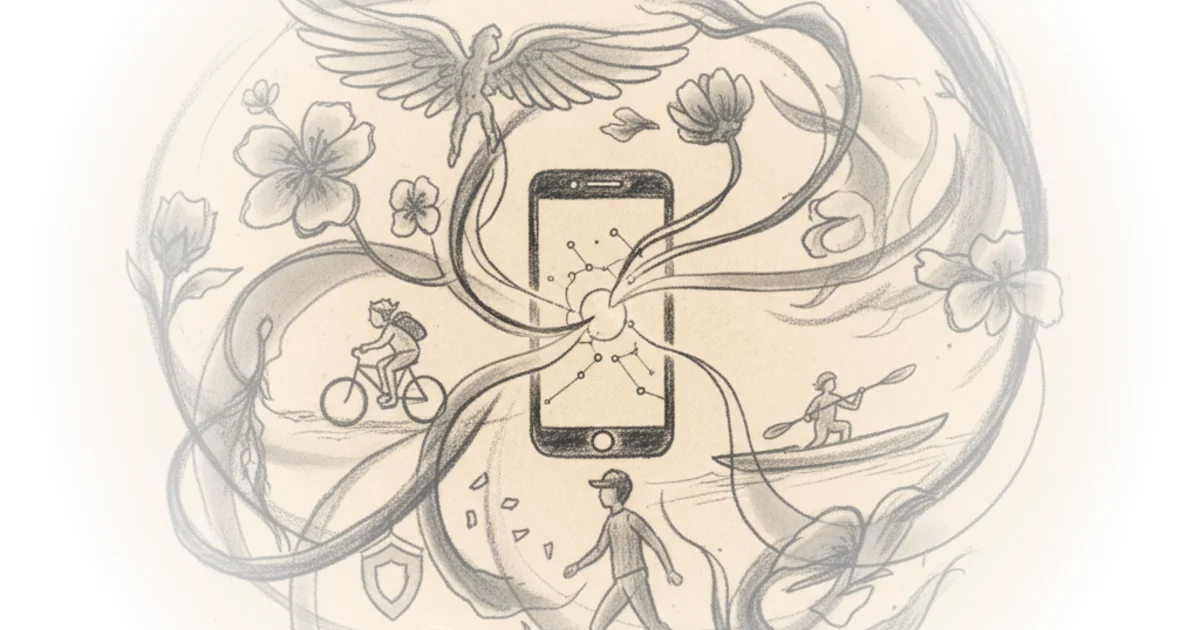
He extends this logic to the realm of self-directed learning, a concept central to his broader body of work. Gray describes using apps to instantly identify wildflowers or verify ideas while walking, turning the outdoors into an interactive classroom. "The smartphone is, without question, the most powerful educational tool ever invented," he asserts. This argument resonates with historical shifts in autodidacticism, where the democratization of knowledge has always been tied to portable media—from the printing press to the pocket calculator. The device, in Gray's view, does not replace the world; it deepens the user's engagement with it.
The route to protecting children is not to deprive them of freedoms to play and explore independently, neither in the physical world nor the online world, but to teach safety rules.
The Florida Study and the Correlation Trap
The core of Gray's piece rests on "The Life in Media Survey," a 2025 study by researchers at the University of South Florida involving 1,510 children aged 11 to 13. The findings are stark and counterintuitive to the mainstream media narrative. Gray highlights that children with smartphones were less likely to feel life was meaningless (18% vs. 26%) and less likely to report frequent anger or depression compared to their non-owning peers. "On almost every question, those who owned a smartphone were found to be better off than those without," he notes, emphasizing that these benefits held true across all income levels.
This data directly contradicts the alarmist literature that often drives parental anxiety. Gray points out that the study found no evidence that getting a phone earlier than age 11 caused harm, nor did it show that internet access was the culprit. Instead, the data suggests that smartphones facilitate in-person socialization and provide a vehicle for self-expression. "The smartphone helps kids get together physically; it helps them keep in touch with friends when they can't be together physically," he explains. This distinction is vital: the device is a bridge, not a barrier.
However, a counterargument worth considering is the direction of causality. Gray himself acknowledges this in his addendum, noting that it is plausible that psychologically healthier children are simply more likely to be granted a smartphone by their parents. "It seems plausible, for example, that kids who are psychologically healthier to begin with would be more likely to be given a smartphone than other kids," he concedes. While the correlation is strong, the study's cross-sectional nature means we cannot definitively say the phone caused the well-being, only that the two are linked. This nuance is essential for a complete picture, even if it doesn't fully dismantle Gray's main thesis.
The Real Danger: Public Posting, Not Ownership
Gray does not ignore the risks of technology; he simply redefines where they lie. The study did identify a negative correlation, but it was not with ownership or general use. Instead, the issue was "frequent public posting on social media." Gray challenges the assumption that posting causes depression, suggesting the reverse may be true: "It seems more likely that the causal direction is the other way around: depression and anxiety result in increased public posting."
To support this, he cites longitudinal research, including a 2021 study of teens in outpatient treatment for suicidality, which found that increased social media use actually correlated with improvement in mental health over time. "Among adolescents who are at high risk for suicide, social media may be indicative of adaptive or healthy social engagement," Gray quotes. This reframing is powerful. It suggests that for vulnerable youth, the public square of social media can be a place of connection and coping, rather than the source of their distress. The problem, then, is not the tool, but the specific behavior of broadcasting one's pain to a wide, unmoderated audience.
Treating them as stupid may make them stupid. And treating them as untrustworthy may make them untrustworthy.
Bottom Line
Peter Gray's argument is a necessary corrective to the moral panic surrounding youth technology, grounding the debate in data that shows smartphone ownership correlates with better mental health outcomes for pre-teens. His strongest move is reframing the phone as a tool for autonomy and safety rather than a source of addiction. The argument's biggest vulnerability remains the causal ambiguity of the Florida study, which Gray admits but does not fully resolve. Readers should watch for future longitudinal research that can definitively untangle whether phones create well-being or simply attract children who are already well-adjusted.