The Arithmetic of Oligarchy
In the 2024 federal election cycle, total dark money spending hit a record $2 billion, doubling from 2020. The crypto industry alone has stockpiled nearly $200 million for the upcoming midterms. Elon Musk gave roughly $300 million to Republicans. These are large numbers by any ordinary standard. But as Hamilton Nolan argues in his latest piece, they are rounding errors compared to what the ultra-wealthy could actually deploy.
Rich people and corporations have not even begun to spend what they are capable of spending in order to buy political influence. If you think that we have too much money in politics now, well, it can get much, much worse.
That is the central provocation. Not that money in politics is corrupting, which is old news, but that the corruption so far represents a tiny fraction of its theoretical ceiling.
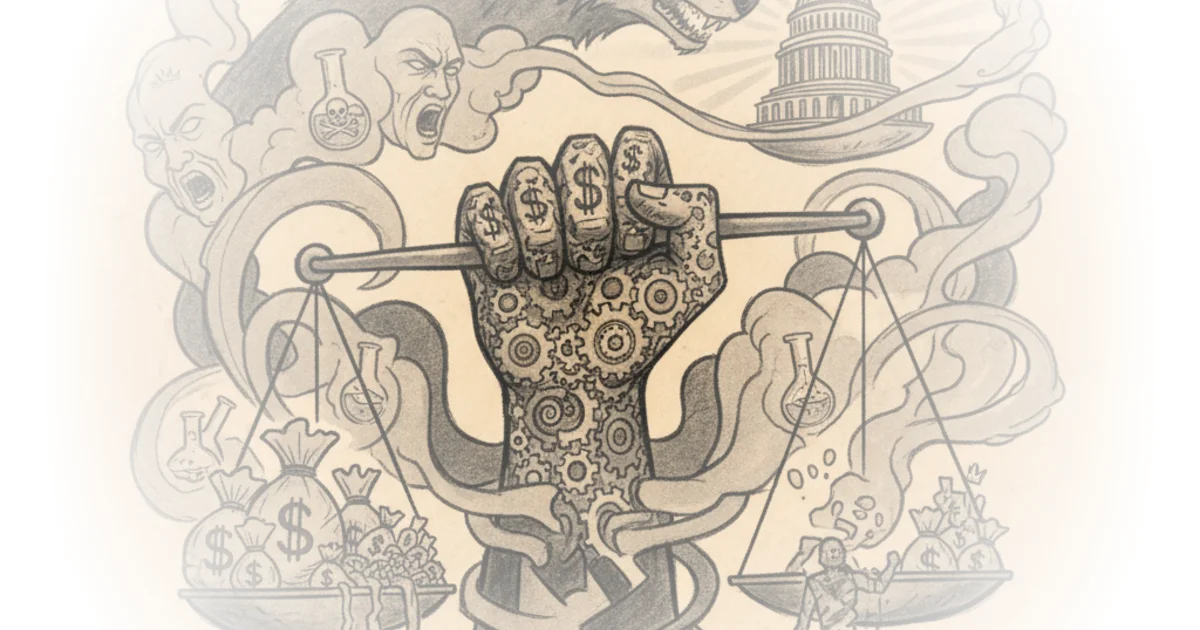
Pocket Change at the Top
Nolan's most effective move is translating billionaire donations into proportional terms. Musk's $300 million, the single largest individual contribution in the cycle, amounts to 0.035 percent of his $845 billion net worth.
That is the equivalent of a $77 donation from an American with the median net worth of $193,000.
The implication lands hard. The donation that made Musk the most feared figure in national politics cost him less, proportionally, than dinner for two costs a median household. Nolan extends the logic to other mega-donors. Miriam Adelson's $150 million to Republicans was 0.4 percent of her fortune. Ken Griffin's $108 million was 0.2 percent of his.
There is zero lifestyle difference between having $40 or $50 billion, but there is a great difference in potential power between spending $100 million on politics, or a hundred times that.
The math checks out. At these wealth levels, even billion-dollar political expenditures would barely register on a personal balance sheet.
Corporate Spending Has Room to Grow
Nolan extends the argument from individuals to corporations, and this is where the scale becomes genuinely staggering. Goldman Sachs estimates that AI companies will spend over $500 billion on infrastructure buildout in 2026. Their main lobbying super PAC raised $125 million last year.
What, do you think, would be a reasonable amount to spend to protect a $500 billion investment if these companies truly believed that it were threatened? It would be foolish not to be willing to spend, you know $100 billion or more, if it seemed to be a political necessity.
Meta's $65 million investment in fighting state-level AI regulations is, by this logic, restrained. Nolan asks readers to consider what $65 billion in political spending would look like. The restraint exists only because, in his telling, the industry does not yet perceive a serious threat.
The level of corporate spending today -- high enough, of course, to make the tech industry one of the most powerful players in Washington -- is only as low as it is because they do not perceive any serious threat on the horizon that would call for the spending to be higher.
The Structural Trap
Nolan traces the problem back to the 2010 Citizens United decision, which removed most meaningful caps on political spending. He describes a self-reinforcing cycle: money buys political power, which protects the money's freedom to keep buying more.
Any legislative attempts to pass a law rolling back the harms of Citizens United will itself run into -- haha! -- a wall of spending to block it. Therefore there are virtually no structural impediments to the increase of political spending, and the increasing capture of politics by money, as far as the eye can see.
This is the piece's bleakest passage, and it is difficult to argue with on its own terms. The mechanism he describes is real. Campaign finance reform legislation routinely dies in committee, outspent by the very interests it would constrain.
Where the Argument Thins
Nolan's solution is organized labor. Unions, he argues, are the only institutional counterweight to organized capital. He is not wrong that unions represent one of the few non-billionaire power structures in American politics. But the piece somewhat undersells the difficulty of the path it prescribes. Union membership in the private sector sits below seven percent nationally, and the legal and corporate obstacles to organizing have only intensified. Saying "get millions more Americans into unions" as a counter to trillion-dollar capital pools is easier declared than executed.
There is also a tension in the argument worth noting. Nolan acknowledges that money cannot buy everything, citing Bloomberg's failed presidential bid. But this concession sits uneasily alongside the rest of the piece, which argues that money's power over politics is nearly unlimited and growing. Both things can be partially true, but the piece does not fully reconcile them.
Money is very effective at bribing politicians and creating propaganda, but it is somewhat less effective for buying the enthusiasm of the people. That is an arena in which organized people power can compete with organized money, and win.
Following the Money as Journalism
One of Nolan's sharper asides concerns political journalism itself. He argues that tracking donor money is more revealing than covering polls or campaign narratives.
A large majority of political communications are just a heap of bullshit covering up various implied obligations in return for payment. Everyone kind of understands this in the abstract, yet the power of narrative on the human mind is so strong that people would find it grotesque if this were the dominant frame of reporting.
This is a point worth dwelling on. The gap between how political journalism is practiced and what would actually inform voters is enormous. Follow-the-money reporting exists, at outlets like Sludge and OpenSecrets, but it remains niche compared to the horse-race coverage that dominates mainstream media.
Bottom Line
Nolan's core contribution here is not the familiar complaint that money corrupts politics. It is the unsettling reminder that current spending levels represent a fraction of what is financially possible. When the richest man on earth can reshape national politics for the equivalent of a $77 donation, and when corporations treat nine-figure lobbying budgets as incidental costs, the system is not at its breaking point. It is still warming up. Whether organized labor can realistically counter that kind of financial gravity is an open question, but Nolan is right that the scale of the problem deserves to be understood before solutions are debated.