This piece arrives with a startling thesis: the chaotic, niche world of 1970s fan fiction has not just survived the internet, it has consumed the entire entertainment industry. Jaime Brooks argues that the transition from underground "filk" circles to billion-dollar AI licensing deals isn't a story of corporate co-option, but of a subculture finally becoming the mainstream. For the busy listener tracking where culture is heading, this offers a crucial map of how fan labor evolved from a hobby into the primary engine of modern capitalism.
The Death of the Niche
Brooks anchors her narrative in the recent passing of Leslie Fish, a figure who embodies the raw, unpolished energy of early fandom. She describes Fish as a "militant shitposter until the very end," a characterization that immediately reframes the artist not as a distant icon, but as an active, combative participant in her community. Brooks writes, "She was publishing erotic fan fiction about Star Trek characters decades before the World Wide Web existed." This detail is vital; it establishes that the impulse to remix and reclaim corporate narratives predates the digital tools we now take for granted.
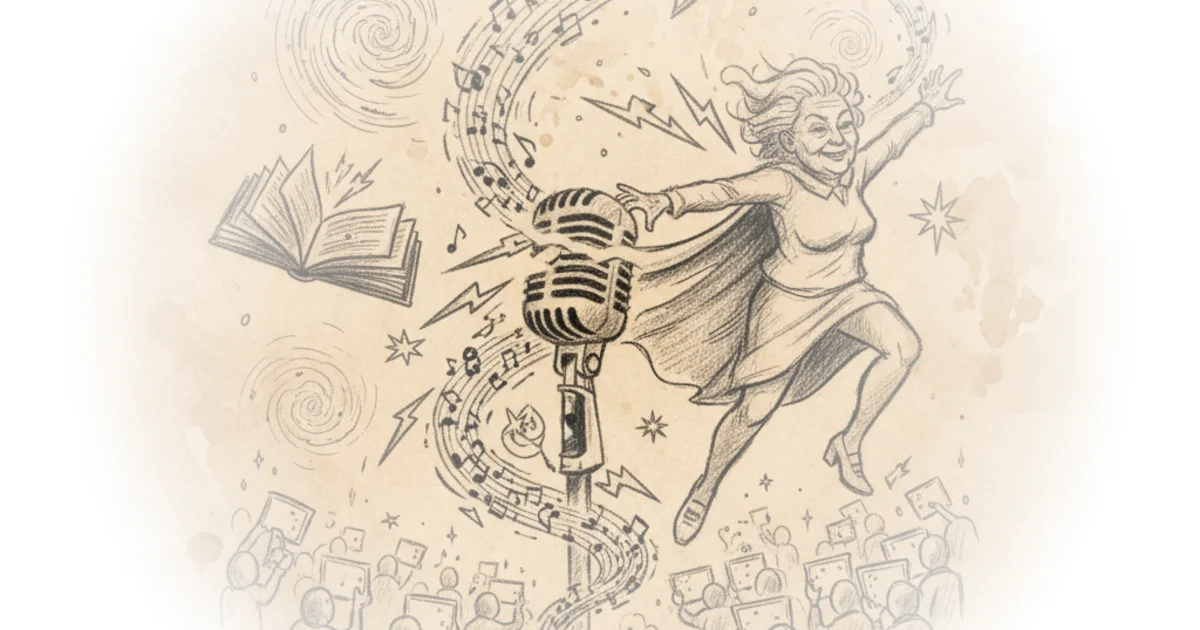
The author draws a sharp line between the "Great Folk Scare" of the 1960s and the emergence of filk, noting that both movements relied on active participation rather than passive consumption. Brooks observes, "Maximum enjoyment required active listening and enthusiastic participation. You had to be there." This distinction is the article's most compelling historical insight. It suggests that the current era of streaming and algorithmic playlists has fundamentally broken the communal contract that once defined music, replacing shared experience with isolated data points. The argument gains depth when Brooks connects Fish's work to the Industrial Workers of the World, noting that her album Solar Sailors featured the band backing her, the Dehorn Crew, which was "the house band for the Chicago branch of the International Workers of the World." This historical nod reminds us that early fandom was often intertwined with radical labor politics, a stark contrast to today's corporate-sanctioned engagement.
"Fandom isn't a subculture anymore, it is the subculture."
From Bathroom Walls to Boardrooms
The piece pivots to the present, arguing that the "total weirdos" who once gathered in convention halls have now become the primary consumers and creators of global media. Brooks traces a direct lineage from Fish's "Banned From Argo" to the current dominance of franchise IP. She writes, "To Fish and her ilk, making 'fan works' probably felt like scribbling obscenities on a bathroom wall, not generating value for corporations." This metaphor perfectly captures the pre-commercial ethos of the movement. Today, that scribbling is the foundation of the economy.
Brooks identifies Taylor Swift as the inflection point where fandom culture fully colonized pop music. "Taylor Swift fans write fan fiction, engage in theorycrafting, and hunt for easter eggs in much the same way that Star Trek fans did in the seventies." This comparison is astute, highlighting that the mechanism of devotion has remained constant even as the scale has exploded. However, a counterargument worth considering is whether the corporate capture of these behaviors has stripped them of their subversive power. If the "scribbling on the wall" is now a billion-dollar marketing strategy, does the rebellion still count?
The author supports this by pointing to the commercial success of artists like Jonathan Coulton and Jack Black, who function as "credentialed liaisons between the rights holders and the kids in the audience." Brooks notes that Jack Black's songs for Minecraft and Super Mario Bros. "would feel completely at home being performed in a filk circle at a convention." The evidence suggests that the industry has stopped trying to fight fan creativity and has instead hired the best of it to sell the product back to the fans.
The AI Frontier
The most provocative section of the commentary addresses Disney's recent billion-dollar investment in OpenAI. Brooks frames this not as a tech play, but as the ultimate monetization of fan labor. She writes, "Sora users will effectively be working for Disney on a volunteer basis, creating content for Disney+ that they don't own or benefit from in any meaningful way." This is a chilling diagnosis of the future of creative work. The article posits that the line between fan fiction and official media is dissolving, with the corporation capturing the value of the former without compensating the creator.
Critics might argue that Disney's move is a defensive necessity, given that core franchises like Dumbo and Snow White are entering the public domain. Brooks anticipates this, writing, "All of those worst-case scenarios are going to happen either way... there will be no legal mechanism stopping AI companies from training models on that IP." While this is legally sound, it overlooks the ethical dimension of a corporation profiting from a system it helped build while simultaneously trying to control the narrative. The article suggests that the "hellscape" of AI-generated content is inevitable, but the question of who owns the resulting value remains unresolved.
"Fandom is what moves the needle now."
Bottom Line
Jaime Brooks delivers a powerful analysis of how the margins of culture have become the center, using Leslie Fish's legacy to trace the arc from underground hootenannys to AI-driven content farms. The strongest part of the argument is the historical continuity it reveals: the desire to remix and reclaim stories is a constant human drive, even if the tools and the beneficiaries have changed. The piece's biggest vulnerability lies in its somewhat fatalistic acceptance of corporate capture, offering little on how fans might resist or reclaim agency in an era where their creativity is the primary asset of the entertainment industry. Readers should watch for how the legal battles over AI and public domain IP play out, as this will determine whether the future of fandom remains a community or becomes merely a workforce.