Tove K delivers a provocative challenge to the modern obsession with early childhood instruction, arguing that our most anxious parenting habits are actually counterproductive to how humans naturally learn. By weaving personal experience with anthropological data, the piece suggests that the Western belief in "scaffolding" infant cognition is a cultural artifact, not a biological imperative. This is not just a parenting tip; it is a fundamental critique of how industrialized societies have severed children from the practical realities of adult life.
The Chore Curriculum vs. The Core Curriculum
The piece opens by dismantling the assumption that children need constant verbal instruction to thrive. Tove K introduces David Lancy's concept of the "chore curriculum," contrasting it with the rigid "core curriculum" of modern schooling. "In the world as a whole, children learn more from looking at and copying people who are older than them than from verbal instruction," K writes, summarizing Lancy's anthropological findings. This observation reframes the toddler's desire to "help" not as a nuisance, but as the primary engine of learning.
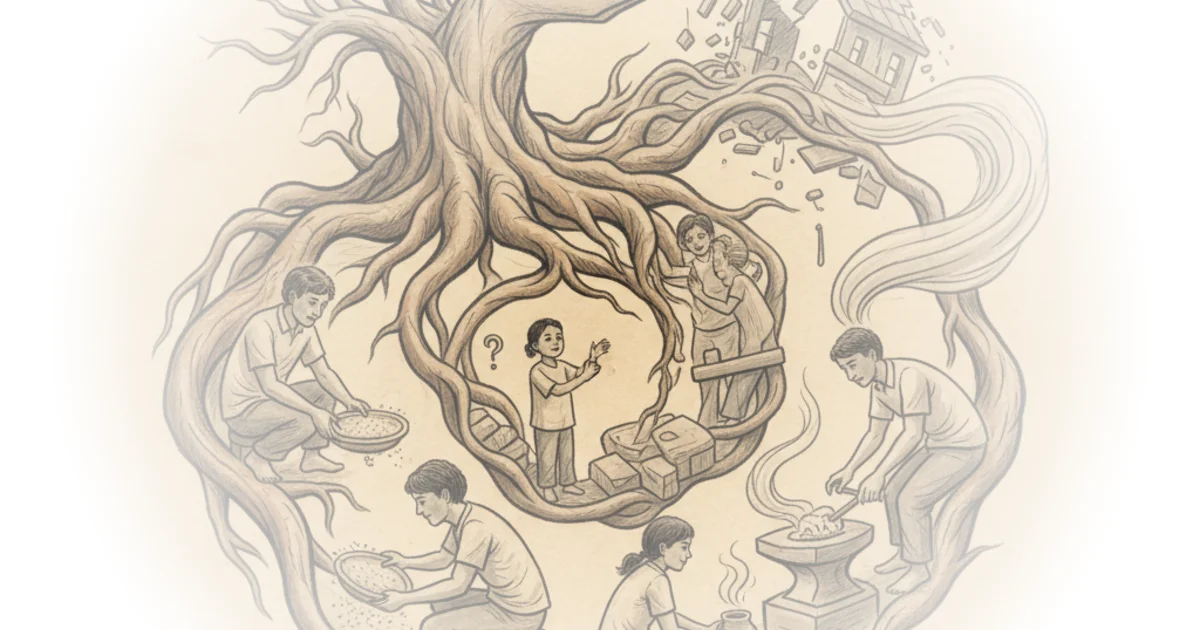
The author supports this with visceral, relatable anecdotes about the futility of teaching a toddler to build with Legos versus letting them watch a parent work. "Kids don't learn mainly from condensed instruction but from seeing elders doing things repeatedly," K notes, explaining why a child might struggle with a puzzle but effortlessly learn to use a screwdriver by osmosis. This lands with force because it validates the exhaustion of modern parents who feel they must constantly "teach" their children, only to be met with resistance. The piece argues that the solution is not better instruction, but better access to observation.
"Watching a caretaker doing things on their own is very important in the world of toddlers. Even more so if they can participate on the fringes."
Critics might argue that this approach romanticizes labor and ignores the need for structured cognitive development in complex fields like literacy or mathematics. However, the author counters this by pointing to the success of children who were raised with minimal direct instruction, suggesting that the drive to learn is intrinsic when the environment allows it.
The Myth of the "Complete Person"
Perhaps the most controversial section challenges the Western tendency to treat infants as fully formed humans waiting to be unlocked. Tove K cites Lancy's observation that many traditional societies withhold "fully human status" until a child is mobile and speaking, viewing the infant as more animal than person. "The belief that babies are small versions of humans lies behind a lot of the ineptitude in modern Western baby care," K argues. This perspective shifts the goal from "reading" a baby's complex emotional needs to managing their biological states.
The author recounts a personal epiphany regarding colic, where the instinct to reason with a screaming infant was replaced by the realization that the baby was simply sleep-deprived and needed to be managed like a "demanding exotic pet." "Basically, a baby is a demanding - and very cute - animal," K writes, advocating for a shift in expectation rather than a shift in technique. This reframing is powerful because it offers relief to parents who feel they are failing to connect with their infants. It suggests that the failure lies in the parent's projection of human intent onto a creature that is still developing one.
The Amish Exception and the Complexity Trap
The commentary then pivots to a critical gap in Lancy's work: the absence of the Amish as a model. Tove K argues that while Lancy contrasts Western education with "dirt poor Third World societies," he misses the Amish, who represent a voluntary, functional alternative within a Western context. "They are lower class by choice, and thereby they lack a number of the less enviable characteristics of communities that are lower class by accident," K observes. This distinction is crucial, as it separates the failure of poverty from the success of a deliberate cultural choice to reject formal schooling.
The author critiques Lancy's conflation of "Western" and "modern," noting that the acronym WEIRD (Western, Educated, Industrialized, Rich, and Democratic) is misapplied when used to describe non-Western modern societies like Japan. "It doesn't matter how educated, industrialized, rich and democratic Japan becomes. It is still not a Western society," K writes, highlighting a semantic error that obscures the unique nature of Western educational imperialism. The piece posits that formal education is not an accident of Western expansion but a necessity of societal complexity. "When a certain level of complexity is attained, the demand for a class of people with knowledge and skills other than what can be easily imitated arises," the author concludes.
"The Amish constitute the middle road between those extremes. Following the Amish way does not condemn a person to grinding poverty. It doesn't mean abstaining from life-saving health care."
A counterargument worth considering is whether the Amish model can scale to a global, digital economy where specialized knowledge is the currency of survival. While the Amish thrive in their niche, it remains unclear if their "chore curriculum" can produce the engineers and scientists required for a high-tech civilization.
Bottom Line
Tove K's commentary succeeds in exposing the anxiety-driven excesses of modern parenting, offering a compelling case for returning to observation-based learning. Its strongest asset is the synthesis of personal narrative with anthropological theory, making the abstract concrete. However, the piece's biggest vulnerability lies in its underestimation of the structural necessity of formal education in complex, modern economies; while the "chore curriculum" works for survival skills, it may not suffice for the specialized demands of the future.