Kahlil Greene does not merely recount a forgotten tragedy; he weaponizes history to expose a dangerous fallacy in current military policy. While the executive branch frames the removal of diversity initiatives as a return to "military lethality," Greene argues that this rhetoric ignores a brutal historical truth: the U.S. armed forces have historically been stronger because of integration, not in spite of it. By centering the 1943 Battle of Bamber Bridge, the piece forces a confrontation between the idealized narrative of American unity and the violent reality of what happens when racial hierarchy is enforced within the ranks.
The Cost of Imported Segregation
Greene's analysis begins by dismantling the notion that the military is a bastion of traditional values untouched by social progress. He writes, "The U.S. military has historically been ahead of American society on integration, not behind it." This framing is crucial because it shifts the debate from abstract culture war battles to concrete operational readiness. The author reminds us that President Truman desegregated the armed forces in 1948, six years before Brown v. Board of Education, precisely because generals understood that "you can't have a unified fighting force if your troops are fighting each other."
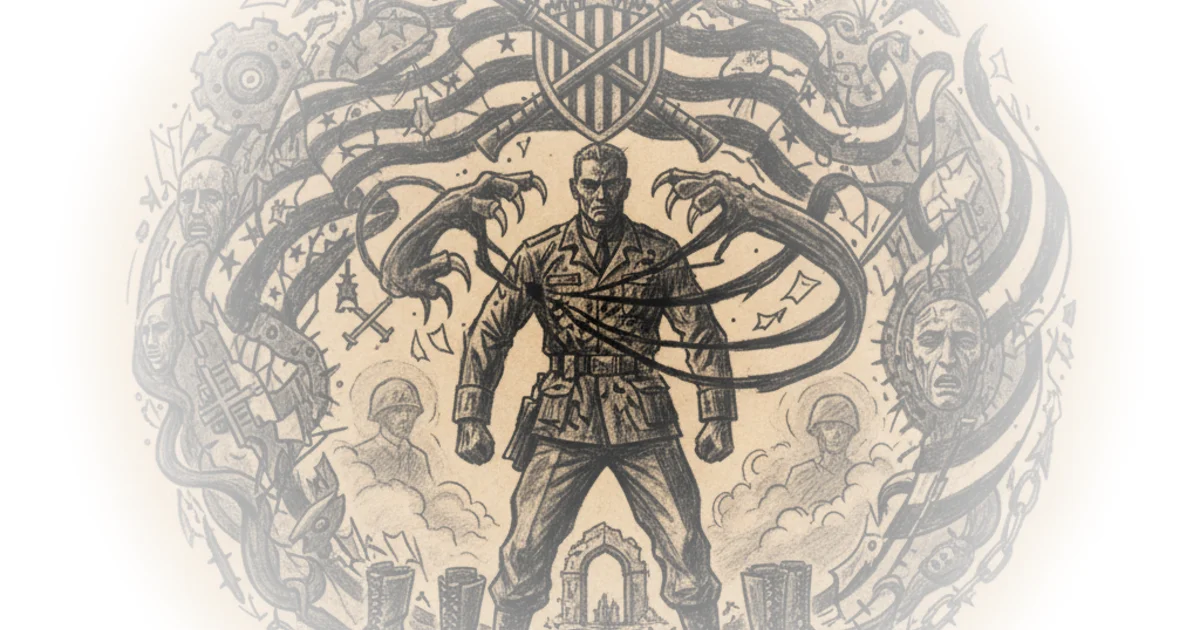
The piece then pivots to the human cost of ignoring this lesson, transporting the reader to a small English village in 1943. Greene describes how the U.S. Army did not just bring soldiers to England; "It brought its racial hierarchy too." This historical detail is not just background noise; it is the catalyst for the violence that follows. While the British public, weary of war, welcomed Black soldiers as allies, white American military police attempted to impose Jim Crow laws on foreign soil. The author notes that pub landlords in Bamber Bridge responded to this pressure by hanging signs reading "Black Troops Only," a defiant act that set the stage for a confrontation.
"The military learned, however imperfectly, that you cannot maintain order through oppression. That prejudice undermines readiness. That a house divided against itself cannot fight a war."
A War Within a War
The narrative tension peaks with a granular account of the night of June 24, 1943. Greene does not shy away from the triviality of the spark that ignited a mutiny: a dispute over a drink at a pub. When white Military Police officers attempted to arrest a Black soldier for a minor infraction, the local community and fellow soldiers intervened. Greene quotes a witness recalling the confusion and anger: "Everyone was saying, 'Leave him alone. He just wants a drink. It's a hot day.'" This quote effectively humanizes the conflict, stripping away the abstraction of "discipline" to reveal the raw friction of human dignity.
The escalation is chilling. When a bottle shattered a police jeep's windshield, the response was disproportionate. Greene details how the MPs returned with reinforcements, leading to a firefight that lasted until 3 am. The most harrowing detail involves Private William Crossland, a 25-year-old who had traveled across an ocean to fight fascism, only to be killed by his own countrymen. The author highlights the Army's initial cover-up, noting that Crossland was "shot in the back," a detail his niece has fought for decades to have officially recognized.
The aftermath reveals the institutional bias Greene critiques. Thirty-five Black soldiers were charged with mutiny, while the white MPs who arrived with a machine gun faced no discipline. Greene points out the irony that the court-martial president acknowledged an "appalling lack of discipline" and poor leadership by white officers, yet the blame fell squarely on the victims. This section serves as a stark counterpoint to the current administration's narrative that diversity initiatives are the source of weakness. As Greene argues, the reforms that followed—integrating MP patrols and replacing racist officers—were born from the realization that exclusion creates chaos.
Critics might argue that focusing on a single mutiny oversimplifies the complex history of military discipline, or that the current push to remove "woke" policies is a reaction to perceived overreach rather than a rejection of integration itself. However, Greene's evidence suggests that the current rhetoric is not about discipline but about erasing the very mechanisms that prevented such fractures in the past. The author writes, "Hegseth's revisionism erases that history. It also erases what happens when the military allows prejudice to fester unchecked."
The Legacy of Bamber Bridge
The piece concludes by connecting the past to the present, arguing that the current administration is attempting to "unlearn" the hard-won lessons of the 20th century. Greene observes that many Black soldiers who survived the war and experienced life without Jim Crow became leaders in the Civil Rights Movement because they "knew American apartheid was a choice, not an inevitability." This historical arc provides a powerful context for the current political moment. The author asserts that the Battle of Bamber Bridge tells a different story than the one being sold today: it shows that when prejudice goes unchecked, the result is "fratricide, court-martials, a dead soldier who never got to fight the enemy he crossed an ocean to face."
The final argument is a direct challenge to the idea that removing diversity training restores strength. Greene writes, "The path to lethality runs through erasing the history of how integration actually made the armed forces stronger." This is a bold claim, but one supported by the specific example of General Ira Eaker, who replaced racist officers and integrated patrols to restore order. The author suggests that the current executive branch is ignoring this playbook, risking a repeat of the same internal fractures that nearly cost the U.S. military its cohesion in 1943.
"William Crossland deserved better. So do the service members the executive branch is targeting today."
Bottom Line
Kahlil Greene's strongest asset is his ability to use a specific, violent historical event to dismantle a broad, abstract political argument, proving that the erasure of diversity history is not just a cultural slight but a tactical error. The piece's greatest vulnerability lies in its reliance on the assumption that current policymakers are fully aware of this history and are choosing to ignore it, rather than simply being unaware of the nuance. However, the verdict is clear: the historical record demonstrates that military cohesion is built on inclusion, and any attempt to dismantle it invites the very internal conflict the executive branch claims to fear.