Sense and Sensibility isn't just a story about romance — it's Jane Austen's masterclass in psychological observation. This lecture unpacks how Austen uses an elegant narrative technique called free indirect discourse to reveal her characters' inner worlds with remarkable subtlety. By examining chapters 1-6, we'll see how Austen drops into the minds of her characters without quotation marks, creating an intimate view into their thoughts while maintaining narrative distance. The result is fiction that rewards careful reading — and reveals why Austen remains one of English literature's most brilliant artists.
Jane Austen's World
Jane Austen was born on December 16th, 1775, into a middle-class clergy family — not the wealthy gentry she would fictionalize in Sense and Sensibility. Her father, Reverend George Austin, was a country clergyman with modest income, often supplemented by teaching private students. The family moved frequently, money was scarce, and Austen's life centered on domestic duties expected of women at that time: needlework, music, reading aloud, and poetry.
What made Austen different was her voracious appetite for novels. Her father encouraged her reading and writing, and she continued her education through his library — an uncommon but supported path for a woman in that era. From a young age, she was determined to become a published author. In her juvenilia, she practiced the epistolary novel style, writing persistently under difficult circumstances until she finally succeeded with help from her brother who acted as her agent.
Austen belonged to the lowest rung of the upper class — what historians call the rural minor gentry. This social position gave her keen insight into how money, inheritance, and marriage shaped women's lives. Her family was much like the characters in her novels: people who could move up or down the social ladder based on marriage and financial luck.
The Georgian Setting
Sense and Sensibility was first published in 1811, but the story is set in the late 18th century during the Georgian period under King George III. This was a time when issues like money, inheritance, social class, and marriage were paramount for women — especially those with no male heir to inherit property.
The backdrop of this period — from the 1790s up to 1811 — included the Napoleonic wars against France, but that context is largely absent from this novel. Instead, Austen creates an isolated private world focused entirely on domestic concerns: specifically, the Dashwood sisters (Elinor, Marianne, and Margaret) and their mother.
The absence of wartime urgency makes Austen's world feel even more claustrophome — a society where women's options were limited to marriage or living on the charity of male relatives. This is the rigid class structure Austen depicts with such precision.
The Dashwood Inheritance
The novel begins with an issue that would have resonated deeply with contemporary readers: entailment and inheritance. Upon Henry Dashwood's death, Norland Park — the family home — is left to his son John Dashwood. The annual income of £4,000 was entirely entailed to him.
Entailment wasn't fair by modern standards. It was a specific legal device that tied property to the male line for generations. A man's entire estate was passed to his firstborn legitimate son upon death — never the daughters. The purpose was to prevent family wealth from being diluted among other people, and it left women in precarious financial positions.
The Dashwood sisters and their mother are reduced from comfortable gentry to impoverished gentry. Henry Dashwood had only £10,000 of his own to leave them, which provided an annual income for his wife and three daughters. But John Dashwood's wife soon reduces the promised inheritance from £3,000 to just £500 a year — a huge reduction from their former lifestyle.
£500 a year was enough to afford three servants and a basic level of comfort, placing them just above the working poor. The sisters' lack of dowries made them unattractive marriage prospects in a society where women's financial security depended entirely on marrying well.
Free Indirect Discourse: Austen's Secret Weapon
Now we reach what makes this lecture most valuable — understanding how Austen uses free indirect discourse to reveal her characters' inner worlds with extraordinary subtlety.
In chapters 1-2, when Mr. and Mrs. Dashwood discuss how much money to leave the sisters and their mother, Austin drops into the mind of Mrs. Dashwood without quotation marks. Listen to how this works:
The narration begins normally: "Mrs. John Dashwood did not at all approve of what her husband intended to do for his sisters." That's straightforward narration.
But then Austen writes as if from Mrs. Dashwood's point of view: "To take £3,000 from the fortune of their dear little boy would be impoverishing him to the most dreadful degree." This is free indirect speech — not direct dialogue with quotation marks, but thoughts and feelings expressed in the character's own vocabulary and tone.
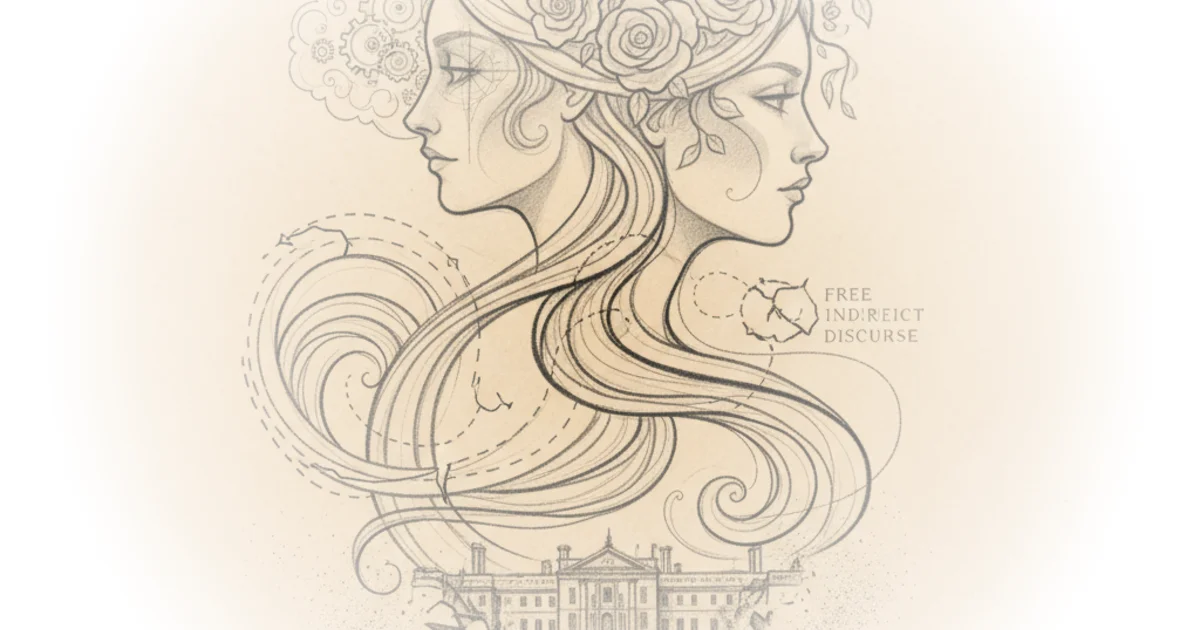
This technique allows Austen to reveal a character's inner world while maintaining careful observational distance. She blends the third-person narrator's voice with the character's thoughts and feelings, creating seamless intimacy without requiring quotation marks.
The result is powerful: readers get access to Mrs. Dashwood's calculating, selfish reasoning in her exact voice — but we're not sure whether we're reading the character's thoughts or the narrator's analysis. This ambiguity is what makes Austen so effective at showing us how people really think.
Counterpoints
Some literary scholars might argue that focusing on free indirect discourse as the central technique oversimplifies Austen's broader narrative achievements. Her brilliance includes plot construction, dialogue, social satire, and character development — not just this one technique. However, understanding how free indirect discourse works gives readers a powerful tool for appreciating her psychological depth.
Pull Quote
"By blurring the lines between narration and character thought, Austen gets into the minds of her heroes — women heroes — in a way that feels like intimate observation rather than reported speech."
This is what makes chapters 1-6 of Sense and Sensibility so rewarding to read slowly. The narrator aligns increasingly with one particular character, and readers can sense who the main character is by how often Austen drops into their mind.
Bottom Line
Austen's genius lies in psychological observation — revealing characters' inner worlds through free indirect discourse creates an intimacy that rewards careful reading. This lecture's strongest contribution is showing us exactly how Austen achieves this effect. The vulnerability of the Dashwood sisters — financially dependent on a selfish half-brother — gives Austen's social commentary real stakes. What makes this piece compelling isn't just understanding the technique; it's seeing why Austen remains one of literature's most acute observers of human nature.