Brad DeLong captures a chilling paradox of the current moment: a nation capable of furious outrage over the price of eggs remains strangely silent as it loses a war, all while its institutions crumble from within. He argues that the true danger lies not in the incompetence of the executive branch, but in the decades of decay that allowed a "lamentable band of rogues" to bypass a constitution designed specifically to stop them.
The Architecture of Decay
DeLong opens by dismantling the comforting narrative that the American system is too robust to fail. He points to a recent conversation among New York Times opinion writers who, with "remarkable equanimity," agree that the United States has lost a war to Iran, yet the public remains unmoved. "We just shrug," one observer admits, a sentiment DeLong finds both shocking and revealing. This collective torpor, he suggests, stems from a dangerous faith that the democratic process will eventually self-correct, a belief that blinds citizens to the immediate erosion of their sovereignty.
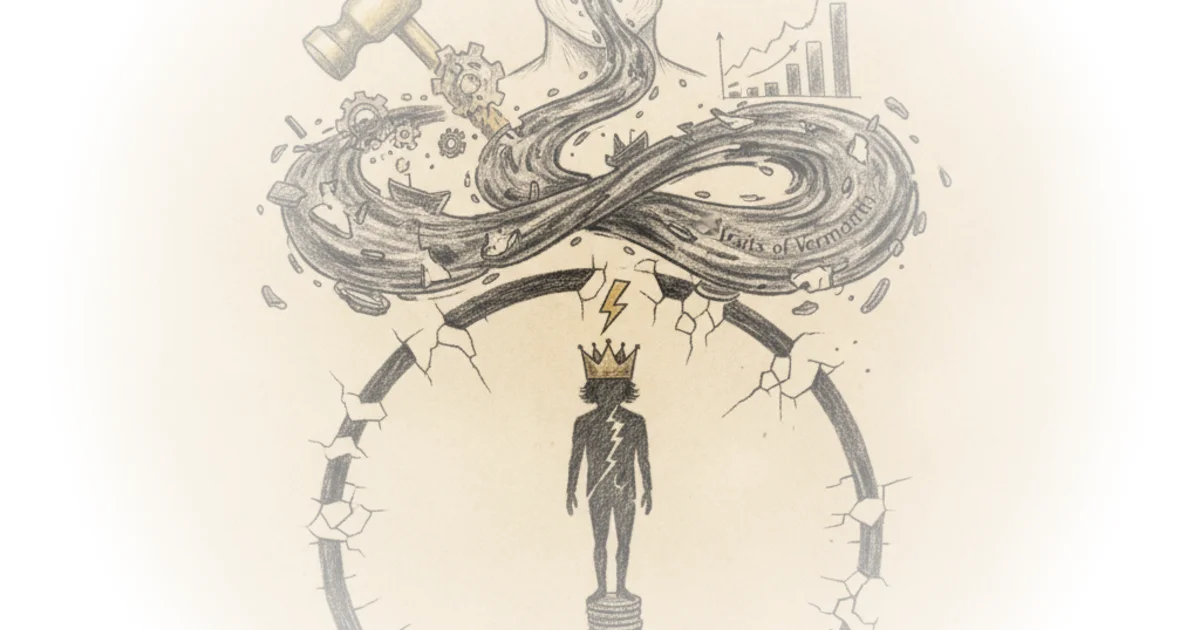
The core of DeLong's argument is that the executive branch has been commandeered not by master strategists, but by a group resembling "the Three Stooges, not Ocean's Eleven." He posits that the question isn't how cunning these actors are, but rather "how a polity with a constitution like that of the United States... could have been so thoroughly and rapidly commandeered by this lamentable band of rogues." The answer, he insists, is that "the termites been eating away for decades now at barriers that once seemed as solid as the doors of the Capitol."
If institutional decay has brought us to this pass, we need to know more about where the wormholes have developed.
This framing is powerful because it shifts the blame from a single "madman president" to a systemic failure that predates the current administration. It forces the reader to confront the idea that the safeguards we rely on have been hollowed out long before the current crisis. However, critics might argue that attributing the collapse solely to long-term decay risks excusing the specific, active dismantling of norms by current officials who are well aware of the vulnerabilities they are exploiting.
Historical Rhymes and Modern Blindspots
To illustrate the gravity of the situation, DeLong draws a sharp parallel to Karl Marx's analysis of the 1851 coup by Louis Bonaparte. He quotes Marx's observation that the French February Revolution was a "surprise attack" that was quickly undone, leaving society with "a shamelessly simple rule by the sword and the monk's cowl." DeLong uses this historical lens to argue that the current administration's actions are not an anomaly but a recurrence of a pattern where constitutional orders are hijacked during moments of national distraction.
He notes that just as the French were "taken unawares" by a "cardsharp's trick," Americans are failing to see the danger in their own "somnolence." DeLong writes, "Weakness... lost all understanding of the present in an inactive glorification of the future that was in store for it." This historical echo serves to underscore the urgency of the moment, suggesting that waiting for a future correction is a fatal error. The comparison to the "Society of December 10" and the "Hunters of Kentucky" serves to highlight that while the specific actors change, the mechanism of institutional capture remains tragically consistent.
The author also critiques the selective outrage of the public, noting that people "shake off our somnolence long enough to protest vociferously the lapses of judgment on the part of the young activists who recruited a candidate as flawed as Graham Platner to run for the Senate in Maine." This contrast highlights a disturbing priority: focusing on the aesthetic flaws of a Senate candidate while ignoring the "irresponsible imperial behavior" that defines the presidency. DeLong asks, "Could an empire of this magnitude... really have been brought this low by a handful of twenty- and thirty-somethings drunk on the notion that the way to the People's heart is to find a candidate who can put on a flannel work shirt and swear like a sailor?"
We understand that this is irresponsible imperial behavior by a madman president, and we're not even paying all that close attention to it.
This rhetorical question cuts deep, exposing the disconnect between the stakes of the presidency and the trivial nature of the political discourse surrounding it. The argument holds weight because it challenges the reader to examine their own complicity in this apathy. Yet, one must consider whether the public's silence is truly due to apathy or a rational calculation that the scale of the crisis is so overwhelming that individual outrage feels futile.
The Path Forward
DeLong concludes by suggesting that the solution requires a bipartisan recognition of the threat. He argues that "no one, right or left, has an interest in licensing irresponsible behavior by an unhinged executive." The goal, he posits, is to "rouse the public from its dogmatic slumbers" and recognize that democracy does not automatically provide safety without active vigilance. He warns against the belief that "democracy will provide" as if it were a self-correcting machine that requires no maintenance.
The piece ends on a sobering note, reminding us that the current administration's actions are not just a temporary aberration but a symptom of a deeper rot. The "mad king" may be preferable to the current "concupiscent kingpin," but the real issue is the system that allows such figures to seize power in the first place. DeLong's call to action is clear: we must identify the "wormholes" in our institutions before they are used to bring down the entire structure.
Bottom Line
DeLong's most compelling insight is that the current crisis is a symptom of long-term institutional decay rather than a sudden, singular event, forcing a re-evaluation of where the true vulnerability lies. The argument's greatest weakness is its reliance on the assumption that recognizing these "wormholes" will be enough to mobilize a public that has already demonstrated a capacity for profound apathy. Readers should watch for whether this diagnosis of systemic failure leads to concrete structural reforms or remains a critique of the moment.