This piece from Compact Magazine delivers a jarring, necessary indictment of the literary world's drift toward ideological purity, arguing that the very institutions built to champion free expression have become the primary enforcers of a new, suffocating orthodoxy. It is not a story about a single controversy, but a forensic look at how the demand for safety has mutated into a demand for silence, turning poets into censors and critics into victims of the very movements they once supported.
The Architecture of Exclusion
The article opens with a personal account that serves as a microcosm for a broader institutional rot. The narrator, a Nigerian critic selected for the National Book Critics Circle Emerging Critics Fellowship, describes being removed from the program not for his work, but for a past tweet expressing orthodox Christian views on sexuality. Compact Magazine reports, "I was given to know that my presence in the program was likely to pose a threat to other fellows, because I hold orthodox Christian views on sexuality." The board's solution was to isolate him, offering a "hybrid format" where he could interact with only one board member and, crucially, "not be able to say that I was in the program, because public acknowledgment of me could trigger the queer fellows."
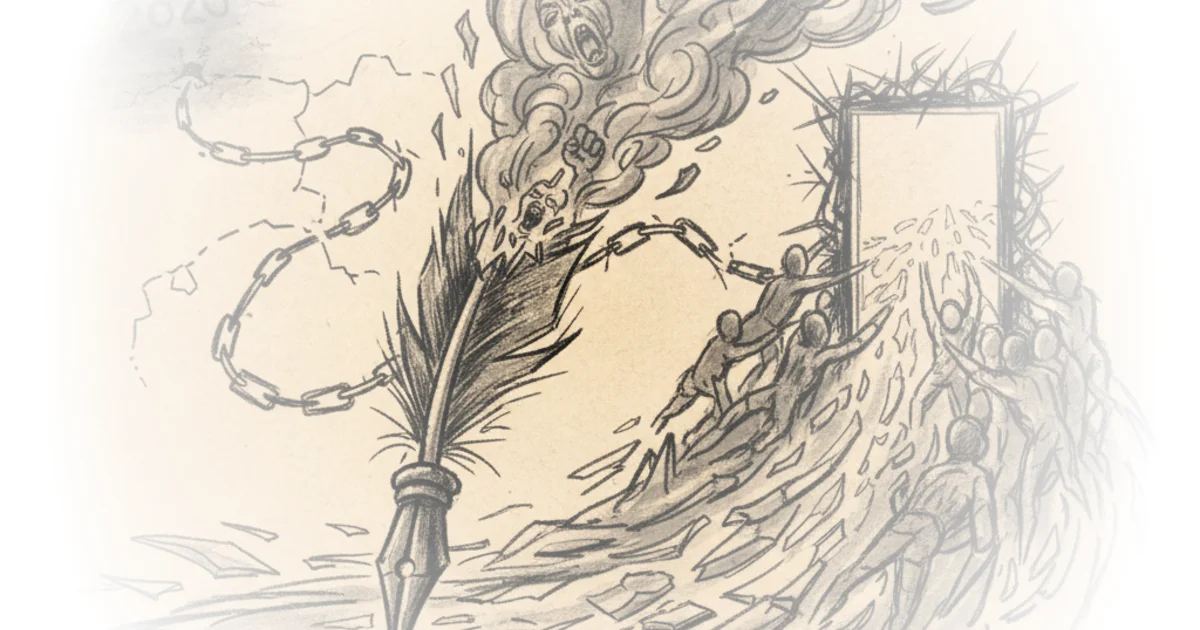
This incident is framed not as an anomaly, but as the culmination of a trend that began in earnest in 2020. The piece traces a lineage of pressure starting with a letter from thirty poets to the Poetry Foundation, demanding the resignation of leadership and the redistribution of funds to specific organizations like Assata's Daughters. The article notes that this group, described as "a queer Black woman-led and youth-focused organization rooted in Black Radical Tradition," became a focal point for demands that quickly escalated into resignations and policy overhauls. The argument here is potent: the initial push for equity has calcified into a mechanism where the definition of "marginalized" is so narrow that it excludes anyone holding divergent views, even on matters of faith.
"The direct, conscious attack on intellectual decency comes from the intellectuals themselves."
The piece invokes George Orwell to anchor its critique, suggesting that the current climate is more insidious than traditional censorship because it is self-imposed by the cultural elite. The author argues that poets, once the last line of defense against tyranny, have adopted the role of the "Stasi," scanning art for ideological impurities. This is illustrated by an anecdote where an American poet warns the narrator that using the word "whore" in a poem would make publication impossible, noting that "'Sex worker' is what you have to say now, which of course is absurd and immediately ruins the poem." The commentary suggests that this linguistic policing strips poetry of its ability to grapple with the messy, often offensive reality of human experience.
Critics might note that the article risks conflating legitimate accountability for hate speech with the suppression of unpopular religious or political views, potentially dismissing the genuine harm that exclusionary language can cause in marginalized communities. However, the piece maintains that the process of exclusion—driven by fear of backlash rather than a commitment to justice—is the true danger to the art form.
The Hypocrisy of the Activist-Writer
The narrative expands beyond the United States to highlight a global pattern of self-censorship, citing the cancellation of the 2026 Adelaide Writers' Festival after the disinvitation of author Randa Abdel-Fattah. The article points out the irony that writers who decry political interference are often the first to demand it when their own views are challenged. Abdel-Fattah, who had previously campaigned for the removal of a New York Times columnist, defended her own removal by invoking power dynamics: "What is missing in this is the question of power. We write letters on Google Docs to boards. The people who want to cancel us have premiers intervening."
The piece argues that this stance is a convenient shield. "Writers have no problem censoring other writers," Compact Magazine asserts, noting that politicians feel justified in intervening precisely because the literary community has normalized the practice of silencing dissent. The article draws a sharp line between the "activist-writer" who demands political safety and the poet who understands the necessity of risk. It suggests that when poetry becomes a vehicle for political cant, it loses its power to illuminate the human condition. The author contrasts this with the work of Anthony Hecht, who could appreciate the art of T.S. Eliot and Ezra Pound despite their deeply troubling personal prejudices, arguing that "good art does not become any less valuable because it contains (what are to us) troubling sentiments."
"In the current climate where poet is activist (or vice-versa), the poems also start to look a lot like cant."
This section of the commentary underscores a critical tension: the demand for artists to be morally perfect in their personal lives is incompatible with the demand for art to be complex and challenging. The piece suggests that by excommunicating writers for their beliefs, the literary world is not protecting the vulnerable but rather narrowing the scope of what can be said and felt.
The Loss of Grace
The article concludes with a poignant moment of connection that stands in stark contrast to the preceding conflict. During a final call with the National Book Critics Circle board, the narrator reads W.B. Yeats's "A Prayer on Going Into My House" to his accusers. Despite the board's attempt to silence him, the poetry itself bridges the divide. "Poetry, the voice of a man lifting from the page, had defined a small moment of grace between me and those who were, in that moment, my oppressors," the piece reflects. Yet, the narrator ends on a somber note: "But grace, as I learned, is fast becoming a strange word."
This ending serves as a warning that the capacity for nuance and empathy—the very qualities that make literature essential—is eroding under the weight of ideological rigidity. The article does not offer a simple solution but rather a diagnosis of a culture that has forgotten how to hold difficult conversations without resorting to expulsion.
Bottom Line
The strongest part of this argument is its demonstration of how the mechanisms of inclusion have been weaponized to enforce a new, rigid conformity that excludes religious and political dissenters. Its biggest vulnerability lies in the potential to downplay the historical necessity of challenging power structures that have long silenced minority voices. Readers should watch for how institutions navigate the tension between protecting marginalized communities and preserving the open inquiry that literature demands.
"The poet is last on the list because tyrants do not have the sense to get what he is saying (or to care)."
The piece ultimately contends that the greatest threat to poetry today is not the tyrant outside the gate, but the censor inside the room.