Then & Now tackles the bewildering rise of global populism not by focusing on a single leader's personality, but by tracing a deep, structural tension inherent to modern democracy itself. The piece's most striking claim is that populism is not an aberration of the system, but a "function of democracy" that emerges whenever the promise of "the people" clashes with the reality of elite governance. For the busy listener trying to make sense of a fractured world, this reframing offers a crucial historical lens: what feels like a sudden explosion of chaos is actually a recurring, episodic moment in the long struggle over who truly rules.
The Paradox of Democratic Sovereignty
The commentary begins by dismantling the idea that populism is a foreign virus infecting healthy democracies. Instead, Then & Now argues that "populism is a function of democracy" and "can't exist in an authoritarian system." This distinction is vital. It suggests that the current surge of anti-establishment sentiment is a symptom of democratic ideals being taken seriously, even if those ideals are being weaponized. The author notes that modern populism only makes sense "after and in reference to the promises and the ideals of the American and French revolutions."
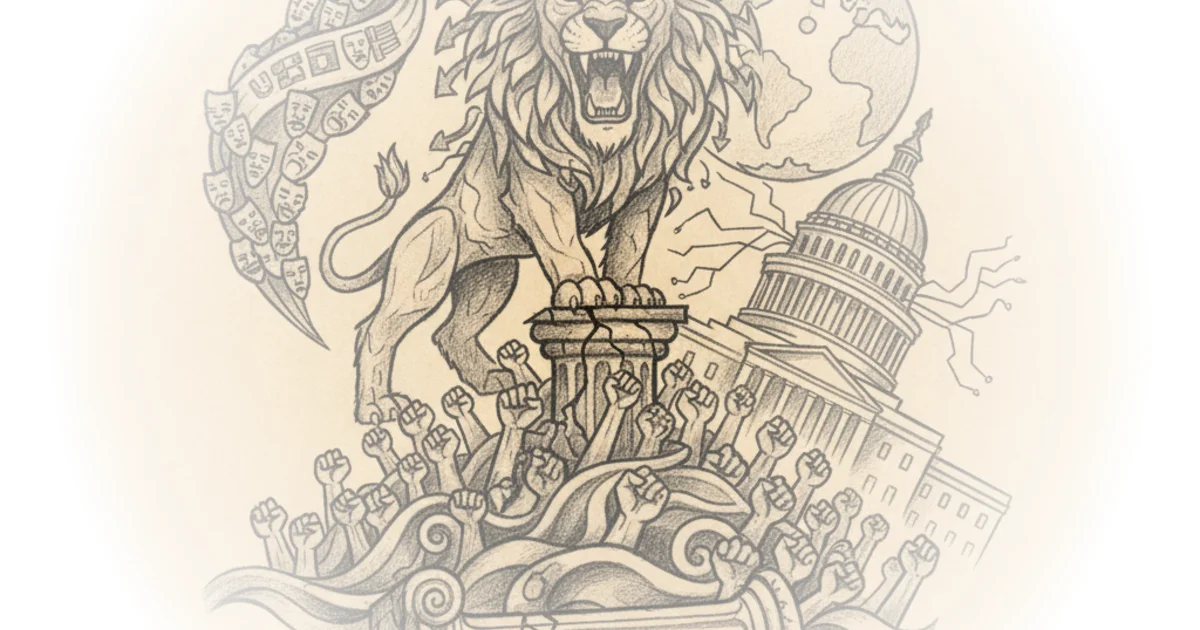
This historical grounding is effective because it moves the conversation away from the sensationalism of current headlines and toward the foundational debates of the Enlightenment. Then & Now highlights the friction between the Jeffersonian belief that "truth is self-evident and common sense... accessible to all of the people" and the Federalist fear that the masses are swayed by "demagogues" and "base emotions." The piece correctly identifies that the entire architecture of Western government—from the US Senate to the French unicameral legislature—was built on trying to answer the question: "How much power should an executive have... and how much Authority should an elite representative of the people have over the people themselves?"
The recurring theme in populism, the central organizing feature, is the binary between the people versus the elites.
This binary is the engine of the phenomenon. Then & Now illustrates this by looking at the 19th-century Russian narodnik movement, where intellectuals tried to go "to the people" to spark revolution, only to find the peasantry resistant to their abstract theories. The author uses this to show that populism often carries a "hostility towards Theory towards ideology and towards intellectualism," favoring an "authentic" but unrefined version of democracy. Critics might note that this framing risks romanticizing the "common sense" of the masses while underestimating the genuine complexity of modern governance that requires technical expertise. However, the point stands: the populist appeal lies in the promise that you don't need a degree to understand the truth.
The Producer Ethic and the Gilded Age
The piece then pivots to the United States, examining the People's Party of the 1890s as a blueprint for today's movements. Then & Now describes a time when "farmers in the South were getting poorer" while "establishment East Coast Elites were getting richer." The argument here is that populism often arises from economic dislocation, specifically when the "producer ethic"—the idea that wealth belongs to those who create it—is threatened by financial monopolies.
The author draws a sharp parallel between the railroad monopolies of the Gilded Age and modern corporate power. "For Farmers the railroads in the Eastern banking establishment were at the heart of a system that seemed to systematically cheat farmers," Then & Now writes. This historical context is essential for understanding why populist rhetoric resonates so deeply in the "Heartland." The piece highlights Ignatius Donnelly, a leader whose speeches railed against the "two great classes: Tramps and millionaires." The author notes that Donnelly's rhetoric was a "textbook example of popular rhetoric" that successfully framed the conflict as a battle between the "plain people" and the "corrupt, the greedy, the elite."
The fruits of the toil of millions are boldly stolen to build up colossal fortunes for a few.
This quote captures the emotional core of the populist argument: a sense of theft and betrayal. Then & Now acknowledges the darker side of this movement, noting that the People's Party was "not without their racism and nativism," with some members blaming Jewish conspiracies or immigrants for economic woes. This is a crucial nuance often missing from modern coverage. The author argues that the "producer ethic" can easily slide into exclusionary nationalism when the definition of "the people" becomes narrow. A counterargument worth considering is whether the economic grievances of the 1890s are truly analogous to today's post-industrial economy, where the "elites" are often seen as globalists rather than just bankers or railroad barons. Yet, the structural dynamic remains: when the system feels rigged against the producer, the binary of "us vs. them" becomes politically explosive.
The Slippery Nature of the Concept
Throughout the analysis, Then & Now emphasizes the difficulty of pinning down populism. Citing scholar Paul Taggart, the author notes that populist movements have "systems of belief which are diffuse" and "lack consistency." This is a smart move, as it prevents the reader from looking for a single policy platform that defines the movement. Instead, the piece argues that populism is defined by its style and its relationship to power. It is a "shadow of democracy" that appears when the promise of the "general will" is perceived to be blocked by institutional checks and balances.
The commentary effectively uses the example of the French Revolution's attempt to enact the "general will" through a single legislative chamber, contrasting it with the American system of checks and balances designed to slow down the "mob." The author suggests that populism is essentially a rejection of these delays. It demands that the "people" rule directly, without the friction of upper houses, judiciaries, or independent central banks. This explains why populist leaders across the spectrum, from the left to the right, often share a disdain for institutions that are supposed to protect minority rights or ensure stability.
Populism is a difficult slippery concept and so to not slip up we'll have to go back to the founding of America to the French Revolution.
By grounding the discussion in these historical origins, Then & Now provides a framework that helps the listener understand why populism feels so chaotic yet so persistent. The piece avoids the trap of treating it as a temporary glitch, instead presenting it as a permanent feature of the democratic landscape that flares up whenever the gap between the ideal of "government of the people" and the reality of "government by the elite" becomes too wide.
Bottom Line
Then & Now's strongest contribution is its refusal to treat populism as a personality cult, instead revealing it as a structural symptom of the tension between democratic ideals and institutional reality. The argument's greatest vulnerability lies in its historical breadth; by covering such a vast timeline, it occasionally glosses over the specific, unique drivers of the current moment, such as the role of digital media in amplifying the "people vs. elite" narrative. However, for a listener seeking to understand the why behind the what, this historical grounding is indispensable. The takeaway is clear: as long as the promise of democracy remains unfulfilled for the "plain people," the shadow of populism will continue to lengthen.