Edward Ongweso Jr delivers a searing indictment of the on-demand labor model, arguing that the "gig economy" is not a technological innovation but a calculated regression to pre-New Deal labor conditions. The piece's most startling claim is that the industry's profitability relies entirely on a legal fiction: the systematic misclassification of workers to offload costs onto them while securing monopoly power through aggressive lobbying. This is not merely an economic debate; it is a story about the deliberate dismantling of worker protections to fuel investor returns.
The Architecture of Precarity
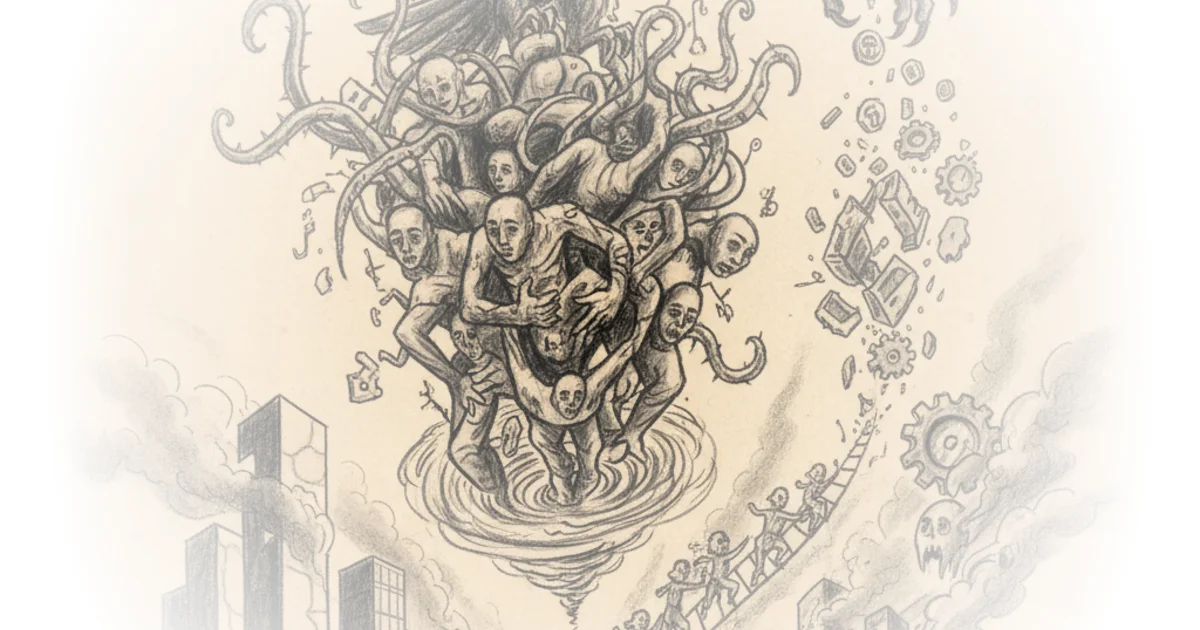
Ongweso Jr anchors his analysis in the work of labor scholar Veena Dubal, tracing how the ride-hail industry weaponized deregulation to reverse hard-won labor gains. He writes, "The so-called 'gig economy' is one of the larger altars to greed and misery in our civilization where millions of people are sacrificed in order to grow Smaugian hoards that are then transmuted into this or that form of power." This vivid metaphor sets the tone for an argument that views these platforms not as disruptors, but as predators. The author contends that the business model is fundamentally about "subverting urban governance" and breaking the regulatory frameworks established in the mid-20th century.
The core of the argument rests on the idea that these firms thrive not through efficiency, but through exploitation. Ongweso Jr notes that the industry has succeeded by leveraging "worker misclassification, algorithmic discrimination, anti-competitive capital-intensive strategies, impressive public relations, robust political lobbying, and shoddy journalism." This list is crucial because it shifts the blame from market forces to deliberate corporate strategy. The author suggests that the "lazy and incurious view" that these companies will eventually become profitable is a myth; they are profitable only because they operate outside the law.
The ride-hail business model is about subverting urban governance, about breaking New Deal era labor regimes, about subjecting workers and workplaces to more authoritarian forms of control and discipline.
Critics might argue that these platforms offer necessary flexibility for workers who cannot commit to traditional schedules. However, Ongweso Jr counters this by highlighting the reality of algorithmic control, where workers are trapped in grueling schedules with declining wages, effectively removing their agency despite the promise of autonomy.
The California Playbook and Global Expansion
The essay provides a detailed case study of California's Proposition 22, where Uber and allies spent over $200 million to secure an exemption from labor laws. Ongweso Jr describes this as a "masterclass on subverting democratic governance," where corporate money was used to mislead voters and co-opt civil rights organizations. The author points out the cynicism of venture capitalists who cheered this outcome. He cites Shawn Carolan, a partner at Menlo Ventures, who wrote that the model could be extended to industries ranging from agriculture to nursing, claiming it would create a world where "the choice of being a gig worker versus an employee doesn't feel like a trade-off."
Ongweso Jr dismantles this optimism with brutal efficiency. He writes, "Everything Carolan—and every other venture capitalist—says in defense of misclassifying on-demand workers is, of course, Bullshit. Pablum. Gibberish. Jejune." The author argues that the reality is the opposite of the promise: platforms use algorithms to practice wage discrimination, ensuring workers receive the lowest possible compensation. The evidence presented shows that since Proposition 22, the industry has not improved worker conditions but has instead expanded its reach, securing similar exemptions in Massachusetts, Pennsylvania, and other jurisdictions while watered-down regulations in the European Union and Brazil.
Uber sells itself as pro-worker in name while opposing legislation that would require it to be so in practice.
This section effectively illustrates the global nature of the threat. The author notes that even where courts have ruled in favor of workers, such as in the United Kingdom, companies like Uber have found ways to renege on promises. The strategy is consistent: bribe, lobby, and litigate until the law bends to the corporate will.
The Next Frontier: Nursing
Perhaps the most alarming part of the commentary is its application of this model to healthcare. Ongweso Jr highlights the emergence of "Uber for nursing" apps, which promise to solve staffing shortages by using algorithms to match nurses with shifts. He references a report by the Roosevelt Institute, which paints a grim picture of the consequences. The author explains that these apps encourage nurses to bid on shifts by offering lower rates, creating a race to the bottom.
The human cost of this model is stark. Ongweso Jr details how nurses are penalized for canceling shifts due to illness, with one nurse reported to have worked while sick with COVID-19 because she feared a rating drop would ban her from the app. He writes, "These apps encourage nurses to work for less pay, fail to provide certainty about scheduling and the amount or nature of work, take little to no accountability for worker safety, and can threaten patient well-being by placing nurses in unfamiliar clinical environments with no onboarding or facility training."
The on-demand nursing industry promises hospitals and medical administrators a different set of controls, namely the capacity to seamlessly staff facilities, reduce manager workloads, and lower labor costs. But what's the reality on the ground? Serious safety and health risks for workers and patients.
This shift from ride-hail to healthcare demonstrates the scalability of the exploitative model. While proponents argue these apps provide flexibility for nurses, the author argues they actually degrade working conditions and endanger patients by prioritizing cost-cutting over care standards.
Bottom Line
Edward Ongweso Jr's strongest asset is his ability to connect the dots between venture capital strategy, political lobbying, and the lived misery of workers, exposing the "gig economy" as a deliberate assault on labor rights rather than a market evolution. The piece's biggest vulnerability is its reliance on the assumption that current regulatory frameworks can be restored, given the immense financial power these companies wield to shape laws globally. Readers should watch for the rapid expansion of this model into other essential sectors, as the "Uber for nursing" example suggests the next wave of deregulation will target the most vulnerable parts of the economy.