A Politician's Faith Forged in Solitary Confinement
Juan Pablo Guanipa spent nine months alone in a Venezuelan prison cell. No cellmates, no priest, no confession. The opposition politician -- widely regarded as the right-hand man of Nobel Peace Prize winner Maria Corina Machado -- was arrested on May 23, 2025, after nine months in hiding, and charged with conspiracy and terrorism by the Maduro regime. He was finally freed on February 9, 2026, as part of a mass release of political prisoners following the January 3 American capture of former dictator Nicolas Maduro. Then he was arrested again, hours later, for giving media interviews.
In a lengthy interview with The Pillar, Guanipa describes how imprisonment deepened rather than destroyed his Catholic faith. The account is striking for its specificity -- the improvised rosary, the nightly repetitions of the Glory Be, the dogged insistence on gratitude even for incarceration itself.
The Cell as a Chapel
Guanipa's conditions were severe. For the first three weeks, he had no bathroom, no sink, no shower -- just a hole in the floor and a one-inch mattress. He asked repeatedly for a priest.
I asked for a priest countless times. They told me it was impossible, without further explanation.
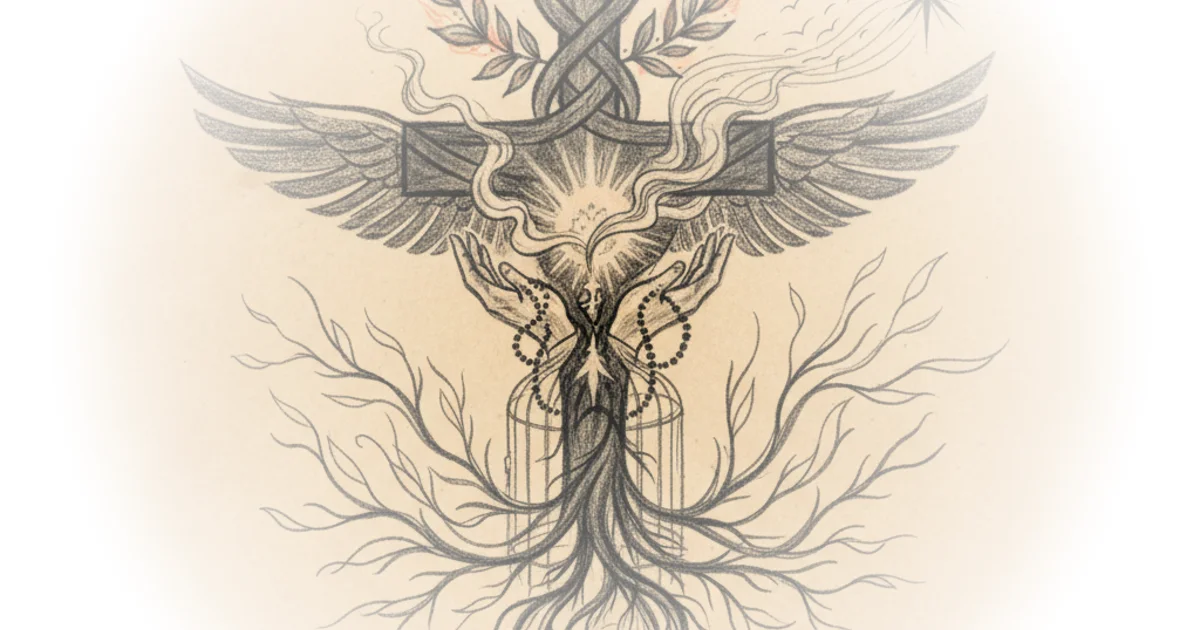
Without access to the sacraments, Guanipa constructed his own daily liturgy. He rose each morning and prayed the same prayer he had learned in school. He took up the Rosary for the first time as a daily habit, fashioning a makeshift decade rosary from a scapular he happened to have in his pocket when arrested.
When they arrested me in May, they asked me to get dressed, and in the pants I put on, I had a scapular in my pocket. When they put me in my cell, I turned that scapular into a decade rosary, tying 10 knots to pray.
After the Rosary came twenty to thirty minutes of mental prayer, then reading. Before sleep, a practice that borders on the monastic: the Glory Be, recited one hundred times every night. Guanipa's explanation for this devotion is disarmingly simple -- he felt the prayer was "very forgotten" and wanted to honor the Trinity.
Gratitude as Survival Strategy
The emotional core of Guanipa's testimony is his insistence on thanking God for everything, including the imprisonment itself. He frames the choice starkly: suffering either destroys faith or deepens it.
But above all, I got used to thanking God for everything. Absolutely everything. And that's when I coined a phrase that was, "Thank you, my God, for everything you have given me, for everything you have helped me with, for everything you have forgiven me for, and for everything you have loved me for."
When pressed on whether this gratitude extended to the prison itself, Guanipa does not hesitate.
Absolutely. I believe that you can learn from everything. I can't say that I wanted to go to prison. Never in my life. I hid for 10 months. I was in 12 different places. I did everything I could to avoid being arrested, but in the end they caught me.
This is not passive resignation. Guanipa went to extraordinary lengths to avoid capture, cycling through twelve hiding places over ten months. The gratitude came after exhausting every practical option. That distinction matters -- it separates his account from the quietism that critics of religious suffering-narratives often target.
Critics might note, however, that framing political imprisonment as a spiritual gift risks normalizing authoritarian abuse. When a politician publicly thanks God for his unjust detention, it can inadvertently soften the moral urgency of the injustice itself. Gratitude and outrage are not mutually exclusive, but Guanipa's account leans heavily toward the former.
The Sacramental Hunger
One of the most revealing passages concerns Guanipa's eventual access to confession. Unable to receive the sacrament in prison, he confessed directly to God "with the commitment to confess to a priest when I got out of there." Even after being moved to house arrest, the regime's surveillance made sacramental confession impossible.
However, I couldn't confess because we suspected there were microphones in my house.
The priest gave general absolution and communion instead. Twelve days later, upon full release, Guanipa went almost immediately to the priest's home for a proper confession lasting about an hour.
It just feels so sweet to be in God's grace.
For non-Catholic readers, the significance is worth explaining. In Catholic theology, confession -- formally called the Sacrament of Reconciliation -- requires a verbal accounting of sins to a priest, who acts in the person of Christ to grant absolution. A direct confession to God, while sincere, is considered incomplete. The fact that regime surveillance prevented even this most intimate of spiritual acts underscores how totalitarian control reaches into domains that politics typically cannot touch.
The Church and Venezuelan Liberation
Guanipa's political theology draws heavily on the example of Pope John Paul II and the fall of communism in Eastern Europe. He sees a direct parallel between the Polish pope's role in ending Soviet domination and what the Venezuelan Church should do now.
I would say that he was one of the architects of the liberation of Poland, of the fall of the Berlin Wall, of the fall of the Soviet empire. So, I think that demonstrates the role that the Church can play in the liberation of peoples.
His message to Pope Francis is respectful but pointed. Guanipa acknowledges the pontiff's concern for Venezuela but pushes back against what he perceives as an insufficient response -- particularly the call to avoid violence without adequately condemning the regime's own violence.
A counterargument is that Pope Francis, himself a Latin American with extensive experience navigating authoritarian politics in Argentina, may be pursuing a diplomatic strategy that Guanipa's public advocacy cannot fully appreciate. Vatican diplomacy often operates on timescales and through channels invisible to even well-connected opposition figures.
Faith Without a Buffet
When asked about working alongside politicians whose views on abortion diverge from Church teaching, Guanipa is unequivocal.
Catholicism is not a map that you can cut up and keep what you like. It is not a buffet where you serve yourself the dishes you like and leave out the ones you don't. You are either Catholic or you are not, period.
He defends his alliance with Machado and others on pragmatic grounds -- the crisis demands coalition -- while insisting he would never vote for legislation that undermines the right to life. His party, he notes, is rooted in the social doctrine of the Church.
The tension here is real but unresolved. Guanipa sidesteps the harder question of whether lending political credibility to pro-choice allies effectively advances the policies he opposes. Coalition politics always involves such trade-offs, and Guanipa's answer is honest about the compromise even if it does not fully reckon with its implications.
A Small Moment of Levity
Amid the gravity of the interview, one detail stands out. On the twenty-first day, guards moved Guanipa to a room with a television while they improved his cell. He discovered "The Chosen," a multi-season dramatization of the life of Christ produced by an evangelical media company.
That day I watched 12 episodes in a row while they fixed the cell. At some point, an officer asked me if I wanted to watch something else and I just replied, "No, brother, this is great."
Guanipa is known in Venezuela for his sense of humor, and this anecdote -- a political prisoner binge-watching a Jesus series while his jailers renovate his cell -- carries the kind of absurdist detail that makes the story feel true in a way no amount of theological reflection can.
Bottom Line
Guanipa's account is compelling because it is concrete. The knotted scapular, the hundred nightly Glory Be prayers, the hour-long confession upon release -- these are not abstractions but the granular details of a faith tested under extreme conditions. His testimony gains further credibility from his political track record: a man who won a gubernatorial election and was barred from office, who hid in twelve locations over ten months, who was rearrested hours after release for the crime of visiting prisoners' families.
The vulnerability of the argument lies in what it leaves unexamined. Guanipa's spiritual framework is deeply personal and individual. He says little about the thousands of other political prisoners who may not share his faith resources, his education, or his international profile. The interview also does not press him on the practical intersection of his Catholic convictions and his party's policy agenda beyond the single issue of abortion. Still, as a first-person account of faith under persecution, it is specific, unsentimental, and difficult to dismiss.