Kings and Generals delivers a sobering autopsy of the Soviet Union, arguing that the empire didn't collapse from a sudden shock, but from a slow, systemic rot masked by a temporary oil boom. The piece's most striking insight is that the Soviet leadership's obsession with "stability" actually incentivized the very lies and inefficiencies that doomed the system, turning economic management into a theater of performance rather than production.
The Illusion of Stability
Kings and Generals begins by contextualizing the Brezhnev era not as a sudden decline, but as a period where growth became unsustainable due to structural flaws inherited from decades of forced industrialization. The authors note that while the 1960s and 70s saw rising living standards, the foundation was warped. They cite Professor Dane Gustaffson of Georgetown University to illustrate this distortion: "The heavy diversions of resources required to attend to the century's unfinished business and the distracting emergencies repeatedly arising from both are major obstacles to sustained and rational policy in the Soviet system." This framing is crucial; it shifts the blame from a lack of resources to a misallocation driven by political necessity.
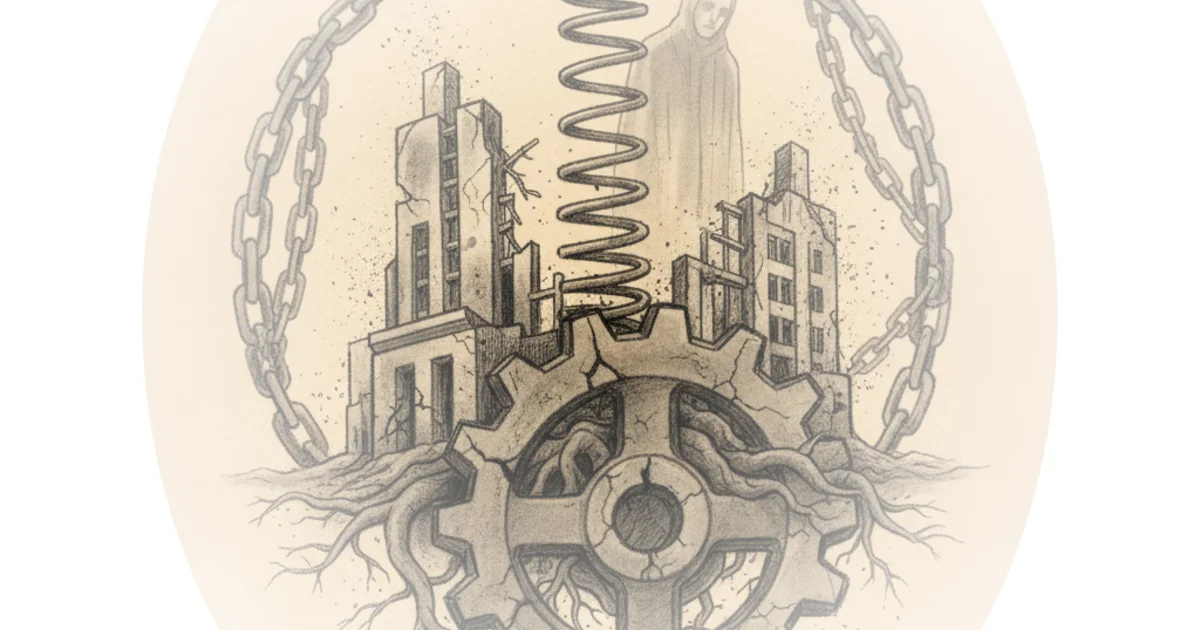
The commentary highlights how the five-year plan system created a perverse incentive structure. Managers were rewarded for hitting quotas, not for creating value. Kings and Generals writes, "Soviet economic managers were stuck trying to keep up with the weakness of the economic system rather than making cohesive plans for improvement." This dynamic led to a culture of fabrication where inflation of production figures became the norm. The authors point out that this wasn't an anomaly but a systemic feature: "The Brev era was defined by stability above all things... [which] incentivized managers to inflate production figures even as huge quantities of goods were either misallocated or simply not produced."
"We pretend to work, they pretend to pay us."
This famous Soviet aphorism, quoted by Kings and Generals, encapsulates the social contract of the stagnation era. The authors argue that the state provided guaranteed employment to avoid the label of "parasitism," while workers provided the appearance of labor. The result was a massive waste of human capital, with millions employed in factories producing goods that had no market demand. Critics might argue that this view oversimplifies the genuine industrial achievements of the period, particularly in heavy industry, but the authors effectively counter this by distinguishing between the "A" and "B" economies.
The Oil Lifeline and the Black Market
Perhaps the most compelling section of the piece is the analysis of how the Soviet Union papered over its internal decay with external windfalls. The authors detail how the discovery of massive oil and gas reserves in the 1960s and 70s, combined with favorable trade policies from West Germany, allowed the USSR to buy its way out of crisis. Kings and Generals quotes reformer Jagger GDAR to explain the mechanism: "The hard currency from oil exports stopped the growing food supply crisis, increased the import of equipment and consumer goods, ensured a financial base for the arms race... and permitted the realization of such risky foreign policy actions as the war in Afghanistan."
This reliance created a dangerous dependency. As global energy prices climbed, the leadership ignored the deteriorating quality of their non-energy exports. The authors note that "supposedly only 5% of tractors exported to Canada from the USSR were seen as fit for market." When the West stopped buying Soviet industrial goods, the USSR was left with a one-trick pony. Kings and Generals observes that this "papering over of the cracks allowed for a high level of atrophy throughout the Soviet system," meaning that when oil prices eventually collapsed in the 1980s, the underlying economic rot was exposed with catastrophic speed.
The piece also explores the dual nature of Soviet life: the public performance of socialist ritual versus the private reality of the black market. Citizens participated in state-mandated volunteerism while secretly craving Western luxuries like blue jeans and rock and roll. Kings and Generals writes, "A dynamic developed whereby people in public would participate in Soviet rituals of work, education, and volunteerism, but in private enjoy the fruits of the black market, Western luxury goods." This duality eroded the ideological legitimacy of the state from within, as the population increasingly viewed the official economy as a farce.
The Currency Conundrum
The authors delve into the bizarre mechanics of the Soviet financial system, which operated on a currency that was virtually meaningless on the global stage. They explain that the internal economy often used "Bznal," a ledger currency that "only existed in their ledgers and never minted or regulated." Kings and Generals cites historian Vladislav Zubac to underscore the opacity of this system: "Only a few professional bankers in the Soviet Union understood how the system worked. And meanwhile, this unique system was vital for Soviet macroeconomic stability."
This complexity masked a fundamental lack of market signals. Without a viable exchange rate or a mechanism for price discovery, the state could not accurately assess the health of its economy. The authors describe how the government used consumption taxes not just for revenue, but as a tool for social control, raising rates on alcohol to curb drunkenness or lowering them to encourage the purchase of domestic goods. Yet, the delivery of these goods remained the critical failure point. The piece recounts a popular joke about a man waiting ten years for a car, highlighting that "consumer goods existed, but they weren't very good or even immediately available." This disconnect between production and availability was the ultimate symptom of a system that could plan for a space shuttle launch but not for a pair of shoes.
Bottom Line
Kings and Generals makes a persuasive case that the Soviet collapse was not a sudden event but the inevitable result of an economy that prioritized political stability over economic rationality, masking its failures with oil revenue until the mask could no longer hold. The strongest part of this argument is the detailed explanation of how the "A" and "B" economies functioned in parallel, allowing the state to maintain military parity while the civilian sector withered. The biggest vulnerability is the relative lack of discussion on how the political elite could have pivoted away from oil dependence, but the piece effectively demonstrates why such a pivot was impossible within the rigid constraints of the five-year plan system. Readers should watch for how modern resource-dependent economies might be repeating these same structural errors today.