Mathematical certainty has always felt rock-solid — like those axioms Euclid laid out millennia ago. But Derek Muller is here to tell us that bedrock was always more sand than stone, and he's bringing the evidence.
The Hole at the Bottom
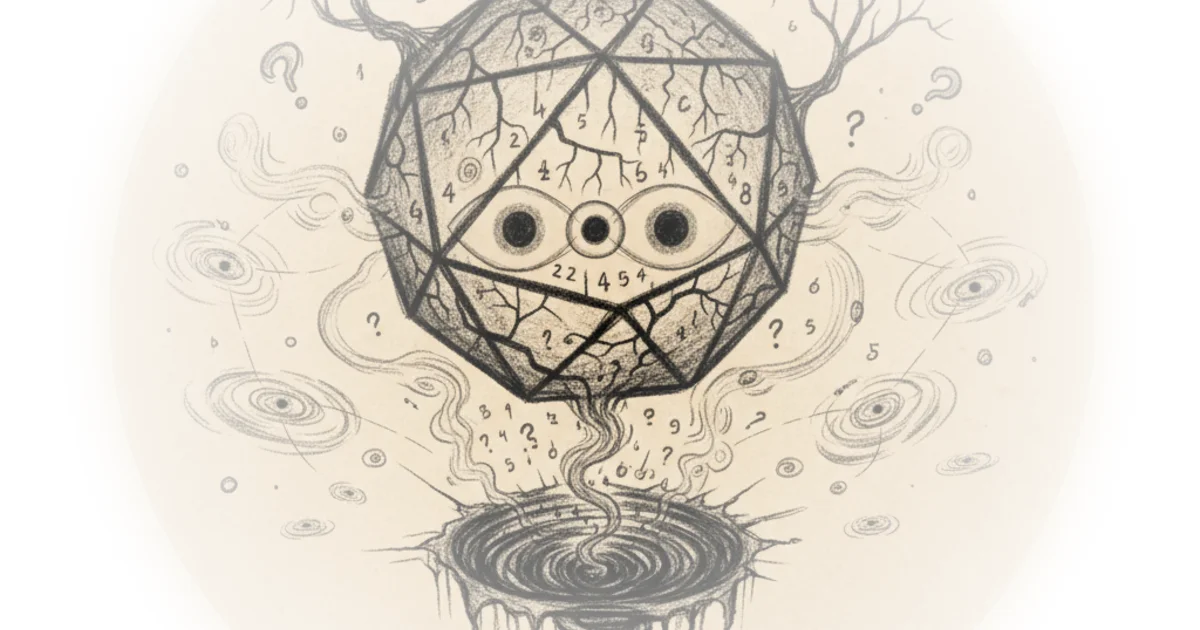
Muller opens with a claim that sounds almost apocalyptic: "There is a hole at the bottom of math... there will always be true statements that cannot be proven." He's not being dramatic for effect — this is the core of Gödel's incompleteness theorems, and he's laying it out with precision. The twin prime conjecture sits in his crosshairs as an example of something we may simply never know: true but unprovable.
The Game of Life connection is where Muller gets particularly clever. Conway's zero-player game — so named because no human can intervene once it's set in motion — produces patterns that are, in a formal sense, impossible to predict. "You would think that given the simple rules of the game you could just look at any pattern and determine what will happen to it," Muller writes, "but it turns out this question is impossible to answer." The phrase he uses is 'undecidable' — meaning no algorithm can guarantee an answer in finite time. This isn't a limitation of our current methods; it's a fundamental property of the system itself.
There is a hole at the bottom of math... there will always be true statements that cannot be proven.
Cantor and the Revolution of Infinity
The historical detour through Cantor's diagonalization proof is where Muller does his finest work. The German mathematician asked whether there are more natural numbers or more real numbers between zero and one — and then systematically demolished the intuitive assumption that these infinities should match. His proof used what Muller describes as "writing down an infinite list matching up each natural number on one side with a real number between zero and one" and then constructing a new number that differs from every entry in at least one decimal place.
The result? "It shows there must be more real numbers between 0 and 1 than there are natural numbers," Muller writes. Cantor called these countable and uncountable infinities respectively, and the implications shattered centuries of mathematical comfort — not just for mathematicians but for anyone who thought infinity was a simple concept.
The Formalists vs. Intuitionists
Muller paints a vivid portrait of the late 19th-century mathematics fracture: "Mathematics fractured and a huge debate broke out among mathematicians at the end of the 1800s." On one side, the intuitionists — led by Poincaré, who "was convinced that math was a pure creation of the human mind" and called set theory 'a disease from which one has recovered.' On the other, the formalists led by Hilbert, who declared "no one shall expel us from the paradise that Cantor has created."
The irony Muller captures is delicious: Hilbert wanted secure foundations, and Russell's barber paradox — the village barber who must shave all men who don't shave themselves but cannot shave himself — seemed to explode the whole project. The resolution restricted what sets could be considered 'sets,' eliminating self-reference problems.
Gödel's Hammer
And then came Kurt Gödel, age 24 at that conference in 1930: "Gödel explained that he had found the answer to the first of Hilbert's three big questions about completeness — and the answer was no." Muller builds this into a dramatic reveal: mathematics is incomplete. Not just incomplete in practice but incompletable in principle.
The proof uses Gödel numbering — representing symbols as numbers, then encoding mathematical statements into number-theoretic relationships. The diagonalization argument that Cantor used for infinity becomes the same tool that cracks open Hilbert's dream.
What Remains Unspoken
Muller is an effective storyteller here, but he leaves a gap worth noting: what does this mean for non-mathematicians? He shows us that mathematics has fundamental limits, but he doesn't fully explore why this matters outside abstract philosophy. The undecidability of Wang tiles and Game of Life patterns are concrete examples — yet he moves quickly past the implications for practical computing, where similar incompleteness results might matter to anyone building systems that need guaranteed termination.
A counter-argument worth considering: some mathematicians working in automated theorem proving might push back that Gödel's incompleteness is a statement about formal systems, not about human mathematical intuition. The human ability to 'see' proofs may not be captured by any formal system — and the incompleteness theorems don't say we can't know these truths, only that we can't algorithmically derive them from axioms.
Bottom Line
Muller's strongest move is making Gödel feel personal — not abstract nonsense but a fundamental limit on what we can ever know. The weakest point is the rush through Hilbert's program: there's more history there about why mathematicians cared so deeply about consistency, and that emotional weight could have deepened the piece. For readers, the takeaway is stark: mathematics isn't broken; it's just far stranger than anyone imagined.