Dan Carlin opens with a confession: his pet peeve is when media confuse the Roman Empire with the Roman Republic. It's "totally out of proportion to the seriousness of the crime," he admits, but it bothers him. This is a charming way to start—Carlin immediately signals that we're in for a deep dive into something he genuinely cares about.
The real hook comes next: Carlin frames this era as a "hinge point"—that moment when the Roman Republic transforms into an empire. "This is traditional right i mean it's caesar it's shakespeare i mean you know everybody understands this is a very interesting spot here," he says. The phrasing is casual, almost conspiratorial, like he's sharing a secret with fellow history nerds.
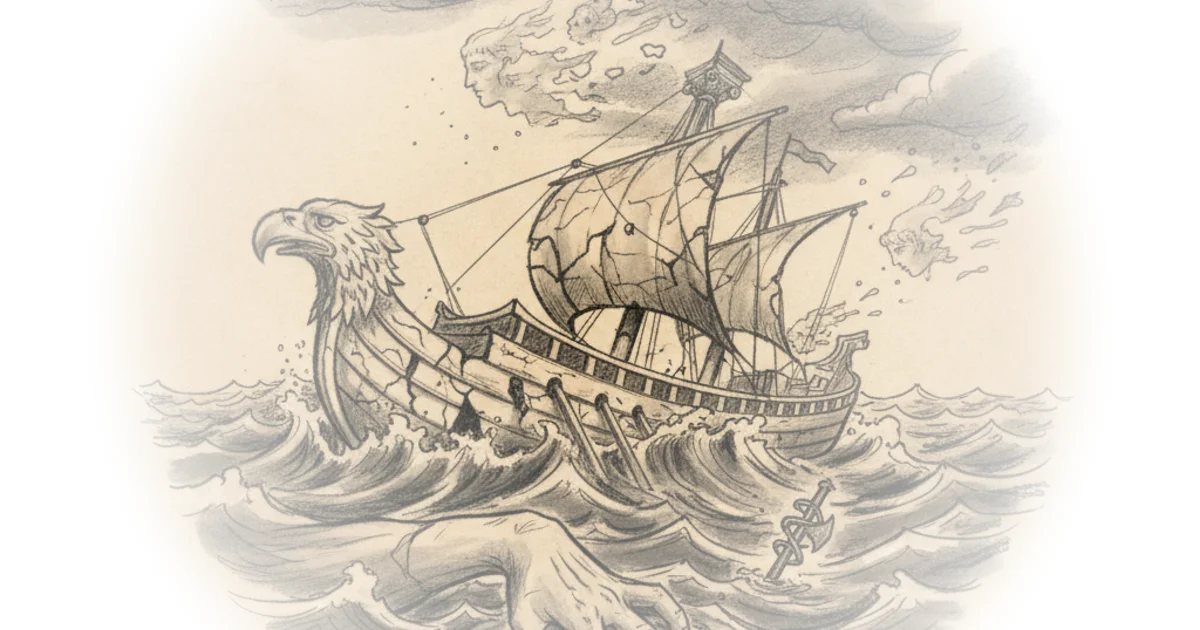
Carlin admits the challenge of telling this story without going back almost to when the republic starts to fray. "How does one tell a story like this without going back almost to when the republic starts to fray," he asks Barry Strauss—then immediately pivots to his actual interview subject, who has a much more focused target: the Battle of Actium in 31 BCE.
The Battle That Made Rome
The battle itself is Carlin's framing device. He sets it up as the climactic encounter between Mark Antony and Cleopatra on one side, Octavian (who will become Augustus) on the other. "This battle sort of determines how that hinge point is going to go obviously if octavian wins which he did it goes the way it went," Carlin explains. If the other side wins—Cleopatra and Antony together—"nobody knows how it goes right maybe you go back to a republic."
The counterfactual possibilities are what make this period sing, but Carlin acknowledges that "it seems pretty doubtful" after his conversation with Strauss. The interview itself is framed as a literary adventure: Barry Strauss's new book on the Battle of Actium is military history for people who love naval warfare.
There were like 600 ships right wooden ships big ships and you the mind has a hard time grasping that.
This is Carlin at his best—acknowledging how hard these ancient scale battles are to comprehend. He's not just telling us facts; he's helping us feel the weight of historical distance.
Cleopatra's Dynasty
The most fascinating portion involves Cleopatra's heritage. Carlin and Strauss discuss how the Ptolemaic dynasty ruled Egypt for three centuries, and Cleopatra was the only one who could speak Egyptian. "She is as far as we know the only one who could speak egyptian in the whole group," Strauss confirms.
Carlin frames this with an editorial observation: "the ptolemies represent in this period when one talks about the balance sheet and what what each side has as its strong point the ptolemies in egypt have money right they have money yes this is the wealthiest place in the mediterranean." This is Carlin's commentary on why Rome cared about Egypt at all—it wasn't military might, but cold hard cash that drove the whole conflict.
The Ptolemaic dynasty's "hijacking of alexander the great's body" becomes a favorite story. There are visits to Alexander's mummified corpse—reportedly by Caligula or Nero—and Carlin loves it: "one of my favorite stories and maybe the best example of that phrase that possession is nine tenths of the law right."
The Rise of Octavian
Perhaps the most substantive part involves how Octavian—the future Augustus—rose to power. Carlin asks about his mother, his early life, and Caesar's role in identifying talent. "Caesar gives him certain offices he holds minor offices even as a teenager," Strauss explains. More importantly, during the campaign in Spain in 45 BC, "octavius goes to spain he doesn't arrive in time for the battle but he arrives shortly afterwards and he spends about six months traveling around spain uh with his great uncle julius caesar."
Carlin's interpretation is sharp: "somebody looked at this kid and kid he was at the time and maybe it was julius himself and said you're destined for great things you have these specific qualities." This frames Octavian not as a self-made man, but as someone identified and cultivated by Caesar himself—a chosen heir in very real terms.
Individual vs. Structure
The piece's intellectual core involves whether individual personalities or larger forces drive history. Carlin poses it directly: "if you are trying to argue against the great man theory of history right... it's so hard when you get to this era because the individual personalities seem to be defying any rules."
Strauss responds with nuance, acknowledging that trends matter—"one of the overriding trends of this era is figuring out how to bring the elites and the concord of the roman empire into into the tent of the roman empire"—but also noting that "there's all the difference in the world between someone like anthony who's very talented and someone like octavian who's just a supernova when it comes to what it takes to be a strategist."
Bottom Line
This episode works because Carlin treats history as both massive structural transformation AND personal drama. The strongest thread is his framing of the Battle of Actium as determining whether the Roman Republic transforms into an empire or something else entirely—making ancient history feel like it's about stakes that matter. His vulnerability is in the interview format itself; Carlin's voice gets buried under Strauss's answers, which means some of the most insightful commentary comes from Carlin's questions rather than his responses. The result is a podcast that makes 31 BCE feel like it still matters today—which, for history nerds, is exactly what makes these episodes indispensable.