Niall Ferguson arrives with a chilling correction to our collective memory: wars do not end when the news cycle says they do. In this piece, he dismantles the comforting illusion that a ceasefire in the Strait of Hormuz equates to peace, arguing instead that we are witnessing a dangerous, slow-burning stalemate where economic pain is merely being redistributed rather than resolved. For the busy reader tracking global stability, the critical insight here is not the latest headline, but the terrifying timeline Ferguson constructs for a supply chain collapse that could trigger stagflation within months.
The Illusion of the Ceasefire
Ferguson begins by invoking the historian's paradox of time, noting that while financial crises move slowly before exploding, wars start fast and linger forever. He applies this lens to the current conflict, which he terms "Operation Epic Fury," launched in late February. Despite a ceasefire announced in early April, Ferguson argues the reality on the ground tells a different story. He writes, "A ceasefire is not a peace agreement," immediately grounding the reader in the precarious nature of the current truce. The evidence he marshals is stark: within days of the truce, Iranian drones struck the United Arab Emirates and swarmed U.S. ships, prompting the U.S. to sink six Iranian fast-attack boats. "The ceasefire was literally over," Ferguson states, stripping away the diplomatic fog.
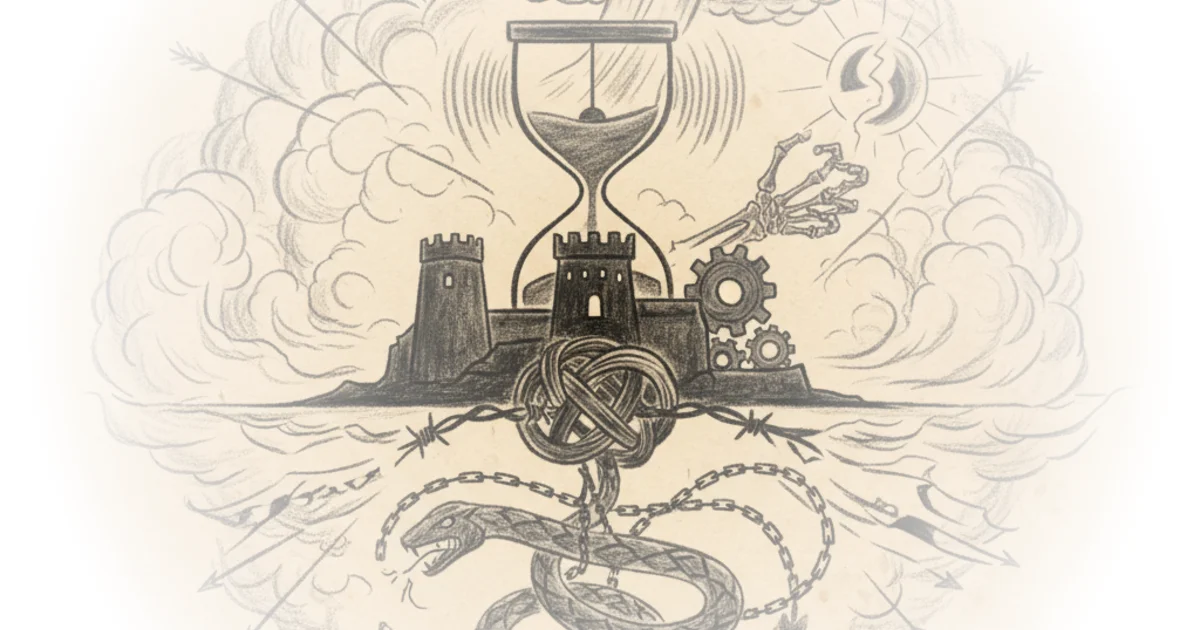
The author contrasts the diplomatic style of the past with the present, noting that while President Dwight Eisenhower practiced "brinkmanship," the current administration prefers "blinkmanship." This distinction is crucial to understanding the volatility. Ferguson describes how the executive branch paused "Project Freedom," a quasi-escort mission for commercial shipping, citing a request from Pakistan and claiming "Great Progress has been made toward a Complete and Final Agreement." Yet, he highlights the threat lurking behind the diplomacy: "If they don't agree, the bombing starts, and it will be, sadly, at a much higher level and intensity than it was before." This oscillation between negotiation and threat creates a state of perpetual uncertainty that is far more damaging to global markets than open warfare.
Wars take much less time to start than you think they will, and last much longer than you thought they could.
Ferguson's skepticism is well-placed. He draws a historical parallel to Woodrow Wilson's 14 Points in 1918, which were supposed to end World War I but were followed by another ten months of fighting. He warns that the current "one-page, 14-point memorandum of understanding" is merely a starting gun for further negotiations, not a finish line. The terms, according to leaks, involve an Iranian moratorium on nuclear enrichment, but the duration remains undefined—five years? Twenty? "If the Iranians make these concessions, I shall be flabbergasted," Ferguson admits, offering a dinner to the negotiators if he is proven wrong. This bet underscores the sheer improbability of the current diplomatic breakthrough.
The Economics of Attrition
The piece shifts to the brutal arithmetic of economic warfare, a theme Ferguson has explored in his companion deep dives on historical operations like Project Azorian. He argues that economic pressure is even slower to act than kinetic force. "The problem with economic warfare is that it is even more slow-acting than actual war," he writes. He cites the sanctions on Russia, which were expected to cripple the war machine but instead proved to be "maybe a 3" on the Richter scale of sanctions. The lesson is clear: no state can inflict pain on an adversary's economy without spilling that pain onto its own.
Ferguson dives into the data, projecting that Iran has roughly $26.2 billion in reserves, which could be exhausted in six to 14 months given the blockade. However, he identifies four critical "pressure valves" that prevent immediate collapse. Iran can bypass the sea blockade via land and air routes, barter oil for food, and utilize a burgeoning cryptocurrency sector developed over the last five years. Furthermore, the author notes that China is almost certainly providing both economic and military support. "There is a chance of Iranian economic and regime collapse, but it doesn't feel like the base case," Ferguson concludes. This is a sobering assessment that challenges the optimistic narrative of imminent regime change.
Critics might note that Ferguson underestimates the internal social unrest that hyperinflation—currently at 62.2 percent headline and 99 percent for food—could ignite. While the regime has pressure valves, the civilian population does not. However, Ferguson's focus remains on the strategic endurance of the state apparatus rather than the humanitarian cost, a choice that reflects his macro-historical lens but risks minimizing the human toll of the blockade.
The Global Supply Shock
The most alarming section of the commentary concerns the global ripple effects of the Strait of Hormuz closure. Ferguson moves beyond oil to discuss the critical shortages of fertilizer, sulfur, and helium. He presents three scenarios generated by an economic model, ranging from a quick reopening to a six-month closure. In the worst-case scenario, a six-month blockade would result in "global stagflation and a systemic collapse of the international fertilizer trade." He warns that the loss of sulfur would "cripple the global phosphate chain," destroying winter wheat preparations and pushing U.S. inflation to nearly 6 percent.
In Scenario 3, a six-month closure, represents a 'worst-case scenario' resulting in global stagflation and a systemic collapse of the international fertilizer trade.
Ferguson points out that the market's current optimism, driven by the AI boom, is dangerously disconnected from the physical reality of supply chains. "The markets may be up, but that doesn't sound too great to me," he writes, citing polling data that shows deep public disapproval of the administration's handling of inflation and gas prices. He notes that the Senate is now "surely in play," suggesting that the economic fallout could reshape the political landscape before the midterms. The author also touches on the rising political violence, noting that one in four young, liberal voters now believe violence can sometimes be justified, a sign of the deepening societal fracture.
Bottom Line
Niall Ferguson's most compelling argument is that the world is sleepwalking into a prolonged economic crisis disguised as a short military conflict. His strength lies in connecting the dots between a stalled diplomatic process, a resilient Iranian economy, and a fragile global supply chain that could snap within months. The piece's vulnerability is its heavy reliance on the assumption that the Iranian regime will prioritize survival over the suffering of its citizens, potentially underestimating the speed of internal collapse. The reader must watch the fertilizer and helium markets closely; if those prices spike, the "blinkmanship" of the administration will face a reality check that no amount of diplomatic theater can fix.