Adrian Neibauer delivers a stinging indictment of modern education not by citing dry statistics, but by exposing the quiet death of the teacher's soul. The piece's most startling claim is that the current drive for efficiency has transformed classrooms into assembly lines where "teaching" is merely "managing academic tasks" and students are reduced to test-score simulations. In an era obsessed with data, Neibauer argues that the very metrics we use to prove schools are working are the ones ensuring they are failing to teach.
The Cost of Compliance
Neibauer anchors his argument in a personal narrative that feels less like a memoir and more like a forensic report on a system in collapse. He describes taking over a fourth-grade classroom after the previous teacher walked out, only to find a space defined by "piles of busy work" and a lack of genuine instruction. This anecdote serves as a microcosm for the broader crisis: the system is so broken that a substitute teacher's first instinct is to "gut the room and redecorate it from scratch" just to find a foothold for authentic pedagogy.
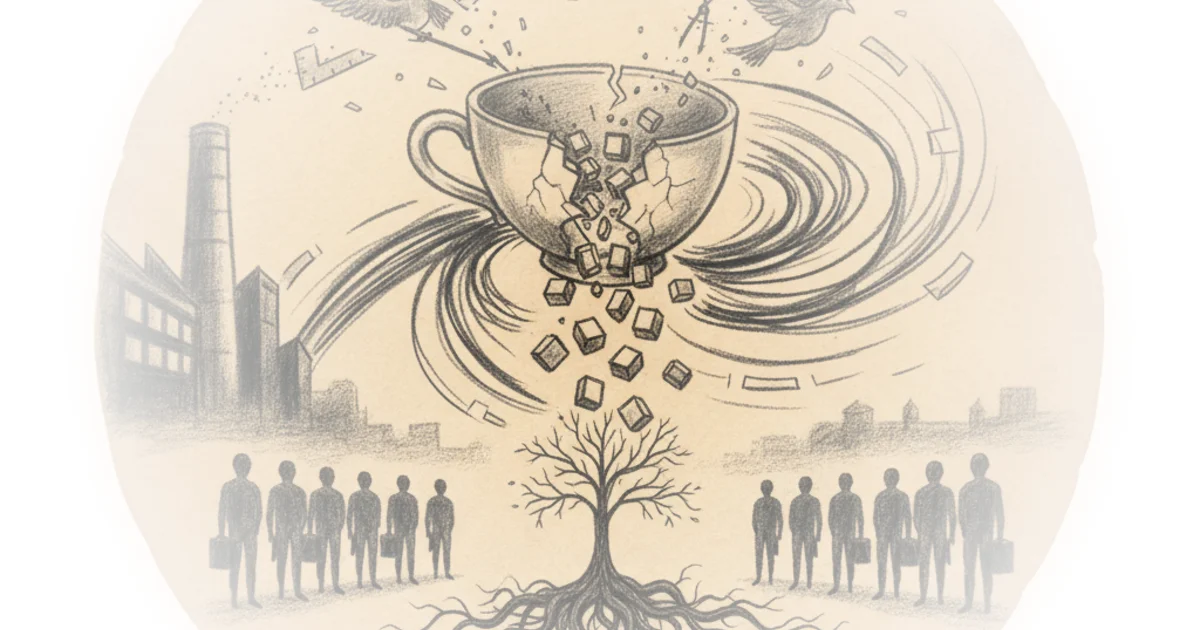
The author's central thesis is that standardization has stripped educators of their agency. "Teaching is an act of generosity and love," Neibauer writes, "To be the best teacher I could means understanding who I am and then fully sharing that with the students." This framing is powerful because it shifts the debate from "what works" to "who we are." It suggests that the rigid adherence to pacing guides and scripted curricula is not just an administrative burden, but a moral violation of the teacher-student relationship.
Critics might argue that without strict standardization, equity suffers, and that consistent delivery ensures every child gets the same baseline of instruction. However, Neibauer dismantles this by showing that the "same way, same day" approach often results in a hollow mimicry of learning rather than the real thing. He notes that under the current "15-Day Challenge" cycles, teachers are forced to "trudge students through short articles, identifying main ideas... because that is what is measured on the standardized test."
Efficiency is replacing humanity, valuing compliance over agency.
The Rise of "Faux" Learning
The most damning section of the piece is Neibauer's critique of "faux-writing." He draws a sharp distinction between the mechanical application of templates like Claim, Evidence, Reasoning (CER) and the messy, cognitive work of actual composition. Citing John Warner, Neibauer argues that when students are drilled to fill out sentence starters, they are not thinking; they are "trying to reproduce a correct answer for the test."
This argument resonates deeply when viewed through the lens of Project-Based Learning, a movement that historically championed student agency and real-world problem solving. While PBL often struggled with scalability, Neibauer's account suggests that the pendulum has swung so far toward standardization that even the scaffolding of critical thinking has been replaced by algorithmic responses. He writes, "Writing is simultaneously the expression and the exploration of an idea... in the act of that attempted capture, it's likely (and even desirable) that the idea will change." By enforcing rigid templates, the system punishes the very evolution of thought that education is supposed to foster.
The author's description of the classroom environment under this regime is haunting: "Instead of boisterous classrooms with students asking questions, classrooms are quiet and dull." This silence is not the quiet of deep concentration, but the silence of compliance. Neibauer points out that students are now reading "AI-generated texts" and locating details, a cycle that produces "identical written responses" across the district. The irony is palpable: in a world increasingly shaped by artificial intelligence, schools are training students to act like machines.
The Loss of Connection
The ultimate cost Neibauer identifies is the erosion of community and critical dialogue. He recounts a conversation with an administrator who praised a Socratic Seminar, only for Neibauer to reveal that such discussions are now impossible within the rigid constraints of the standardized curriculum. "There is no room for discussions in 15-Day Challenges," he explains, because the system prioritizes drilling discrete skills over "wrestling with complex ideas."
This is where the argument hits its emotional peak. Neibauer asserts that while students may leave school able to "summarize the text" or "draw inferences," they will have missed the chance to "read an entire novel and discuss it with anyone." The trade-off is explicit: we have gained the ability to measure narrow skills but lost the capacity for meaningful connection. As Neibauer puts it, "In the push to desperately raise test scores by making every classroom the exact same, schools have lost the very essence of public education: meaningful connection through authentic teaching and learning experiences."
The piece acknowledges that this outcome was not accidental but the result of policy choices dating back to the No Child Left Behind era. The prevailing idea that "if every student is drilled on the same standards in the same way, standardized test scores will rise" has proven to be a fallacy that ignores the human element of learning. Neibauer's conclusion is that "my classroom learning experiences can never be standardized," a declaration of resistance that feels increasingly urgent.
Bottom Line
Neibauer's strongest asset is his refusal to accept the premise that standardization equals quality; he exposes the hollowness of "simulations" that look like learning but lack the substance of critical thought. The argument's vulnerability lies in its reliance on the ideal of the autonomous teacher, which may be difficult to scale in under-resourced districts, yet the core insight remains undeniable: a system that values the test over the thinker is failing its most important mission. As schools double down on these cycles, the risk is not just lower test scores, but a generation trained to follow instructions rather than think for themselves.