Heather Cox Richardson delivers a chilling exposé on a $1.776 billion fund that bypasses the courts to place nearly two billion dollars of taxpayer money under the direct, unaccountable control of the executive branch. The piece's most startling claim is not merely the existence of the fund, but its explicit design to function as a "pardon on steroids," shielding the former president and his associates from future tax audits and criminal prosecution while potentially rewarding those involved in the January 6 insurrection.
The Mechanics of a Slush Fund
Richardson immediately dismantles the administration's framing of the "Anti-Weaponization Fund" as a legitimate redress for victims of "lawfare." She points out the fundamental legal absurdity: the fund was created after the plaintiff dropped a lawsuit that was destined to fail, not as a result of a court-ordered settlement. "The document that purports to be a 'settlement' has the words 'settlement agreement' written in capital letters across the top of it, but the important word is 'agreement,'" Richardson writes. "It is not the settlement of a legal case: Trump dropped the case when it looked like the judge would throw it out. It is simply an agreement between Trump and his own appointees at the Department of Justice."
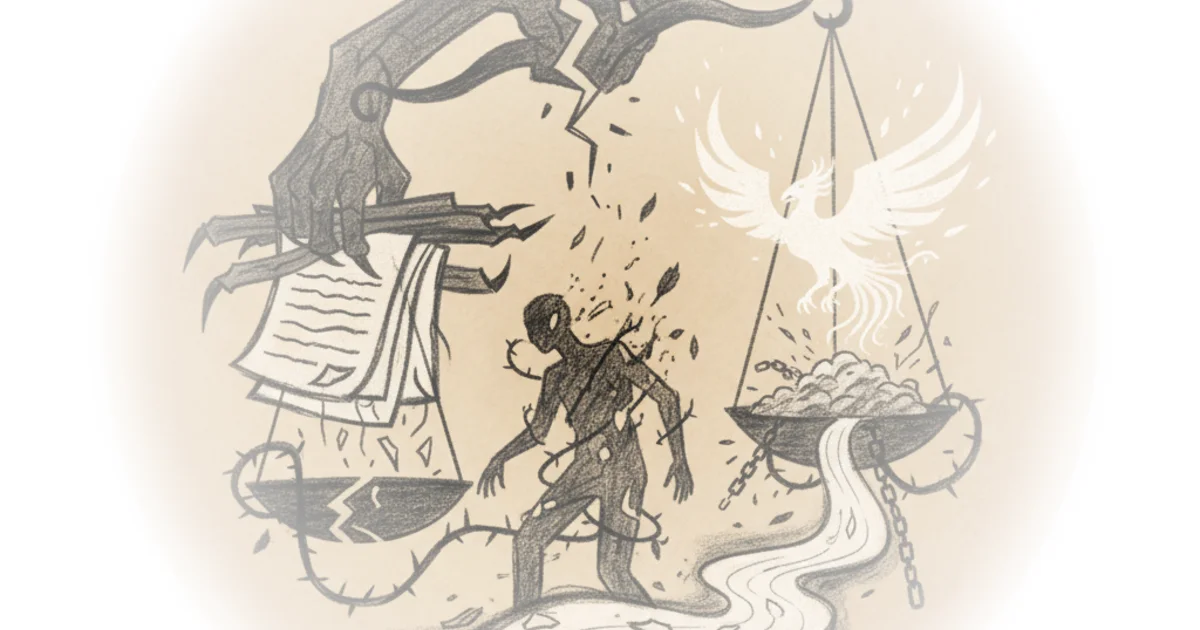
This distinction is critical. By avoiding a judicial settlement, the administration sidesteps the rigorous oversight and public record-keeping that usually accompany such payouts. Richardson highlights that the fund is structured to be a black box: a five-person committee, four of whom are hand-picked by the acting attorney general, will decide who gets paid, with the process remaining confidential and overseen only by the very department that created the fund. The lack of transparency is staggering. "Once the funds are deposited into the Designated Account, the United States has no liability whatsoever for the protection or safeguarding of those funds, regardless of bank failure, fraudulent transfers, or any other fraud or misuse of the funds," she notes, quoting the DOJ document. This clause effectively creates a legal shield for mismanagement, a feature that would be unthinkable in any other federal program.
Critics might argue that the administration is simply providing a mechanism for those who feel targeted to seek closure, but the sheer scale of the fund and the specific exemptions granted to the former president suggest a different motive. The structure mirrors the historical precedent of the Keepseagle v. Vilsack settlement, which addressed systemic discrimination against Indigenous farmers, yet as Richardson observes, "Unlike the Keepseagle settlement, though, Trump's fund is not part of a legal settlement." The comparison only serves to highlight the irregularity of the current arrangement.
It is simply an agreement between Trump and his own appointees at the Department of Justice. And what an agreement it is.
The Constitutional Red Flag
The commentary takes a darker turn as Richardson connects the fund's specific dollar amount—$1.776 billion—to the rhetoric of the January 6 insurrection. The number is not random; it is a deliberate invocation of the year 1776, a symbol co-opted by the rioters. "Famously, on January 6, 2021, newly-elected representative Lauren Boebert (R-CO) posted, 'Today is 1776.' During the attack, the rioters shouted '1776,'" Richardson writes. This connection raises a profound constitutional question: does the fund violate the Fourteenth Amendment, which explicitly prohibits the government from paying debts incurred in aid of insurrection?
Richardson brings in the perspective of legal scholar Jonathan Ladd and Representative Jamie Raskin to underscore the gravity of this potential violation. "In his comments to Sargent, Raskin noted that if the fund pays off the January 6 rioters, the government will be doing precisely that: 'using federal taxpayer dollars to compensate people who participated in insurrection.'" The evidence suggests the administration is already signaling that such payouts are on the table. Richardson details how Senator Chris Van Hollen questioned the acting attorney general about whether a pardoned rioter who committed sexual abuse and tried to use the fund to silence his victims would be eligible. The official's refusal to rule it out, combined with the fact that the administration has discussed paying rioters since late 2024, paints a picture of a system designed to reward political loyalty over legal accountability.
The human cost of this policy is not abstract. Richardson points to the case of Andrew Paul Johnson, a pardoned rioter convicted of abusing children, who claimed he would use expected fund payouts to buy the victims' silence. "At the time of Johnson's sentencing, Representative Jamie Raskin (D-MD) noted that Trump's support has made the January 6 rioters 'think they're untouchable,'" she writes. This sense of impunity is exactly what the fund appears designed to cement, turning the justice system into a tool for political protection rather than a guardian of the law.
A Pardon on Steroids
The most damaging revelation in the piece is the amended agreement that effectively grants the former president immunity from IRS investigations. Richardson explains that the new document "RELEASES, WAIVES, ACQUITS, and FOREVER DISCHARGES" the former president and his associates from any claims related to the IRS. "In other words, Blanche is asserting a blanket promise to stop all IRS audits of Trump's taxes and not to prosecute any crimes Trump, his family, his businesses, or his associates might have committed that crossed the IRS," she writes. This moves beyond a simple settlement; it is a pre-emptive strike against the rule of law.
Legal analyst Joyce White Vance is quoted describing the document as "a pardon on steroids," a phrase that captures the sheer scope of the immunity being granted. Richardson draws a historical parallel to the prosecution of Al Capone, noting that "after years of pursuing the gangster Al Capone, the government finally managed to convict him of tax evasion. It appears Blanche and Trump's loyalists are trying to make sure that can't happen again, declaring any such investigations the 'weaponization' of the Justice Department." This reframing of legitimate law enforcement as political persecution is a strategy designed to erode public trust in the institutions meant to hold power accountable.
The piece concludes by contrasting this massive financial maneuver with the administration's distraction on other fronts. While the attorney general testifies before Congress about the fund, the former president holds a press conference focused on building a "drone-proof" ballroom with "sniper capacity." "He wanted to talk about his ballroom," Richardson writes, noting the surreal disconnect between the corruption of the fund and the leader's focus on fortifying his own image. The juxtaposition serves as a final, stark reminder of where the administration's priorities truly lie.
Bottom Line
Richardson's strongest argument lies in her forensic dissection of the legal mechanics, proving that this is not a settlement but a unilateral grant of power that bypasses the judiciary and the Constitution. The piece's biggest vulnerability is its reliance on the assumption that the courts will eventually intervene, a hope that may be misplaced given the current composition of the federal bench. Readers should watch for the first disbursement of funds, which will likely be the moment the true scope of this immunity pact becomes undeniable.