Cory Doctorow delivers a chilling diagnosis of the current economic moment, arguing that the artificial intelligence boom is not a technological renaissance but a predatory mechanism designed to strip wealth from ordinary workers. He doesn't just predict a market correction; he frames the entire bubble as a deliberate transfer of life savings from the many to the few, leaving behind a landscape of ruin that only the insiders can navigate.
The Anatomy of a Fraudulent Legacy
Doctorow begins by dissecting the aftermath of past economic collapses to establish a pattern of "productive residue." He contrasts two massive corporate frauds from the early 2000s: Enron and Worldcom. While both were monumental scams, their legacies diverged sharply. Enron, a scheme that engineered rolling blackouts to jack up energy prices, left behind almost nothing but a "giant repository of emails" that became a privacy-violating dataset for researchers.
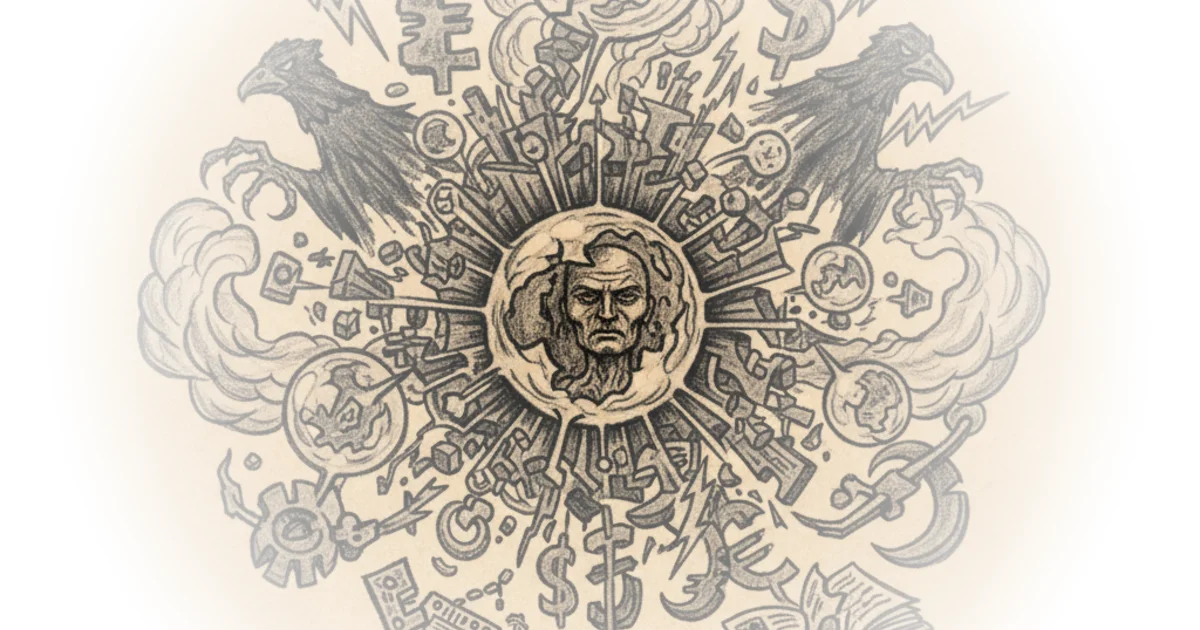
In stark contrast, Worldcom falsified orders for fiber optic lines, yet when the fraud was exposed, the physical infrastructure remained. "When Worldcom went bankrupt, all that fiber stayed in the ground, and many people are still using it today," Doctorow notes. He points out that his own home in Burbank relies on this very fiber, bought for pennies by AT&T after the collapse. This distinction is crucial: Enron was pure extraction, while Worldcom, despite its criminality, accidentally built the backbone of the modern internet.
"The point of the bubble wasn't ever the residue or lack thereof — it was a transfer from working people to crooks."
Doctorow applies this lens to the cryptocurrency bubble, which he predicts will follow the Enron model. He argues that while crypto will eventually go to zero, the only "residue" will be "shitty monkey JPEGs and even worse Austrian economics." He acknowledges a minor silver lining: the bubble subsidized a generation of programmers learning Rust and cryptography. However, he dismisses this as "small ball" compared to the hundreds of billions flushed away to enrich insiders.
Critics might argue that the technological innovations in distributed ledgers have genuine utility beyond speculation, but Doctorow's focus remains on the net loss of societal wealth. He suggests that the tools developed, like Metalabel's revenue-sharing logic, are useful only because they are being stripped of their toxic financial shell.
The AI Bubble as Worldcom on Steroids
The core of Doctorow's argument is that the current AI bubble is more akin to Worldcom than Enron, but with catastrophic stakes. He posits that once the hype subsides, the physical assets—the data centers, the graphics processing units, and the skilled workforce—will remain. "The data centers will still stand. The GPUs will still be there," he writes, noting that these assets could be repurposed for genuine innovation once the speculative frenzy ends.
He draws a parallel to the dot-com crash of the early 2000s, where the collapse of inflated valuations allowed a new wave of entrepreneurs to access cheap hardware and talent. "Almost overnight, the legion of humanities undergrads who'd been treated to subsidized training in perl, Python and HTML found themselves looking for work," he recalls. This environment birthed Web 2.0, allowing people to build "real things that were good" without the interference of venture capital demanding impossible returns.
"It's one thing to anticipate salvaging something useful out of a catastrophe, and another thing altogether to deliberate induce or prolong that catastrophe so as to maximize the amount of salvage."
However, Doctorow insists that the potential for a "Web 2.0 moment" in AI does not justify the bubble itself. He argues that the current surge is not a natural market correction but a rigged game. He points out that since the Carter administration, workers have been forced to shift from defined-benefit pensions to 401(k)s, effectively making them bet their retirement on the stock market.
The Human Cost of "Irrational Exuberance"
The most damning part of Doctorow's analysis is his focus on who pays the price when the bubble bursts. He describes the stock market as a casino where "nearly all the money is harvested by less than 1% of bettors." With 35% of the S&P 500 tied up in seven AI companies, he warns that a pop in this sector would vaporize a third of the US stock market.
"Millions of people who worked hard all their lives and deprived themselves of small comforts in order to save for their retirement will be wiped out."
He paints a grim picture of the aftermath: retirees forced to sell homes to pay medical bills, a collapse in consumption that tanks the economy for a generation, and a political vacuum that invites authoritarianism. "Austerity drives voters into the arms of fascist strongmen, who blame all their woes on a scapegoated minority in order to win office," he warns. This connects the financial mechanics of the bubble to the broader rise of political extremism, suggesting that economic despair is the primary fuel for the current global shift toward fascism.
Doctorow's framing is effective because it refuses to let the "productive residue" argument serve as an excuse for the fraud. He acknowledges that the South Sea Bubble of the 1720s and the Enron scandal both left behind some historical lessons or infrastructure, but he insists that the moral calculus remains the same. The swindlers are "monsters" who have set out to destroy the futures of a generation of savers.
Bottom Line
Doctorow's strongest contribution is his refusal to separate the technological potential of AI from the predatory financial engineering that currently drives it. While the argument that the bubble will leave behind useful infrastructure is plausible, his warning that the human cost will be catastrophic is the piece's defining insight. The biggest vulnerability in his thesis is the assumption that the bubble must pop to save the economy, ignoring the possibility of a prolonged, slow-burn stagnation that could be equally damaging. Readers should watch for how the 35% concentration of the S&P 500 in AI stocks plays out, as this single metric could determine the stability of the next decade.