Ryan Grim & Jeremy Scahill deliver a dispatch that refuses to let the world look away from the grinding machinery of destruction in Gaza, while simultaneously exposing how the machinery of American power is being retooled to enable it. This is not merely a list of headlines; it is a forensic accounting of a genocide in real-time, paired with a chilling look at the legal and financial architectures being built to sustain it. The most jarring revelation is not just the scale of death, but the specific, calculated nature of the debris left behind: over 60 million tons of rubble, a landscape so saturated with explosives and asbestos that it threatens to poison the region for generations.
The Weight of Rubble and the Cost of Silence
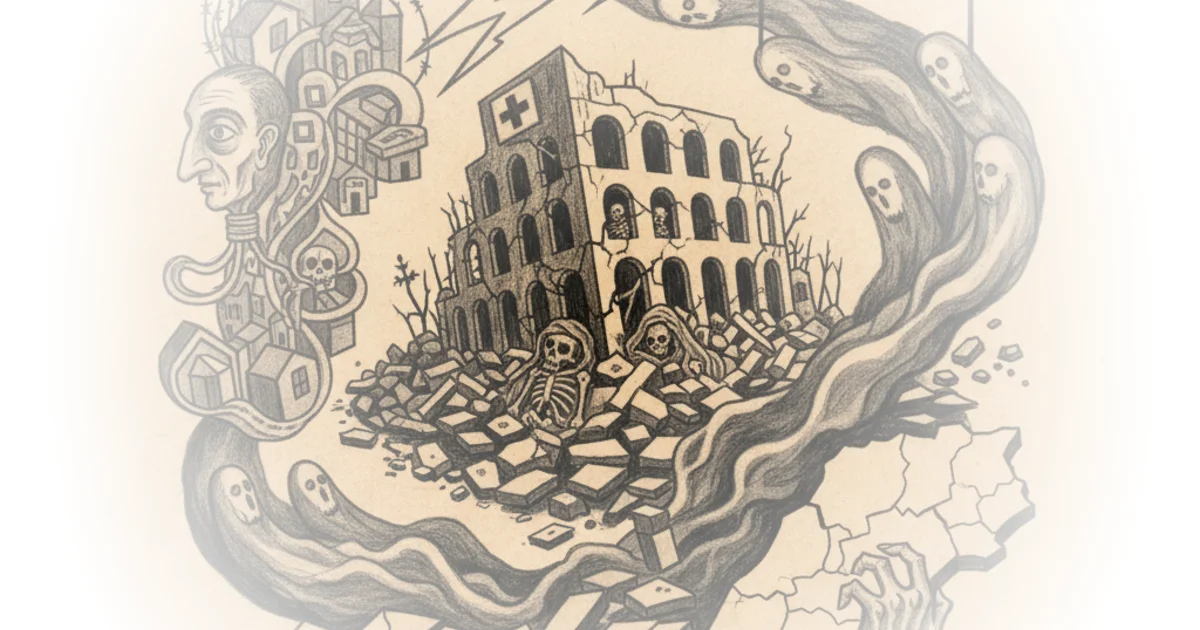
The coverage anchors itself in the immediate, visceral horror of the Al-Shifa Hospital exhumation, where Civil Defense teams recovered 98 bodies from the courtyard. Grim & Scahill do not shy away from the forensic reality of the destruction. They report that "Gaza’s Environmental Quality Authority told an emergency government meeting this week that Israel’s assault has produced more than 60 million tons of rubble—including 4 million tons of hazardous waste, 50,000 tons of asbestos, and roughly 100,000 tons of explosives and unexploded ordnance." This statistic transforms the narrative from a temporary humanitarian crisis into a permanent ecological disaster. The authors effectively argue that the destruction of infrastructure is not collateral damage but a strategic outcome, noting that the "destruction of 80 percent of Gaza’s water and sanitation infrastructure" has spread contamination across the enclave.
As the authors note, the human toll is relentless even under a supposed ceasefire. "Since October 11, the first full day of the ceasefire, Israel has killed at least 377 Palestinians in Gaza and wounded 987, while 626 bodies have been recovered from under the rubble." This framing is crucial; it dismantles the notion that the violence has paused, replacing it with a grim reality of continued attrition. The piece highlights that winter storms are now compounding the tragedy, with officials warning that the storm "carries real dangers, including the flooding of tents, the inundation of displaced encampments by rainwater, and the renewal of the tragedy endured by more than 1.5 million displaced people." The editorial choice to link the climate disaster directly to the blockade—"We hold the Israeli occupation fully responsible for exposing displaced persons to the dangers of the climate"—is a powerful indictment of the policy of containment.
The Gaza genocide has created over 60 million tons of rubble, leaving at least 700,000 tons of uncollected waste and causing widespread chemical leakage into Gaza’s soil and groundwater.
Critics might argue that focusing on environmental data distracts from the immediate political negotiations, but Grim & Scahill make a compelling case that the environmental ruin is a permanent feature of the occupation, rendering any political solution moot without addressing the physical reality of the land.
The Architecture of Annexation and Impunity
The commentary shifts from the rubble of Gaza to the legislative and financial engines driving expansion in the West Bank and the normalization of violence within Israel. The authors expose a coordinated effort to cement control through land and law. They detail how "Israel’s far-right finance minister Bezalel Smotrich has allocated 2.7 billion shekels ($843 million) over five years to dramatically expand settlements across the occupied West Bank," a move described by Israeli media as "de facto annexation." This allocation is not merely about housing; it is about "legalizing existing outposts" and relocating army bases into Palestinian areas, effectively erasing the possibility of a contiguous Palestinian state.
The piece takes a particularly dark turn when examining the rhetoric of Israeli leadership. Grim & Scahill describe a disturbing spectacle where "Israeli National Security Minister Itamar Ben-Gvir, Heritage Minister Amichai Eliyahu, and other members of the Otzma Yehudit (Jewish Power) party wore gold noose pins—a symbol widely associated with racial terror and lynching—to signal support for legislation that would allow Israel to execute Palestinian detainees." The authors quote Ben-Gvir directly, noting he said the noose is just "one of the options through which we will implement the death penalty law for terrorists...there is the option of the gallows, the electric chair, and also the option of euthanasia." This is not hyperbole; it is a documented statement of intent by a cabinet minister, signaling a shift toward state-sanctioned extrajudicial killing.
The authors further highlight the systemic nature of this injustice, pointing out that "Israeli military courts convict more than 99% of Palestinian defendants." This statistic provides the necessary context for the noose pins: they are not an anomaly but a reflection of a judicial system that has already abandoned due process. The coverage also notes the holding of 32 Gazans with expired sentences, a practice the authors label a "war crime under the Fourth Geneva Convention," and the return of bodies showing signs of "systematic" violations, including organ removal.
The American Enabler
Perhaps the most significant contribution of this piece is its unflinching look at how the United States is legally and financially binding itself to these actions. Grim & Scahill reveal that the National Defense Authorization Act (NDAA) would "require ongoing U.S. assessments of any foreign arms embargoes on Israel and authorize Washington to fill resulting 'defense capability gaps.'" This effectively mandates that if European allies like Spain or the Netherlands suspend arms sales, the U.S. must step in to ensure Israel's military machine never stalls. The authors write that the act would "obligate the U.S. to supply weapons whenever other governments suspend weapons exports in response to Israel’s conduct."
The piece also scrutinizes the consolidation of media power, noting that "Paramount Skydance launched a $108 billion hostile takeover bid for Warner Bros. Discovery—a move backed by Jared Kushner’s private-equity firm, Affinity Partners." The authors suggest this is not just a business deal but a political maneuver, as executives reportedly told shareholders that "Kushner’s involvement could ease regulatory approval under a Trump administration." This connection between media consolidation and political patronage underscores the authors' broader argument about the erosion of independent oversight.
Furthermore, the commentary addresses the dismantling of the administrative state, noting that the Supreme Court seems ready to support the firing of independent bureaucrats. The authors highlight Justice Elena Kagan's warning that dismantling these protections would hand the White House "massive unchecked" power. This is framed not as a political squabble but as a fundamental shift in the balance of power that threatens the ability of agencies to regulate nuclear safety or labor relations. The piece also touches on the human cost of immigration policy, where "unaccompanied children as young as three are being forced to appear before a judge and defend themselves against deportation, often without lawyers."
The Supreme Court’s conservative majority signaled Monday that it is prepared to overturn 'Humphrey’s Executor,' the 90-year-old precedent that limits a president’s ability to fire members of independent federal agencies.
A counterargument worth considering is that the administration views these tariffs and policy shifts as necessary leverage to force compliance on water and border issues. However, the evidence presented by Grim & Scahill suggests these actions are less about negotiation and more about the unilateral imposition of will, often at the expense of vulnerable populations, from Mexican farmers to Yemeni separatists.
Bottom Line
Ryan Grim & Jeremy Scahill have constructed a narrative that connects the dots between the rubble of Gaza, the expansion of West Bank settlements, and the legal frameworks in Washington that enable both. Their strongest move is treating the environmental destruction of Gaza not as a side effect but as a central feature of the conflict, while simultaneously exposing the U.S. legal mechanisms that guarantee the continuation of the violence. The piece's biggest vulnerability is the sheer density of its grim findings, which risks overwhelming the reader, yet this density is precisely what makes the argument undeniable: the machinery of destruction is not broken; it is functioning exactly as designed. Readers must watch for the implementation of the NDAA provisions, which could legally force the U.S. to override international pressure on Israel, effectively ending any hope of a unified global response to the crisis.