The Will to Power: Why Nietzsche's Most Dangerous Idea Still Matters
Nietzsche's "will to power" isn't just another philosophical concept—it's a radical redefinition of what it means to be human. In section 36 of Beyond Good and Evil, Friedrich Nietzsche articulates something that has haunted Western thought ever since: the idea that reality itself is driven not by logic or reason, but by an underlying force of expansion, expression, and power.
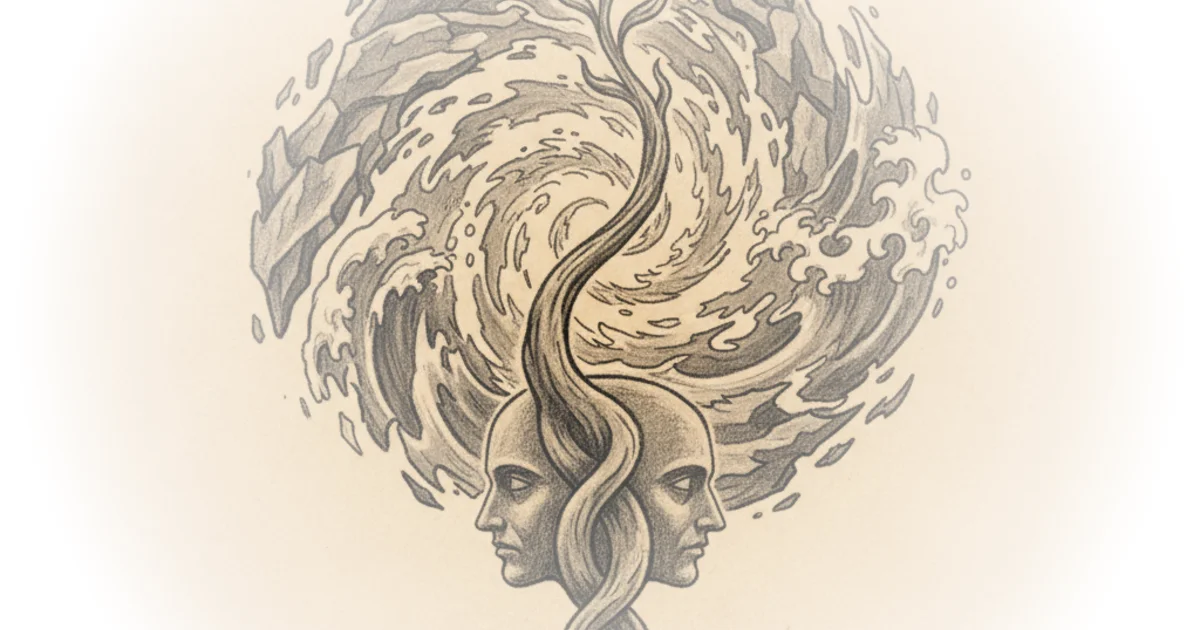
This isn't abstract metaphysics. It's a fundamental challenge to how we think about choice, causation, and what it means to will anything at all.
The Desire-Driven Universe
Nietzsche opens this section with a provocative question: what if everything we experience as "reality" is simply the world of our desires and passions? What if there is no other reality accessible to us beyond that driven by our feelings?
Most thinkers would consider this limiting—a constraint on human knowledge. But Nietzsche flips it entirely. He argues that this desire-driven reality isn't a poor substitute for some higher truth. It's sufficient. It captures reality just as effectively as so-called mechanical or material explanations—perhaps even more authentically.
The key insight is this: when we try to understand the world through cold mathematical models, we lose something vital. We chop continuous processes into artificial pieces. We create beginnings and ends where none exist. We separate emotions from thoughts, desires from actions. But reality doesn't work that way.
Nietzsche calls for what he terms a "morality of method"—a recognition that all organic functions, including self-regulation, nutrition, metabolism, and cellular processes, are synthetically united. These aren't discrete mechanical operations. They're one unified process happening simultaneously.
Freud's Ghost and the Mechanical Mind
This insight connects directly to Freud's early work on psychological processes—attempts to define mental life through energy units like psychic atoms of plus and minus, seeking a balance akin to electrical fields.
Nietzsche anticipates what critics would later call the problem of first cause. If we believe in causality—if we believe things have causes—then we must ask: what caused the first cause? The big bang before the big bang? These temporal puzzles reveal that when you artificially divide reality into separate parts, you create insoluble problems.
The will to power solves this by eliminating the imagined subject—the "I" that stands outside all these processes. There is no separated thinker judging from above. There is only the will to power as a functional natural force: the primary drive of life itself, the drive for expansion and expression.
Beyond Free Will and Determinism
This is where Nietzsche's argument becomes genuinely revolutionary.
The traditional debate frames everything as either free will or determinism—a binary choice that has paralyzed philosophy for centuries. But Nietzsche offers something else entirely. The will to power isn't a choice. It's not a decision made by some floating monad. It's a law of the universe, like gravity.
All life has this will. Not in any sense of "free" choice in the way we typically mean it—but as a fundamental operating principle. When critics ask whether we have free will, Nietzsche responds: what do you even mean by "free"? The question isn't whether will exists. It absolutely exists. It's necessary for life.
The binary opposition between free will and determinism is, Nietzsche suggests, almost complete vacuity. It fails to account for the vast intellectual history of people who have thought carefully about these problems—including Nietzsche himself.
Critics might note that reducing all human motivation to "will to power" risks oversimplifying complex psychological phenomena. The drive for power explains much but perhaps not everything: artistic creation, pure intellectual curiosity, or altruistic sacrifice seem poorly served by this lens.
Reality captured through desires and emotions is more real than reality captured through mechanical equations.
What Nietzsche offers instead is a third option—one that most people simply haven't considered because they're trapped in the binary. The will to power isn't an illusion. It doesn't obstruct or damage our reasoning. It's the pathway to what he calls the intelligible world: the world felt through our bodies, through emotions, through psychological constructs and senses.
Bottom Line
Nietzsche's articulation of the will to power remains one of the most audacious challenges in Western philosophy because it doesn't deny agency—it redefines what agency means. The strongest part of this argument is how thoroughly it dismantles the false choice between free will and determinism, revealing both positions as incomplete. Its vulnerability is its ambition: if everything is will to power, the concept risks explaining everything and nothing simultaneously. Readers curious about these questions should next explore how Deleuze and Guattari developed this into their "desire machines"—the logical continuation of exactly this insight.