A Scientist Turns on the System That Made Him
Zhang Hong is a 56-year-old biologist and academician at the Chinese Academy of Sciences. He specializes in autophagy research, holds a PhD from the Albert Einstein College of Medicine, and has spent two decades building a career inside China's scientific establishment. He is, by any measure, a system insider. Which makes his broadside against what he calls "resource-driven research" all the more striking.
Published in December 2025 by the Chinese-language outlet "The Intellectual," Zhang's essay -- introduced and translated by Sinification's James Farquharson and Paddy Stephens -- attacks the way massive centralized funding is corroding the culture Chinese science needs to produce genuinely original work. His argument is not that China spends too much on research. It is that the money flows in the wrong direction, rewarding scale over insight and bureaucratic maneuvering over scientific curiosity.
The Barren Soil Problem
Zhang concedes freely that Chinese research output is booming. Hundreds of papers appear each year in the top-tier Cell, Nature, and Science journals. The "1-to-100" applied work -- taking known breakthroughs and developing them further -- is genuinely strong. But he draws a sharp line between that kind of progress and the foundational discoveries that create entirely new fields.
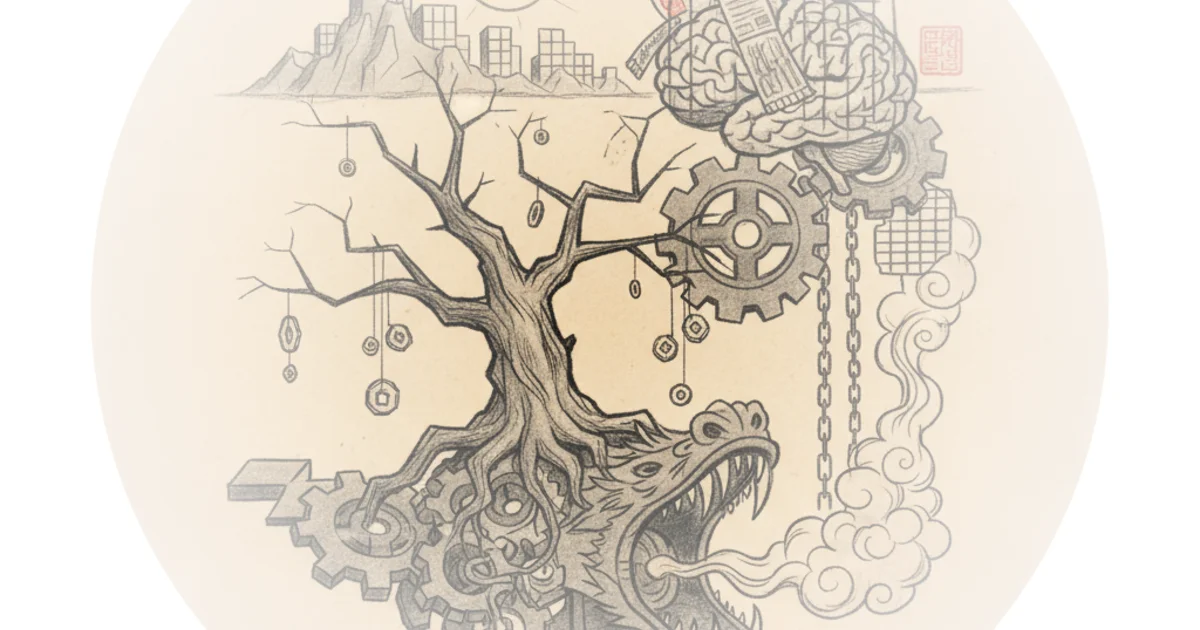
Chinese scientific research is flourishing, and we should never underestimate the value of "1-to-100" research. However, what the country truly needs to encourage "0-to-1" original discoveries is the right "soil." Yet in recent years, that "soil" -- or scientific culture -- for producing innovative discoveries has become increasingly "barren."
The metaphor is agricultural and deliberate. You cannot force a harvest by dumping fertilizer on dead ground. Zhang argues that the obsessive pursuit of large-scale, resource-intensive projects is not merely wasteful -- it actively poisons the conditions under which original thinking might grow.
Some papers cost tens of millions, even hundreds of millions to produce; it is by dint of the vast quantities of money and human labour they involve that they get published.
For a developing country, Zhang considers this terrible value for money. Worse, these mega-projects crowd out the smaller, curiosity-driven work that actually leads to breakthroughs.
From Zero-to-One Down to Zero-to-Minus-One
Zhang's most caustic formulation is his inversion of the familiar innovation scale. Rather than moving from zero to one -- the leap of fundamental discovery -- he argues that China's scientific culture is actually regressing. The system piles resources into impressive-looking projects that produce what he bluntly calls "a heap of rubbish."
The kind of research in our country that relies on amassing manpower and resources is much like collecting stamps -- the papers it produces are ultimately just a heap of rubbish.
He points to a particular kind of irreproducibility: not fraud, but sheer scale. When a result requires tens of thousands of omics datasets and enormous teams to produce, no independent lab can verify it. The papers look authoritative. They are, in a practical sense, unfalsifiable.
This creates what Zhang describes as a vicious cycle. Resource-heavy papers get published in prestigious journals. Publication brings awards and recognition. Recognition unlocks more resources. Young scientists watch this cycle and draw the obvious conclusion.
This not only squeezes out research funding for young people, but also encourages many to imitate the seemingly "successful path" of these individuals. Young researchers come to believe that they too must seek out resources and "hang on to the coattails" of powerful patrons.
The phrase "hang on to coattails" has become common parlance among China's junior researchers, Zhang notes -- a fact that itself measures how far the culture has drifted from independent scientific inquiry.
The Returnee Problem
Where Zhang's critique becomes most pointed is in his assessment of superstar scientists returning to China from elite Western universities. These homecomings are usually narrated as triumphs -- proof that China can lure top talent back. Zhang sees something more complicated and often corrosive.
He recounts a moment that "particularly shocked" him. When he told a younger colleague that a well-known senior scientist was about to return to China, the first response was not excitement but alarm:
How many young people will have to tighten their belts and be left without funding to do research?
The returnees, Zhang argues, frequently demand salaries several times their American pay and budgets far exceeding what they had abroad. New institutions compete to lure them with nearly unlimited resources. But few of these celebrated figures actually mentor young talent or build the healthy research cultures they were recruited to establish.
They must not assume that because they return and an institution is willing to offer so much money, this is merely a matter between two parties. It is not!
The money is public. The damage extends beyond the transaction. Every yuan funneled into a returnee's vanity institute is a yuan not available to a young principal investigator doing patient, original work in a lab.
Celebrity Scientists and Broken Peer Review
Zhang reserves particular scorn for what he calls "internet celebrity scientists" -- researchers who spend more time cultivating public profiles than working at the bench.
So-called "internet celebrity scientists" who are constantly active in public are certainly not on the front lines of research. Nor, indeed, are they thinking deeply about scientific problems, because they are too busy maintaining their online "internet celebrity" effect.
These figures, he argues, wield outsized influence on policy and resource allocation despite being entirely detached from laboratory reality. The problem is compounded by a peer review system that Zhang considers fundamentally broken. Funding evaluations group unrelated disciplines together -- plant science alongside cell biology alongside ecology -- in pursuit of a superficial fairness that makes genuine expert assessment impossible.
If you asked me as a life scientist to evaluate mathematics or physics, how would I do it? I believe we need to set aside these formal, superficial notions of fairness and impartiality, and return to peer review.
The result is that the people who evaluate research are often unqualified to judge it, and the people who are qualified have been sidelined by bureaucratic procedures designed to look impartial.
A Counterpoint Worth Noting
Zhang's argument, powerful as it is, has a blind spot. He acknowledges that large-scale projects like genomics "have made immense contributions to humanity," then waves this aside to focus on the abuses. But the line between wasteful mega-science and productive mega-science is not always obvious in advance. China's investment in structural biology, cryo-electron microscopy infrastructure, and large-scale sequencing has produced internationally recognized work that could not have emerged from small curiosity-driven labs alone. The question is not whether big science is always bad -- Zhang himself says it is not -- but whether China has the evaluation mechanisms to tell the difference. On that point, his critique is devastating.
It is also worth noting that the pathologies Zhang describes are not uniquely Chinese. American science has its own version of resource-driven research, its own celebrity scientists, and its own young investigators struggling for funding while established labs absorb disproportionate shares of NIH grants. What distinguishes the Chinese case, as Zhang presents it, is the speed and scale at which centralized funding decisions can distort an entire ecosystem.
Bottom Line
Zhang Hong is a system insider making an argument that system insiders rarely make in public -- certainly not in China. His essay is a detailed, specific, and angry indictment of how bureaucratized funding is hollowing out the scientific culture that China needs to compete at the frontier. The "0-to-minus-1" formulation sticks because it captures something real: a system that does not merely fail to produce breakthroughs, but actively degrades the conditions under which they might occur. His call to return to genuine peer review and to stop treating returned scientists as saviors with blank checks is practical and pointed. Whether anyone with the power to change things is listening is, as Zhang himself concedes, a question for history to answer.