In an era obsessed with whether inflation is "transitory" or "permanent," Brian Albrecht delivers a startling reminder: we may be measuring the wrong thing entirely. While policymakers and pundits debate the speed of price rises, Albrecht argues that the very tools we use to track the cost of living are theoretically flawed, potentially leading us to reject sound economic hypotheses simply because our data is imprecise. This isn't a call for conspiracy theories about manipulated numbers, but a rigorous plea to align our empirical measurements with the actual mechanics of consumer choice.
The Myth of "Let the Data Speak"
Albrecht begins by dismantling a pervasive modern bias in economics: the belief that data can stand alone. "Data do not speak," he writes, a blunt assertion that cuts through the noise of the current "let the data speak" mentality prevalent in the profession. He argues that without a theoretical framework to generate hypotheses, data is useless, and worse, improper measurement can cause researchers to incorrectly reject valid theories. This is a crucial intervention. In a field increasingly dominated by machine learning and big data, Albrecht insists that theory must guide measurement, not the other way around.
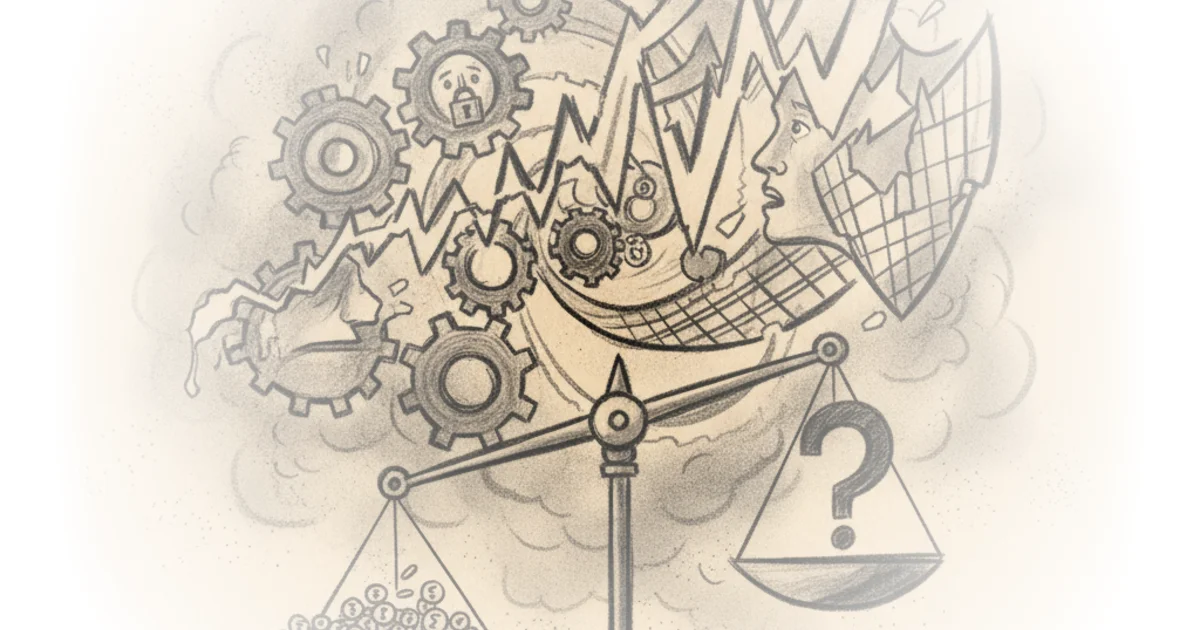
He points to the work of William Barnett on monetary aggregation as a prime example of this principle in action. Barnett demonstrated that simply adding up different types of money ignores the fact that they are not perfect substitutes—a flaw that has obscured the true drivers of inflation for decades. "Barnett's approach demonstrated that these existing aggregates only make sense when every component of the aggregate is a perfect substitute for all other components," Albrecht notes. The implication is profound: if we can't measure money correctly, we can't measure the price level correctly. This aligns with historical shifts in monetary theory, such as the move from simple M1/M2 aggregates to the more nuanced Divisia monetary aggregates index, which attempts to weight money by its liquidity services rather than just its face value.
"If you are going to do good empirical work, you need to make sure that you are measuring things properly. To measure things properly, you also need theory."
Critics might argue that this focus on theoretical purity is impractical for real-time policy making, where speed often trumps precision. However, Albrecht's point is that the current "speed" is misleading because it is built on a shaky foundation.
The Flaw in the "Cost of Living"
The article then pivots to the definition of the price level itself. Albrecht challenges the common assumption that a price index is merely a weighted average of prices. He illustrates that if all prices rise by 2%, real income is unchanged, but if relative prices shift, consumers are forced into new consumption bundles that alter their well-being. "The objective of any attempt to measure the price level should be to adjust the weights of the index in response to relative price changes such that utility remains constant," he explains.
This is where the distinction between a simple average and a true cost-of-living measure becomes critical. Standard indices, like the Consumer Price Index (CPI), often struggle to account for how consumers substitute cheaper goods when prices rise. Albrecht introduces the concept of Hicksian demand curves—derived from the work of economist John Hicks—to solve this. Unlike Marshallian demand, which tracks quantity based on income, Hicksian demand tracks quantity while holding utility constant. "Isn't this exactly what we are looking for?" Albrecht asks rhetorically, before confirming that the expenditure function derived from Hicksian demand is the theoretical ideal for measuring the price level.
He connects this to the practical reality of inflation measurement. When relative prices change, a standard index fails to capture the fact that consumers are worse off (or better off) than the raw numbers suggest. "If the price level rises by a modest amount and relative prices change such that the consumer is actually a little better off than before. Would the rise in prices really measure the change cost of living? No, it would overestimate the rise in the cost of living," Albrecht writes. This insight reframes the entire inflation debate: the administration's or the Federal Reserve's focus on headline inflation numbers might be missing the nuanced reality of household welfare.
Substitution Bias and the Linear Trap
Albrecht identifies the most famous flaw in current measurement: substitution bias. Because standard indices often use fixed weights (or update them too slowly), they fail to account for the fact that people buy less of a good when its price rises. "This flaw is known as substitution bias," he states. "It gets this name because when the price of a particular good goes up, the quantity demanded of the good goes down."
He explains that the true expenditure function is concave—meaning the cost of maintaining a constant utility level rises at a decreasing rate as prices increase—while our standard price indices are linear approximations. "As a result, the bigger the change in one particular relative price, the bigger the bias in the price index compared to the theoretically correct price level," Albrecht warns. This is not a minor statistical error; it is a structural distortion that grows larger the more volatile prices become.
"The fact that we cannot literally measure utility isn't of first-order importance... We have a general guide to measure the price level that is derived explicitly from price theory."
While Albrecht acknowledges that we cannot perfectly measure utility, he argues that using the theoretical framework of Hicksian demand provides a far superior guide than the current ad-hoc methods. This echoes the challenges faced in constructing the Divisia index, where the goal was to move beyond simple summation to a weighted measure that reflects economic reality. The limitation, as Albrecht hints, is that implementing a fully dynamic, utility-adjusted index is computationally and data-intensive, which is why the simpler, flawed models persist.
Bottom Line
Albrecht's strongest contribution is his insistence that the "messiness" of the real world doesn't invalidate theory; it demands that we use theory to build better measurements. His argument that substitution bias and dynamic decision-making render standard indices incomplete is a vital corrective to the simplistic inflation narratives dominating the news cycle. However, the piece's biggest vulnerability lies in the gap between this elegant theoretical ideal and the practical constraints of real-time data collection. Until the executive branch or central banks adopt more sophisticated, theory-driven indices, policymakers will continue to navigate inflation with a map that is, as Albrecht puts it, "a linear approximation of this curve." Readers should watch for how future monetary policy debates address the gap between these theoretical ideals and the flawed data currently driving decisions.