Ben Reinhardt delivers a necessary reality check to the hype cycle surrounding humanoid robots, arguing that the very technological breakthroughs needed to make them viable will likely render them obsolete before they ever hit the factory floor. While the industry fixates on robots that mimic human form, Reinhardt's analysis suggests that the path to true automation efficiency lies in specialized, non-humanoid hardware that is cheaper, faster, and far less prone to mechanical failure.
The Cost of Mimicry
Reinhardt begins by dismantling the assumption that a robot must look like a human to work like one. He writes, "When people imagine humanoid robots, they're usually assuming that they can do basically anything a person can do. While I do want to flag how hard that will be to achieve, I think the more interesting question is 'in a world where AI is good enough to enable human-parity humanoid robots, what other manufacturing paradigms would be unlocked?'" This reframing is crucial; it shifts the conversation from a sci-fi fantasy of replacement to a pragmatic engineering problem. The author's skepticism is well-placed, noting that we have "seen awesome humanoid robot demo videos for almost a decade without many humanoid robots out in the world."
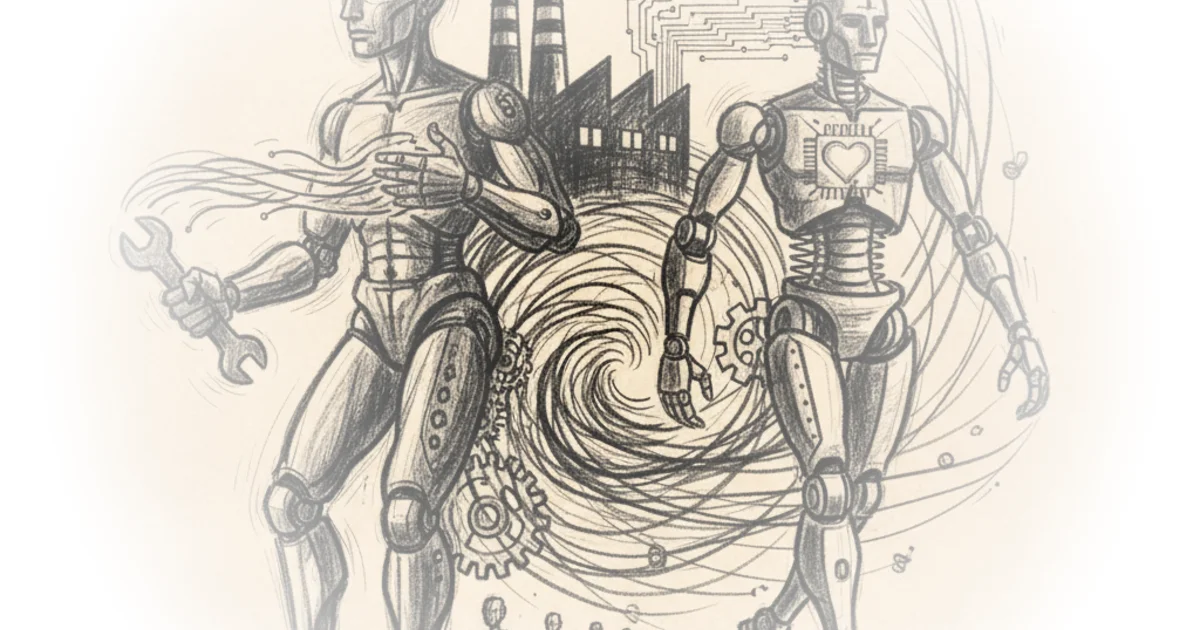
The financial analysis reinforces this skepticism. Reinhardt breaks down the costs of human labor, humanoid robots, and specialized machinery, concluding that the middle ground is a trap. He notes that while humanoids might eventually cost between "$60k/year and ~$13k/year," the hardware complexity is the killer. He describes a humanoid robot as "approximately four robot arms and a ton of sensors in a trenchcoat," a vivid metaphor that highlights the unnecessary redundancy of the form factor. Critics might argue that the flexibility of a humanoid allows for rapid retooling without new infrastructure, but Reinhardt counters that the same software advances required for humanoids would make designing specialized systems dramatically faster and cheaper.
"In a world where there is good enough software and hardware to create humanoid robots that are as good and flexible as a human at manufacturing tasks, we will also be able to quickly create more task-specific hardware or use less complex hardware that can do those roles cheaper, faster, and better."
The Physics of Failure
The piece's most compelling argument rests on the mechanics of reliability. Reinhardt points out that humanoid robots possess roughly 70 "degrees of freedom," meaning 70 different ways to move. He explains that "each DoF adds additional complexity, cost, and ways for the robot to fail," creating a system where the probability of total failure increases exponentially with every added joint. In contrast, a specialized machine might have a fraction of these moving parts.
He illustrates the speed disparity with stark clarity: "humanoids produce things at the same speed as a human, while a specialized system can move many times faster on almost any given task." This is a critical insight for manufacturers where throughput is king. The author calculates that while specialized machines currently cost about "$0.13 per widget," the labor cost for humanoids sits between human and machine efficiency, offering no clear economic advantage. As Reinhardt puts it, "The vast majority of tasks don't need a full-on humanoid. Instead, many tasks could be done by something like a single robot arm on a wheeled base. Or two hands on sticks. Or itty bitty spider robots."
This section effectively challenges the "drop-in replacement" narrative. The industry wants to swap a human for a robot without changing the factory layout, but Reinhardt argues that this is the least efficient path. He suggests that the real revolution isn't in the robot's shape, but in the software that allows for a fleet of diverse, specialized machines to coordinate. He writes, "It would also be a strange world where we have software that enables humanoid robots to easily do most work but we don't have software that can help design better specialized systems, or teams of specialized robots."
The Microprocessor Fallacy
Reinhardt addresses the common counter-argument that humanoids will follow the trajectory of microprocessors: general-purpose tools that become so cheap they dominate the market. He rejects this analogy, noting that chip costs are driven by design and initial production, whereas robot costs are driven by physical components like motors and sensors. "As you drive down the cost of the motors for a humanoid robot, you also drive down the cost of other robots that also use motors," he observes. This means the economic incentives favor specialized hardware that utilizes these cheaper components efficiently, rather than a bloated, general-purpose chassis.
The author concludes that the allure of the humanoid is largely psychological—a desire to see a machine do exactly what a human does. But in manufacturing, where efficiency and speed are paramount, the human form is a liability. "If it's just as cheap and easy to use the specialized tool as a general-purpose tool, you'll use the specialized tool," Reinhardt asserts. The data suggests that the future of automation isn't a factory full of dancing robots, but a highly optimized ecosystem of simple, fast, and reliable machines.
Bottom Line
Reinhardt's analysis is a vital corrective to the current frenzy, grounding the discussion in the hard realities of physics and economics. While his cost projections rely on assumptions about future hardware prices, his core thesis—that the software enabling humanoids will inevitably make specialized automation superior—is logically sound and difficult to refute. The biggest vulnerability in the current industry strategy is the belief that form follows function; in this case, function demands a departure from the human form entirely.