his piece reveals one of the most important yet overlooked figures in physics: a mathematician who discovered why the fundamental laws of nature actually work. Emmy Nutter proved that Einstein's approach to energy conservation was fundamentally flawed, and in doing so, she created a framework that underlies all of particle physics. Her theorem explains not just why energy is conserved—but why any conservation law exists at all.
The Problem That Baffled Einstein
In 1915, Albert Einstein presented his new theory of gravity—what would become general relativity—at the University of Ginga. The lectures were well-received, but Einstein hadn't yet settled on the final form of his field equations. One problem consumed him: how to show that total energy was conserved in his new theory.
Classically, physicists understood gravitational field energy through a mathematical framework they thought they had mastered. But with these new equations, the question becameWhere does the term for energy go? Is it in the curvature? The stress-energy tensor?
Einstein proposed that the principle of conservation of energy—long established as bedrock physics—might hold the key to working out the correct field equations.
In the audience, legendary mathematician David Hilbert was intrigued. He began searching for energy conservation within Einstein's theory. What he found instead was a set of equations called the Bianke identities. They demonstrated that energy was conserved but only in a completely empty universe—one with nothing in it. For our universe, filled with matter and radiation, these identities seemed useless.
Hilbert was stumped. Then he remembered his assistant: Emmy Nutter.
The Mathematician Who Wasn't Allowed to Learn
Nutter had dreamed of following in her father's footsteps—a mathematics professor at the University of Erlingan. She received special permission to attend lectures at the university, but the academic senate refused to admit her as an official student. They held that admitting women would overthrow all academic order.
So in 1903, she spent a semester at Goodinkan instead, learning about a new approach to geometry using symmetry.
Symmetry is one of those ideas that's easy to recognize but harder to explain. An equilateral triangle has three axes of symmetry—reflections about these axes leave the triangle unchanged. Mathematicians generalized this further: any action that leaves an object unchanged counts as a symmetry. A rotation by 120° or 240° does the same thing.
Over twelve years, Nutter became Germany's second woman to earn a doctorate in mathematics. Her expertise in symmetry would soon help solve the problem that stumped Hilbert and Einstein.
The Flaw in Einstein's Equations
The issue had bothered Einstein so much that he proposed a new conservation equation: if you add together the energy of matter plus the energy of the gravitational field, that total remains constant. Its change over time and space equals zero.
But when Nutter saw this equation, she was convinced Einstein had made a fundamental mistake.
This equation disregarded a foundational principle on which general relativity was built. Ten years earlier in 1905, Einstein introduced his special theory of relativity, built on the idea that the laws of physics were independent of your frame of reference. But so far, Einstein had only applied this principle to inertial frames—those moving at constant speed.
Einstein began wondering: what would it take to generalize this to more general states of motion? People don't move at a single constant speed forever. Trains speed up and slow down.
In 1907, he wrote: "Is it conceivable that the principle of relativity also applies to systems that are accelerated relative to each other?"
This made him wonder if his principle could apply to accelerating and rotating frames—frames moving in any way at all. That's the general in general relativity.
Einstein got to work on this intellectual pursuit. Then, while daydreaming in the patent office, he had what he called the happiest thought of his life: he imagined a window cleaner falling from the top of an opposite building. While falling, that person wouldn't feel their own weight. They would be weightless, and anything they dropped would remain stationary relative to them—as if floating in outer space.
Einstein realized that while someone is in free-fall motion, they actually feel no gravity at all. There must be some equivalence between accelerated motion and the action of gravity.
If you were stuck in a rocket accelerating at 9.8 m/s squared, it would feel exactly like standing on Earth's surface. This was huge: if Einstein could figure out how to understand accelerating frames, he wouldn't just get a more general theory—he would have an entirely new theory of gravity.
To achieve this, Einstein needed the laws of gravity to have the same form in every frame of reference. To satisfy this principle—known as general covariance—he had to use mathematical objects called tensors.
A simple tensor is a vector. You can write it as components multiplied by basis vectors—for example, 3x + 2y. But you could also write it using a different coordinate system. The components change, but the vector itself stays the same. That's because when the basis vectors change, the components adjust in a complementary way.
A general tensor can have any number of components in the form of a matrix. And just like with vectors, you can change a tensor from one coordinate system to another and it stays the same.
This was exactly the problem Nutter found. When she examined Einstein's proposed energy conservation equation, it contained something called a pseudo-tensor. As the name implies, that's not quite a tensor. When you try to transform it from one frame of reference to another, it doesn't remain the same quantity in different frames. The gravitational energy you observe in one frame completely disappears in another.
Nutter knew Einstein's proposed solution couldn't be right. She began thinking: what if general covariance and energy conservation are simply incompatible?
The Symmetries of the Universe
If those two principles can't work together, Nutter started considering what the symmetries of the universe actually look like—beginning with the simplest possible case: an empty, static universe.
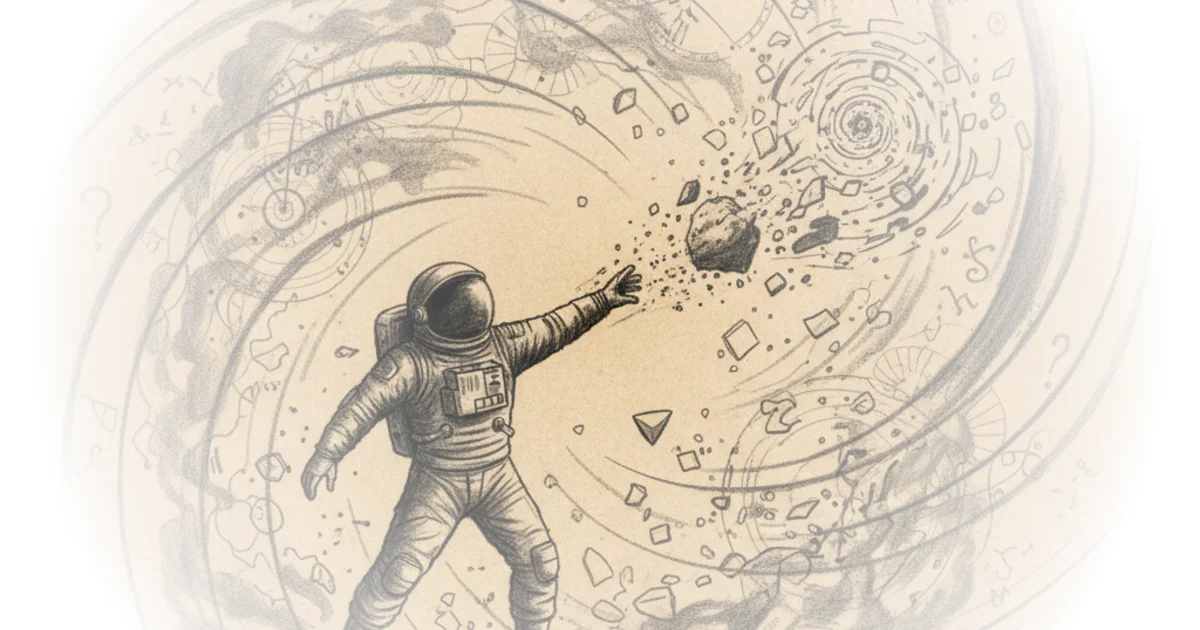
Imagine you're an astronaut drifting in deep space. Since it's empty, there is nothing special about any particular point. It doesn't matter if you're over here or over there. The universe is completely symmetric under translations in space.
Suppose you throw a rock as hard as you can. It will travel at constant velocity in a straight line—Newton's first law. After some time, it will have traveled some distance. But since the laws of physics are the same here as just before, we can shift the whole universe and we're back to where we started.
We can keep doing this over and over, showing that the object will continue with that same speed indefinitely.
What we've discovered is that conservation of momentum is a direct result of translation symmetry in the universe. An experiment done in one spot gives identical results to that same experiment done somewhere else. You could move everything from one place to another and the physics won't change.
Similarly, the laws of physics don't depend on whether you perform an experiment or rotate everything by 90°. This universe is symmetric under rotations.
Imagine we take a metal rod and spin it. If we let it rotate for a minute, it will have moved through a small angle. But we can rotate the whole universe back by that same angle. And now we're at the starting position again. We can keep doing this so each instant looks exactly like the one before—the object will keep rotating indefinitely.
So conservation of angular momentum comes from rotational symmetry.
Another important symmetry is time symmetry: the laws of physics don't change over time. If you do an experiment today or tomorrow, you'll get the same result.
To understand what this symmetry leads to, we need a different way of doing mechanics—using the principle of least action.
Everything always follows the path that minimizes a quantity known as action—the integral of the Lagrangian over time. In the simplest case, that's just kinetic minus potential energy.
Suppose we do an experiment where the result is the same now as some tiny time interval later. Then how does this affect the action? The time changes from t to t + epsilon, and the Lagrangian also changes.
But remember: the result will be exactly the same a little while later—which means that whatever term this is doesn't affect the equations of motion. And it's from this symmetry in the action that we'll find the conserved quantity.
Through mathematical manipulation, we discover that if you take the time derivative of certain quantities, it's equal to zero—meaning that whatever this is has to be constant.
And what is it? In the simplest case, the Lagrangian equals kinetic minus potential energy. If we take the partial derivative with respect to velocity, we get something that becomes 12 mv² plus v. This simplifies to just total energy.
We've discovered that time translation symmetry is equivalent to saying energy is conserved. Conservation of energy is a direct consequence of time translation symmetry.
The Theorem That Changed Everything
Nutter proved these examples are no coincidence. For centuries, people had no idea where conservation laws came from. But Nutter discovered their origin.
She proved that anytime you have a continuous symmetry, you get a corresponding conservation law. Translational symmetry gives you conservation of momentum. Rotational symmetry gives you conservation of angular momentum. Time translation symmetry gives you conservation of energy.
But these are all symmetries of a static, empty universe. The universe we live in is very different.
In the 1920s, astronomers measured velocities of distant galaxies and realized they're all moving away from us. The farther away they are, the faster they're moving. In the distant past, everything must have been much closer together.
Precise measurements of supernovae in the 1990s revealed that not only was the universe expanding—but it was expanding faster than anyone expected.
This raises a profound question: if time symmetry is broken by cosmic expansion, what happens to energy conservation at a cosmological level?
Critics might point out that interpreting these results requires assumptions about what's fundamentally driving cosmic expansion—whether it's vacuum energy, dark matter, or something else entirely. Different theoretical frameworks yield different predictions, and the exact mechanism remains contested.
Conservation of energy isn't just a rule we follow—it's a consequence of time translation symmetry itself.
Bottom Line
Nutter's work reveals that conservation laws aren't arbitrary rules handed down by physics—they emerge directly from the symmetries underlying our universe. Her theorem provides a profound insight: every continuous symmetry in nature corresponds to a conserved quantity. This framework now underlies particle physics and explains why anything is conserved at all. The piece's strongest contribution is making abstract mathematics feel like a detective story about where energy actually goes.