Batool Abu Akleen's essay does something rare in war coverage: it refuses to let the reader look away from the mundane, crushing reality of survival while the world debates strategy. Instead of tallying casualties or analyzing missile trajectories, The Walrus presents a narrative where the primary antagonist is not just the drone overhead, but the terrifying paradox of fearing life itself. This is not a report on a conflict; it is a forensic examination of a psyche fracturing under the weight of a genocide that has lasted fifteen months, offering a visceral counter-narrative to the sterile language of international diplomacy.
The Architecture of Fear
Abu Akleen opens by dismantling the expectation that fear in war is solely about the threat of death. She writes, "The funniest thing of all, and I don't know if it's really funny, is that the fear I'm experiencing isn't a fear of death or annihilation, but rather a fear of life." This distinction is the essay's intellectual anchor. It reframes the trauma of displacement not as a singular event of violence, but as a chronic condition where the future—exams, learning Italian, gaining weight—becomes a source of panic because the present is so unstable.
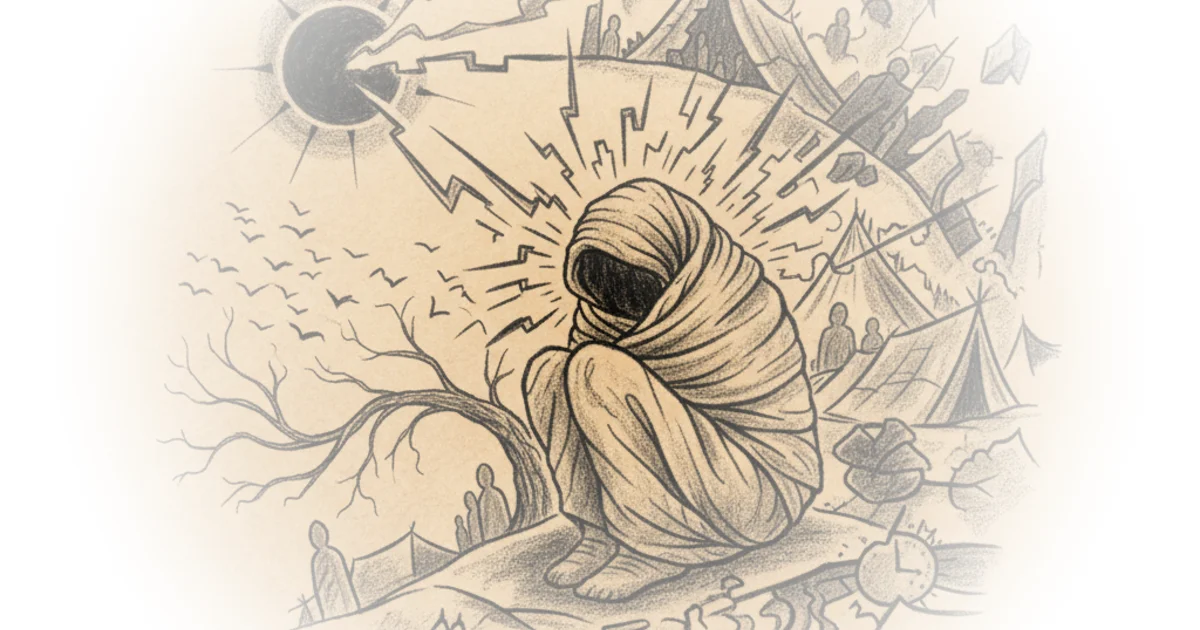
The author grounds this abstract terror in the physical constraints of a four-by-four-meter tent in Deir al-Balah. She describes the environment with a precision that makes the reader feel the claustrophobia: "My head is filled with the desire to leave: to escape this cosmic hell by any means necessary, even if leaving means death." The Walrus highlights how the author's family, including four younger siblings, navigates a space that serves as a bedroom, study, and kitchen simultaneously. This framing forces the reader to confront the impossibility of normalcy. How does one study for a phonetics exam when the ground is shaking? As Abu Akleen notes, "Death has never frightened me; it has only restricted me, casting black, petrified sadness on my heart."
"The fear I'm experiencing isn't a fear of death or annihilation, but rather a fear of life."
The narrative power here lies in the juxtaposition of academic ambition against the backdrop of total societal collapse. Abu Akleen details her struggle to access the internet for her English literature degree, noting that her laptop battery lasts only an hour and a half. She attempts to listen to a lecture at double speed, yet admits, "After thirty minutes of loading and reloading the lecture with a crappy internet connection, I haven't learned a thing." This is not just a complaint about infrastructure; it is a testament to the systematic dismantling of the intellectual life of a generation. The destruction of the Islamic University of Gaza, where her beloved professor Refaat Alareer was killed in a targeted bombing on December 6, 2023, along with his brother, sister, and four nephews, serves as the tragic fulcrum of this section. The loss of Alareer, a figure who had become a symbol of resistance through education, underscores the administration's strategy of targeting the very institutions that sustain civilian identity.
The Erosion of Memory and Dignity
As the essay progresses, Abu Akleen explores how prolonged displacement erodes the basic cognitive functions required for daily life. She recounts a moment of confusion at a makeshift wash-hut, realizing she has forgotten her toothbrush. "As soon as I reach the small wash-hut beside our tent, I realize I've forgotten my toothbrush and have to go back to retrieve it from the empty pea tin I've set aside for pens and other random things." This small detail is devastating in its implications. The author attributes this to memory problems, a symptom of the trauma that has persisted for over a year and a few months. The Walrus uses this to illustrate that the psychological toll of the conflict extends far beyond the immediate violence; it rewires the brain.
The description of the shared sanitation facilities further highlights the dehumanizing conditions. With eighteen people often sharing a single bathroom, the author notes, "I am lucky, having to share this room only with a maximum of eleven people." This casual acceptance of extreme overcrowding speaks to a normalization of crisis that is difficult for the outside world to comprehend. The author's hair, falling out at an "alarming rate," becomes a physical manifestation of the stress that has consumed her. She observes, "I want to say it has grown quickly, but then I remember that fifteen months of this genocide have passed." This line serves as a stark reminder of the timeline, contrasting the slow, agonizing passage of time for the displaced with the rapid news cycles of the international community.
Critics might argue that focusing on individual psychological trauma risks obscuring the broader political and military strategies at play. However, Abu Akleen's argument is that the political is deeply personal; the inability to study, the loss of family, and the degradation of living conditions are direct results of the policies enacted by the executive branch and the military. The narrative does not let the reader off the hook by treating these as collateral damage; they are the intended or accepted outcome of the campaign.
The Silence of the Streets
The essay shifts to a broader observation of the changing landscape of Gaza, where the disappearance of taxis and the rise of donkey carts symbolize the regression of society. Abu Akleen writes, "These days, I choose between a horse and a tuk-tuk, if I can find a tuk-tuk. Otherwise, I choose between a horse and a donkey." This regression is not merely logistical; it is a cultural erasure. The author describes the silence of the streets, where the usual hum of city life has been replaced by the sounds of survival. She notes the disappearance of the Shawa and Hosari Tower, once a hub for press organizations, which now stands as a "pile of ashes."
The conversation with a fellow passenger on a donkey cart reveals the collective trauma of the population. When asked about her home, Abu Akleen replies, "They tore the tower apart like a cake... It collapsed on the third day of Ramadan." The casualness with which she recounts this destruction, and the passenger's response, "May God compensate you with something better," highlights a shared resignation. The author reflects, "The unbearable traffic has transformed shared rides into daily funerals in which each passenger remembers their lost home and martyred loved ones." This metaphor of the commute as a funeral procession is one of the most powerful images in the piece, capturing the pervasive grief that permeates every interaction.
"Poems built from death can never bring pride; they can only bring more pain."
The Burden of Art in a Time of Genocide
In the final section, Abu Akleen turns her gaze inward, grappling with the role of art and poetry in the face of such devastation. She questions the validity of her own work, asking, "Who am I to tell someone being subjected to genocide that their pain isn't well crafted, that their pain isn't painful enough?" This self-reflection challenges the reader to consider the ethics of consuming art produced in the context of mass suffering. The author's guilt over writing "stylized pain" while her father has lost twenty kilograms and her friends are dead is palpable.
She describes the process of editing a digital pamphlet for Modern Poetry in Translation, a collection of Gazan poets, and the difficulty of evaluating the "beauty and ugliness" of poems written about personal pain. The Walrus uses this to highlight the moral complexity of the situation: how does one critique art when the subject matter is the ongoing destruction of a people? The author's admission that "All of this pain assessing is ridiculous" serves as a rejection of aesthetic standards in the face of existential threat. The essay concludes with a sense of unresolved tension, as the author waits for news of ceasefire negotiations, fearing the reality of returning to a city that no longer exists.
Bottom Line
Batool Abu Akleen's essay is a masterclass in humanizing the statistics of war, forcing the reader to confront the psychological and cultural costs of the conflict in Gaza. Its greatest strength is the refusal to separate the personal from the political, showing how the destruction of a city is also the destruction of a mind. The piece's vulnerability lies in its emotional intensity, which, while powerful, may be difficult for some readers to sustain without context, but this is precisely the point: the experience of the displaced is one of unrelenting intensity. As the world watches the negotiations, this piece serves as a crucial reminder that the human cost of the conflict is not a footnote, but the central story.