Most geopolitical analysis treats the current Middle East escalation as a strategic windfall for Beijing, assuming a distracted United States creates an opening for China to expand its influence. This piece from Sinification dismantles that comforting narrative, arguing instead that the conflict delivers a "greater-than-expected" shock to China's own economy, threatening to destabilize its supply chains and fuel inflation rather than weaken its rival.
The Myth of the Strategic Dividend
The prevailing liberal consensus often frames the administration's military escalation as a grave strategic error that will inevitably benefit China. However, the editors at Sinification warn against reading the war as a straightforward boon. Instead, they highlight a stark reality: the conflict has triggered commodity price volatility with "systemic and greater-than-expected impact on China's economy, with [the potential to generate] repeated disruptions." This reframing is crucial for busy observers who might otherwise assume that a rival's quagmire is automatically a nation's gain.
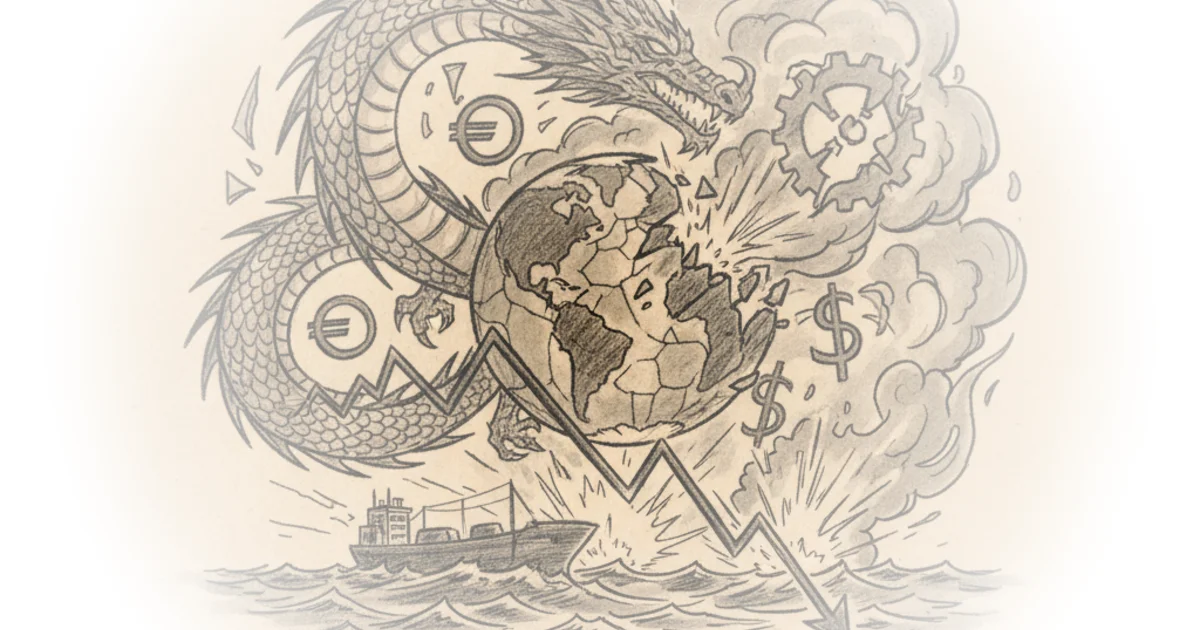
The piece argues that while a protracted conflict might drain US resources, it simultaneously exposes China's acute vulnerabilities. With crude oil import dependence standing at 72.7%, and nearly half of those imports transiting the Strait of Hormuz, China is not merely a passive observer but a primary target of supply chain shock. The editors note that "roughly 20 million barrels of crude oil pass through the Strait of Hormuz each day," a choke point where 84% of the volume is bound for Asian economies. This concentration of risk means that any disruption here does not just raise prices; it cascades from upstream inputs to downstream firms, creating a multiplier effect across chemical, agricultural, and textile sectors.
"The commodity price volatility triggered by the escalation of the current US-Iran conflict has had a systemic and greater-than-expected impact on China's economy, with [the potential to generate] repeated disruptions."
Critics might argue that China's massive strategic petroleum reserves should insulate it from short-term price spikes. While the piece acknowledges these reserves, it points out that the baseline scenario involves a cycle of "fighting punctuated by talks," keeping oil prices fluctuating between $90 and $130 per barrel for months. This prolonged uncertainty is arguably more damaging than a single spike, as it prevents businesses from planning and forces the government into a reactive posture. The argument gains weight when considering the historical context of petrodollar recycling; just as the US once leveraged energy dominance to stabilize its currency, the current volatility threatens to undermine the stability of the renminbi as China attempts to internationalize it.
The Human and Industrial Cost
Beyond the macroeconomic indicators, the analysis brings a sobering focus on the specific industrial bottlenecks that will affect daily life and manufacturing. The piece details how the conflict has exposed a critical "helium bottleneck," noting that disruption at Ras Laffan in Qatar cuts over one-third of the global supply. This is not an abstract financial metric; it directly worsens vulnerabilities in the production of semiconductors and MRI-related medical equipment, sectors essential to both economic growth and public health.
Furthermore, the editors highlight the tangible impact on the manufacturing floor, where disruptions in South Korea's petrochemical chain are already raising logistics risks for China. Some sectors are facing "production halts due to material shortages," a phrase that signals a move from theoretical risk to operational crisis. The piece suggests that the administration's strategy of "fighting punctuated by talks" creates a dangerous environment where "international oil prices will fluctuate at a high level... and imported pressures on China persist and intensify periodically."
This focus on the human and industrial cost is a necessary counterweight to the abstract geopolitical chess game often played in Washington and Beijing. While the administration may view the conflict through the lens of containment and military pressure, the reality on the ground involves supply chain fractures that halt production and drive up the cost of essential goods. The piece argues that "the core policy logic is to use the certainty of domestic supply assurance and price stability to offset external geopolitical uncertainty," a strategy that requires immediate, tiered emergency measures including reserve releases and import diversification.
"Disruptions in South Korea's petrochemical chain raise logistics and delivery risks for China, with some closely linked sectors already facing 'production halts due to material shortages'."
The analysis also touches on the delicate political tightrope Beijing must walk. While some commentators have argued that high oil prices act as a "de facto carbon tax" benefiting China's green economy, the editors note a persistent sensitivity around portraying the war as an "opportunity." Beijing prefers to position itself as a neutral mediator, yet the economic reality is that the conflict is "both good and bad" in a binary sense that offers no clear winners. The piece suggests that the balance between risk and opportunity will shift depending on the war's duration, but the immediate trend is one of destabilization.
The Bottom Line
The strongest part of this argument is its refusal to accept the convenient narrative that a rival's military entanglement is a strategic gift; instead, it exposes the deep structural fragility of China's energy-dependent economy. Its biggest vulnerability lies in the uncertainty of the "pessimistic scenario," where a total blockade of the Strait of Hormuz could push prices toward $160, a threshold that would test even the most robust emergency response plans. Readers should watch for how the administration's policy of "fighting punctuated by talks" evolves, as the duration of this instability will determine whether China's economy can absorb the shock or if the "repeated disruptions" will become a permanent feature of the global landscape.